Recently, JAMA Oncology (IF 33.012) published an important scientific research achievement jointly by the team of Professor Guoxiang CAI from Fudan University Shanghai Cancer Center, the team of Professor Zheng Wang from Renji Hospital Affiliated to Shanghai Jiao Tong University School of Medicine, and Kunyuan Biology [1] : “Early Detection of Molecular Residual Disease and Risk Stratification for Stage I to III Colorectal Cancer via "Circulating Tumor DNA Methylation (Early Detection of molecular Residual lesions and risk stratification of stage I-III colorectal Cancer through circulating tumor DNA methylation)" This research is the world's first multi-center study to apply PCR-based blood ctDNA multi-gene methylation technology for the prediction and monitoring of colorectal cancer recurrence. It provides a more cost-effective technical path and solution compared with existing MRD detection technology methods, and is expected to significantly increase the clinical application rate of colorectal cancer recurrence prediction and monitoring. And significantly improve the survival period and quality of life of patients. This research has also received high praise from the journal and editors, listed as a key recommended paper of this issue, and invited Professor Juan Ruiz-Banobre from Spain and Professor Ajay Goel from the United States for comments. The renowned American biopharmaceutical professional media GenomeWeb also reported on this research.
The article was published onJAMA Oncology
Colorectal Cancer (CRC) is a common malignant tumor of the digestive tract in China. According to the data from the International Agency for Research on Cancer (IARC) in 2020, there were 555,000 new cases in China, accounting for approximately one-third of the global total, and the incidence rate rose to the second place among common cancers in China. There were 286,000 deaths, accounting for approximately one-third of the global total, and it ranked fifth among the common causes of cancer deaths in China. It is worth noting that among the confirmed patients, the TNM stages I, II, III, and IV are respectively: 18.6%, 42.5%, 30.7%, 8.2%, over 80% of the patients were in the middle or advanced stage, and 44% of the patients had simultaneous or metacharous distant metastases in the liver, lungs and other parts, which seriously affected the survival period, endangered the health of Chinese residents, and caused a heavy social and economic burden. According to statistics from the National Cancer Center, the average annual growth rate of diagnosis and treatment costs for colorectal cancer cases in China is approximately 6.9% to 9.2%. Within just one year of diagnosis, personal health expenses of patients can account for 60% of their family income. Cancer patients, while suffering from the disease, also bear tremendous economic pressure [2].
Ninety percent of colorectal cancer lesions can be removed through surgery. The earlier the tumor is detected, the higher the five-year survival rate after radical surgical resection. However, the overall recurrence rate after radical resection is still around 30%. The five-year survival rates of colorectal cancer in the Chinese population at stages I, II, III and IV were 90.1%, 72.6%, 53.8% and 10.4% respectively.
Minimal residual disease (MRD) is the main cause of tumor recurrence after radical resection. In recent years, the MRD detection technology for solid tumors has advanced rapidly. A number of significant observational and interventional studies have confirmed that the postoperative MRD status can indicate the risk of postoperative recurrence of colorectal cancer. ctDNA detection has the advantages of being non-invasive, simple, rapid, having high sample accessibility, and overcoming tumor heterogeneity.
Both the NCCN Colon Cancer Guidelines of the United States and the CSCO Colorectal Cancer Diagnosis and Treatment Guidelines of China point out that for the risk assessment of postoperative recurrence of colon cancer and the selection of adjuvant chemotherapy, ctDNA testing can provide prognostic and predictive information, assisting patients with stage II or III colon cancer in making adjuvant treatment decisions. However, most existing studies focus on ctDNA mutations based on high-throughput sequencing technology (NGS), which have complex processes, long cycles, and high costs [3], and their universality is slightly insufficient, resulting in a relatively low penetration rate among cancer patients.
Take patients with stage III colorectal cancer as an example. Dynamic monitoring of ctDNA based on NGS technology can cost up to tens of thousands of yuan for a single monitoring and require a waiting period of up to two weeks. If the multi-gene methylation detection technology ColonAiQ® Changaike ® in this study is used for dynamic monitoring of ctDNA, patients only need to pay one-tenth of the cost and can obtain the test report within two days at the earliest.
Given that there are 560,000 new cases of colorectal cancer in China each year, patients with stage II-III colorectal cancer (accounting for approximately 70%) have a more urgent need for dynamic monitoring. Therefore, the market size of dynamic monitoring for colorectal cancer MRD reaches several million person-times annually.
It is evident that this research achievement holds significant scientific research and practical significance. Through large-scale prospective clinical studies, it has been confirmed that the PCR-based blood ctDNA multi-gene methylation technology can be used for the prediction and monitoring of colorectal cancer recurrence, and it also features sensitivity, timeliness and economy, thus better enabling precision medicine to benefit more cancer patients. This research is based on the colorectal cancer multi-gene methylation detection technology ColonAiQ® Changaike ® independently developed by Kunyuan Biology. Its clinical application value in early screening and diagnosis has been confirmed by the center's clinical research.
In 2021, Gastroenterology (IF33.88), a top international journal in the field of gastrointestinal diseases, reported the multi-center research results jointly conducted by several authoritative medical institutions such as Zhongshan Hospital Affiliated to Fudan University and Fudan University Shanghai Cancer Center with Kunyuan Biology. The excellent performance of ColonAiQ® Changaike ® in the early screening and diagnosis of colorectal cancer was confirmed, and its application potential in the prognosis monitoring of colorectal cancer was initially explored.
To further verify the clinical application value of ctDNA methylation in risk stratification, guiding treatment decisions, and early recurrence monitoring in stage I-III colorectal cancer, the research team included 299 patients with stage I-III colorectal cancer who underwent radical surgery. Blood samples were collected at each follow-up point (with an interval of three months) within one week before the operation, one month after the operation, and during the postoperative adjuvant therapy for dynamic blood ctDNA testing.
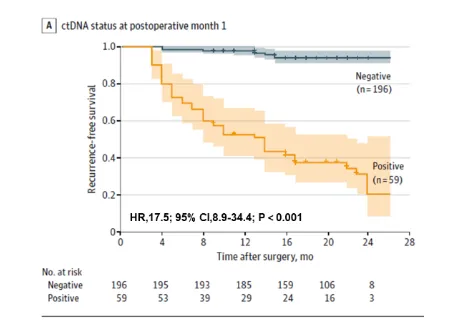
Firstly, research has found that ctDNA testing can predict the recurrence risk of colorectal cancer patients at an early stage, whether before surgery or in the early postoperative period. The postoperative recurrence probability of patients with positive preoperative ctDNA was higher than that of patients with negative preoperative ctDNA (22.0% > 4.7%). Early postoperative ctDNA testing can still predict the recurrence risk of patients: One month after radical resection, the recurrence probability of ctDNA positive patients is 17.5 times that of negative patients. The research team also found that the combined detection of ctDNA and CEA could slightly improve the performance of detecting recurrence (AUC=0.849), but the difference was not significant compared with the detection of ctDNA alone (AUC=0.839).
Clinical staging combined with risk factors is currently the main basis for risk stratification of cancer patients. Under the current model, there are still a large number of patients with recurrence [4]. In clinical practice, overtreatment and undertreatment coexist, and there is an urgent need for better stratification tools. Based on this, the research team divided patients with stage III colorectal cancer into different subgroups according to the clinical recurrence risk assessment (high risk (T4/ N2) and low risk (T1-3N1)) and the adjuvant treatment cycle (3/6 months). The analysis results revealed that for the high-risk subgroup of ctDNA positive patients, if they received six months of adjuvant therapy, the recurrence rate was lower. In the low-risk subgroup of ctDNA positive patients, there was no significant difference between the adjuvant treatment cycle and the therapeutic effect of the patients. The prognosis of ctDNA-negative patients is significantly better than that of CTDNA-positive patients, and the postoperative recurrence-free period (RFS) is longer. All CTDNA-negative patients with stage I and low-risk stage II colorectal cancer had no recurrence within two years. Therefore, the integrated application of ctDNA with clinical features is expected to further optimize risk stratification and better predict recurrence.
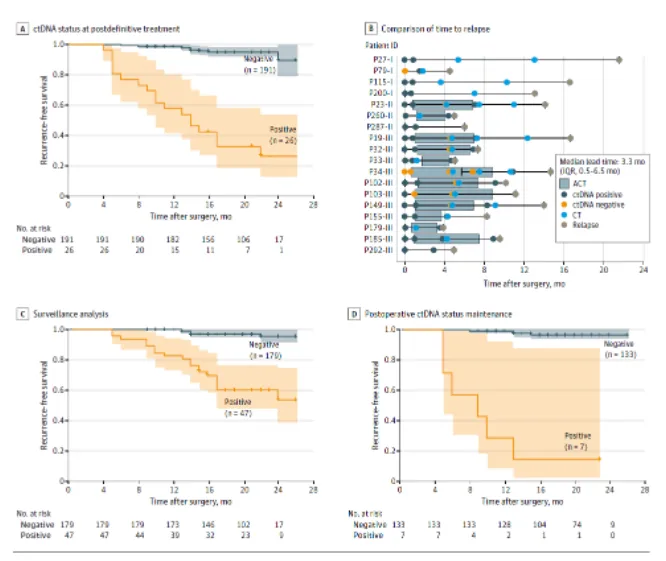
Further dynamic ctDNA testing results showed that during the disease recurrence monitoring stage after definitive treatment (after radical mastectomy + adjuvant therapy), the recurrence risk of patients with positive dynamic ctDNA testing was significantly higher than that of patients with negative ctDNA testing (Figure 3ACD), and ctDNA could indicate tumor recurrence up to 20 months earlier than imaging tests (Figure 3B) It provides the possibility for the early detection and timely intervention of disease recurrence.
At the same time as the publication of this paper, Professors Juan Ruiz-Banobre and Ajay Goel made the following comments and recommendations:
A large number of translational medical studies on colorectal cancer have led the development of the discipline. In particular, MRD detection based on ctDNA has shown great potential, which can improve the postoperative management of colorectal cancer patients by achieving recurrence risk stratification, guiding treatment decisions and early recurrence monitoring.
DNA methylation is selected as a novel MRD marker. Compared with mutation detection, its advantage lies in the fact that it does not require whole-genome sequencing screening of tumor tissues and can be directly used for blood testing. Moreover, it avoids false positive results caused by the detection of somatic mutations from normal tissues, benign diseases, and clonal hematopoiesis.
This study and other related research have confirmed that MRD detection based on ctDNA is the most important independent risk factor for postoperative recurrence of stage I-III colorectal cancer. It can be used to assist in guiding treatment decisions, including the "upgrade" and "downgrade" of adjuvant therapy, to achieve precise treatment.
The MRD field is developing very rapidly at present, and a large number of innovative, highly sensitive and highly specific detection technologies based on epigenetics (DNA methylation and fragment omics) and genomics (ultra-deep targeted sequencing or whole genome sequencing) have emerged. We look forward to ColonAiQ® continuing to organize large-scale clinical studies and becoming a new MRD detection indicator that is accessible, high-performance and economical, and can be widely applied in routine clinical practice.
References
[1] Mo S, Ye L, Wang D, Han L, Zhou S, Wang H, Dai W, Wang Y, Luo W, Wang R, Xu Y, Cai S, Liu R, Wang Z, Cai G. Early Detection of Molecular Residual Disease and Risk Stratification for Stage I to III Colorectal Cancer via Circulating Tumor DNA Methylation. JAMA Oncol. 2023 Apr 20.
[2] "The Burden of Colorectal Cancer in the Chinese Population: Has It Changed in Recent Years?" Chinese Journal of Epidemiology, Vol. 41, No. 10, October 2020.
[3] Tarazona N, Gimeno-Valiente F, Gambardella V, et al. Targeted next-generation sequencing of circulating-tumor DNA for tracking minimal residual disease in localized colon cancer. Ann Oncol. Nov 1, 2019;30(11):1804-1812.
[4] Taieb J, André T, Auclin E. Refining adjuvant therapy for non-metastatic colon cancer, new standards and perspectives. Cancer Treat Rev. 2019;75:1-11.
0756-8699969
Address: No. 88, Shuian 1st Road, Nanping Science and Technology Park, Xiangzhou District, Zhuhai City, Guangdong Province
Email: marketing@biori.com
Wechat official account |
Product consultation |
Join us |
Video Account |