Article Source: IVD Tool Person
The author of this article is Gene talks
What is dPCR?
dPCR: Digital PCR (dPCR), by performing extreme dilution on the sample to be tested until there is an average of only one copy or no target DNA molecule in each reaction chamber, and then adding a fluorescence signal for PCR amplification, can detect mutations as low as one copy.
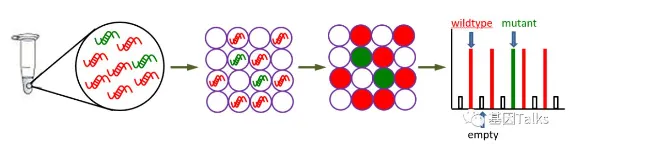
The principle of dPCR detection
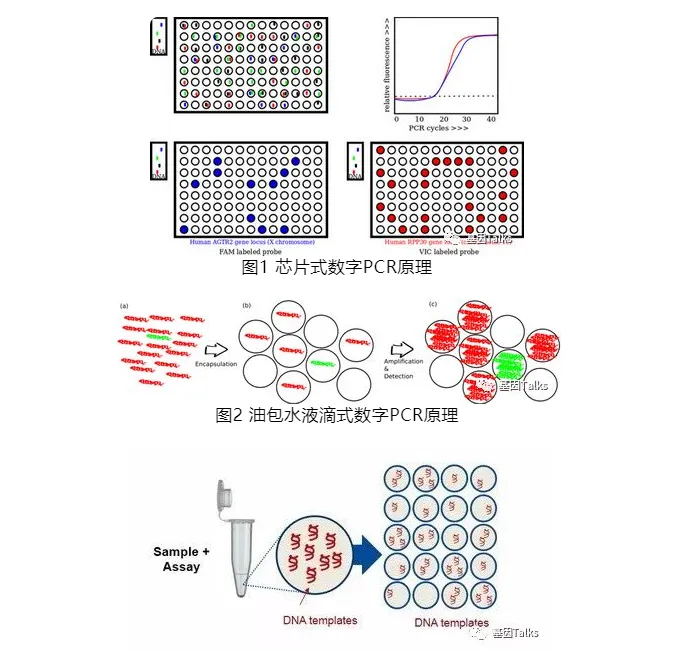
Digital PCR is a new method for nucleic acid detection and absolute quantification. Compared with traditional PCR and qPCR, digital PCR adds a step of partitioning, which divides the pre-prepared PCR reaction system containing primers, templates, buffers, enzymes and other components of dozens of microliters into numerous tiny and independent reaction systems. This enables the direct counting of the number of DNA molecules. Absolute quantification of the initial sample is achieved by dividing a sample into tens of thousands to millions of parts and distributing them to different reaction units. Each unit contains one or more copies of the target molecule (DNA template). PCR amplification of the target molecule is performed separately in each reaction unit. After amplification, statistical analysis of the fluorescence signals of each reaction unit is conducted. The presence of fluorescence signals is recorded as 1, and the absence of fluorescence signals is recorded as 0 (unlike the qPCR method that conducts real-time fluorescence measurement for each cycle, the digital PCR technology collects the fluorescence signals of each reaction unit after amplification is completed).
During the distribution process, the components such as primers and enzymes were in excess, while the template was not in excess. The template DNA molecules randomly enter each small reaction system. After PCR amplification, the system containing the template is amplified, while the system without the template is not amplified. (The principle of ddPCR is the same as that of fluorescence PCR. TaqMan probes, molecular beacon probes or dye methods can be designed for detection Bole Company recommends the use of BHQ1 for gene suppression.
The process by which template DNA molecules enter each small reaction system conforms to the Poisson distribution law. Therefore, by detecting the signal strength of the amplification PCR product and calculating it through the Poisson distribution formula, the copy number of the initial template DNA molecule can be determined. At present, there are two allocation technology principles for digital PCR, as shown in Figures 1 and 2.
Super powerful Poisson statistics Since dPCR is a terminal analysis method, if the target molecule is not well discretized, for instance, if a small cell has more than one target at the end (for example, several mutant targets appear simultaneously in one droplet, such as KRAS, EGFR, BRAF and TP53, etc.), then theoretically, the concentration obtained may be discarded. This is where Poisson statistics come into play.
According to GeorgeKarlin-Neumann, director of Scientific affairs at the Digital Biology Center of the Bio-Rad Laboratory, Poisson statistics describe a random distribution. As long as the cells have not reached saturation, users can calculate their initial number of molecules in reverse, even if some Wells actually contain more than one molecule (this situation is read as a single count in digital PCR). Just tell me how many chambers or droplets you have and what proportion of them are negative. It will basically tell me the initial concentration, and this will also tell me the ratio of the positive chamber to the negative chamber.
The molecular mixture is discretized or separated into a large number of reaction chambers (the more the better), so that on average there is one or zero target nucleotides in each chamber. After conducting PCR reactions for each district, Poisson's statistics were used to convert the count of positive signals into an absolute value.
If this process is compared to first-generation sequencing (Sanger sequencing), sequencing a mixture of 100 template molecules (one of which is mutant) in a single tube will produce an electrophoretic map, in which the significant signal at the mutation site will be wild-type bases.
You won't even notice that there is a small protrusion under the (signal peak) indicating the reading of different bases, because its proportion in the entire molecular mixture is too low. However, when these molecules are diluted and distributed in multiple reactions, 99 wild-type signals and one distinct mutation signal can be generated. This is the result of digital, absolute quantification and also the greatest advantage of dPCR.

Comparison between dPCR and qPCR
Digital PCR differs from traditional PCR technology in that it employs absolute quantification. The strategy it adopts can be simply summarized as "divide and conquer", similar to the "divide-and-conquer algorithm" in computer science. It distributes a standard PCR reaction into a large number of tiny reactors. Each reactor contains or does not contain one or more copies of the target molecule (DNA template) to achieve "single-molecule template PCR amplification". After amplification, the copy number of the target sequence is "counted" by the number of positive reactors, which is particularly suitable for detecting rare mutations in complex backgrounds.
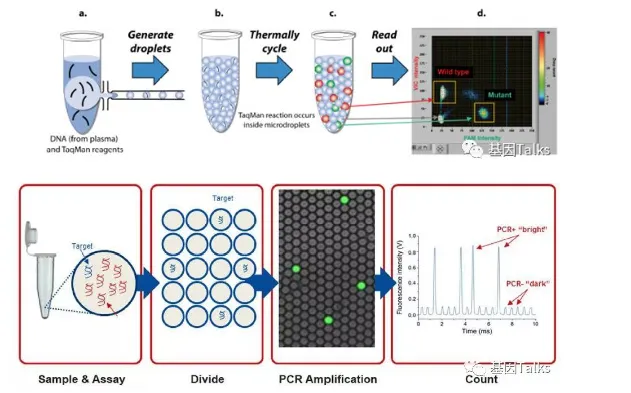
Digital PCR "divide and conquer"
At present, there are three mainstream digital PCR companies in the market:
1. Life Technologies 3D Digital PCR (Chip Digital PCR) : It can be regarded as microwell digital PCR. Mainly, 20 μ l of the reaction system is dispersed into 20,000 microwells for reaction, forming 20,000 reaction systems. After the PCR reaction is completed, CCD photography is used to count the positive reaction Wells.
2. Bio-Rad microdroplet digital PCR (water-in-oil droplet digital PCR) : A 20ul reaction system is formed into 20,000 water-in-oil reaction systems using a droplet reactor. After the PCR reaction is completed, the principle of flow cytometry is applied to detect each liquid and count the number of positive reaction droplets.
3. RainDance's digital PCR (water-in-oil droplet digital PCR) : Its principle is the same as that of Boluo's droplet digital PCR, but its liquid formation ability is much stronger than that of Boluo. Theoretically, it can generate 10 million small oil droplets.
Prices from high to low: Raindance, Bio-Rad, Life Technologies respectively.
The development of digital PCR in China
Digital PCR was rated as one of the top ten breakthrough technologies by MIT Technology Review in 2013 and was selected as one of the world's top ten emerging technologies by the World Economic Forum in 2017. After several years of development, it has now been applied on a small scale in clinical molecular detection in China.
In 2015, the Expert Committee on Individualized Medical Testing Technology of the National Health and Family Planning Commission, based on extensive solicitation of opinions, formulated the "Guidelines for Individualized Treatment Testing Technology of Tumors (Trial)". In this "Guidelines for Individualized Treatment Testing Technology of Tumors (Trial)", digital PCR technology represented by QX200 has been officially included.
In April 2016, based on Thermo Fisher's products, Covis applied for the invention patent of core consumables and applied for the green channel for the approval of IVD class medical devices: chip-based digital polymerase chain reaction (DPCR) analysis system.
On July 27, 2017, the CFDA Tianjin Market and Supervision and Administration Commission has officially approved the marketing of Digital PCR chip reader - Digital PCR NG by Tianjin Novogene Bioinformatics Technology Co., LTD. [Tianjin Medical Device Registration No. 20172400198] (developed in cooperation with Thermo Fisher) At the same time, it is clear that this instrument is applicable to the detection of T790M mutations in plasma cell-free DNA samples derived from the human body. This marks that the instrument has become the first digital PCR chip reader approved for marketing by the Food and Drug Administration in China. (CFDA verifiable
In October 2017, Shunde Yongnuo successfully developed the MiniDrop™ droplet digital PCR instrument, which is the first droplet digital PCR instrument in China with complete independent intellectual property rights, and put it into production.
October 31, 2017 The CFDA Chongqing Food and Drug Administration has officially approved the marketing of GENETRON 3D, a biochip reader (Digital PCR) of Chongqing Genetron Biotechnology Co., LTD. [Chongqing Medical Device Registration No. 20172400136] (developed in cooperation with Thermo Fisher). Among the digital PCR instruments that have been marketed and approved by the CFDA, GENETRON 3D from Genetron has a wider range of applications and is not limited by the accompanying reagent kits. It should be a local second-class registration certificate. The editor couldn't find it at the CFDA but only at the Chongqing Food and Drug Administration. Please correct me if there are any mistakes.
Introduction to Application Examples of dPCR Method
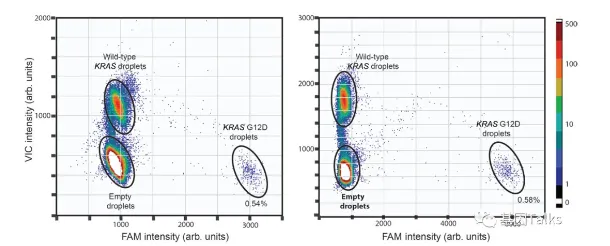
Two tests were conducted, and both 0.54% and 0.58% were detectable
Example 2 The efficacy and recurrence of a patient with colorectal cancer were monitored by digital PCR. Before the operation, the KRAS G12A mutation was detected by digital PCR, and then rectal resection was performed. Chemotherapy treatment was carried out after the operation. After some time, digital PCR detection was conducted again, and at this time, the KRAS G12A mutation disappeared. After the 11th month, the KRAS G12A mutation emerged and continued to increase. Liver metastasis was detected in the 12th month, and then hepatectomy was performed. Digital PCR continued monitoring and found that it reached the peak in the 16th month. Lung metastasis was detected in the 18th month, and chemotherapy combined with bevacizumab was administered at this time. Then, digital PCR continued monitoring and found that the proportion of KRAS G12A mutations decreased. Subsequent continued monitoring found that the mutation abundance was stable and no metastasis occurred in other sites. It can be seen that digital PCR is a very good method in dynamic monitoring. This is just a technical introduction of individual cases. Don't pay attention to the mutations and drugs in the individual cases. Although KRAS mutations may lead to resistance to bevacizumab, the evidence level does not reach the clinical evidence level.
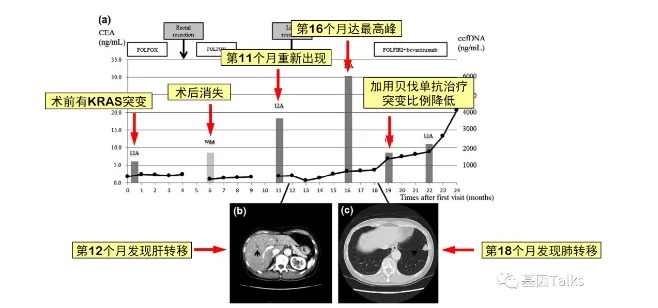
Dynamic monitoring of digital PCR
The main operational steps of the entire experiment
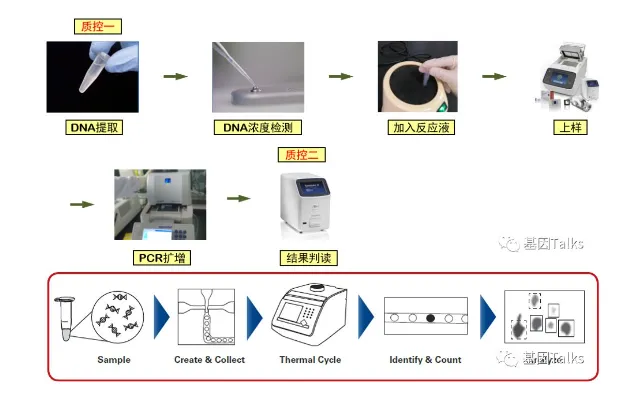
Review of dPCR Detection Technology
Advantages
1. High sensitivity, capable of detecting mutations as low as 0.1%;
2. It can perform absolute quantification without relying on reference substances or standards.
3. The operation process is simple;
4. The result analysis is simple.
Disadvantage
1. Low flux (up to 10 reactions per tube)
2. Special instruments and equipment are required;
3. The scope of application is relatively limited;
4. The cost of detection is relatively high.
This method is suitable for detecting low-frequency mutations in ctDNA or other low-concentration samples, and is particularly applicable to "liquid biopsy".
0756-8699969
Address: No. 88, Shuian 1st Road, Nanping Science and Technology Park, Xiangzhou District, Zhuhai City, Guangdong Province
Email: marketing@biori.com
Wechat official account |
Product consultation |
Join us |
Video Account |