Article Source: Dr. Yuan Takes You for Tests
Author: Dr. Yuan
In my mind, the several revolutionary inventions in the history of detection technology are the immunolabeling technology based on the principle of specific binding of antigens and antibodies, PCR technology and sequencing technology. Today, let's talk about PCR technology. According to the evolution of PCR technology, people habitually divide it into three generations: ordinary PCR technology, real-time fluorescence quantitative PCR technology and digital PCR technology.
I. Common PCR Technology

Kary Mullis invented the polymerase chain reaction (PCR) method in 1983. It is said that while driving with his girlfriend, he suddenly had a flash of inspiration and thought of the principle of PCR (on the benefits of driving). Kary Mullis won the Nobel Prize in Chemistry in 1993. The New York Times commented as follows: "It is highly original and of great significance, almost dividing biology into two eras: pre-PCR and post-PCR."
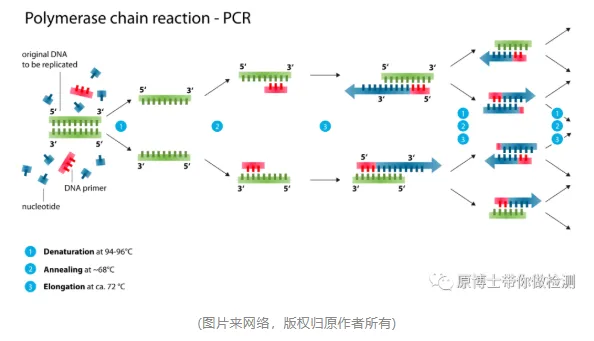
The principle of PCR: Under the catalysis of DNA polymerase, using the mother strand DNA as a template and specific primers as the extension starting point, through steps such as denaturation, annealing, and extension, a complementary daughter strand DNA to the mother strand template DNA is replicated in vitro. It is a DNA in vitro synthesis amplification technology that can rapidly and specifically amplify any target DNA in vitro.
Classic methods, with complete international and domestic standards
The cost of the instrument reagents is relatively low
PCR products can be recycled for other molecular biology experiments
Prone to pollution
The operation is cumbersome
Only qualitative analysis is possible
Moderate sensitivity
There is non-specific amplification. When the size of the non-specific band is the same as that of the target band, it cannot be distinguished
(3PCR based on capillary electrophoresis
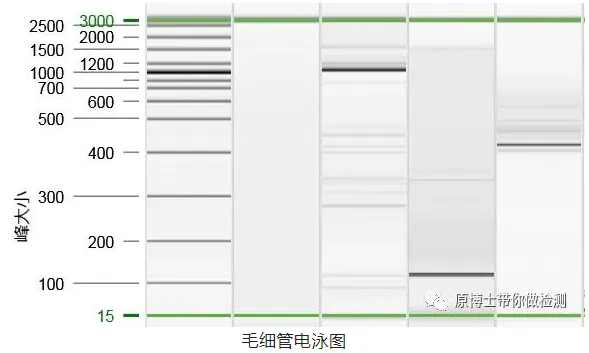
In response to the shortcomings of conventional PCR, some manufacturers have launched instruments based on the principle of capillary electrophoresis, which complete the electrophoresis step after PCR amplification in a capillary tube. These instruments have higher sensitivity, can distinguish the differences of several bases, and can calculate the content of the amplification product through MAERKER. The drawback is that the PCR products still need to be opened and placed in the instrument, and there is still a significant risk of contamination.
Ii. Real-time Fluorescence Quantitative PCRQuantitative Real-time PCR ,qPCR)"Technology"
Fluorescence quantitative PCR, also known as Real-Time PCR, is a new nucleic acid quantification technology developed by the American PE (Perkin Elmer) Company in 1995. The history of the development of fluorescence quantitative PCR is a thrilling struggle among giants like ABI, Roche and Bole. Those interested can check it out. This technology is currently the most mature and widely used semi-quantitative PCR technology.
SYBR Green I is the most commonly used DNA-binding dye in fluorescence quantitative PCR and does not specifically bind to double-stranded DNA. In the free state, SYBR Green emits a weak fluorescence, but once it binds to double-stranded DNA, its fluorescence increases by 1000 times. Therefore, the total fluorescence signal emitted by a reaction is proportional to the amount of double-stranded DNA that appears, and it increases with the increase of amplification products. Because the dye does not specifically bind to double-stranded DNA, false positive results may occur.
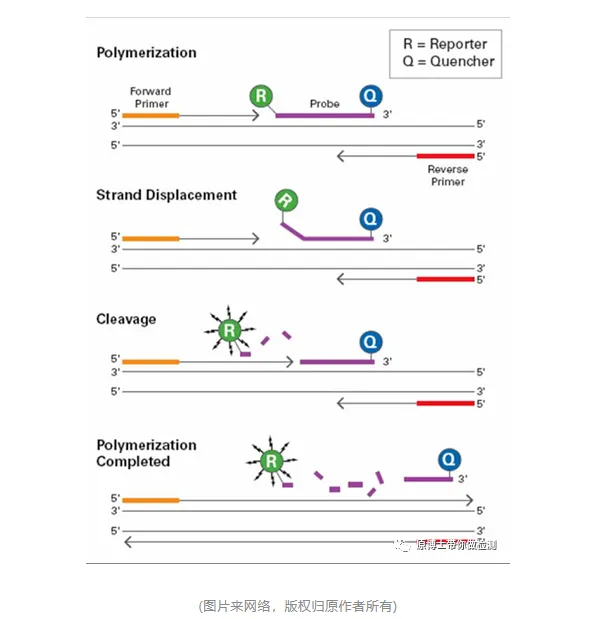
During PCR amplification, a pair of primers are added along with a specific fluorescent probe. This probe is a linear oligonucleotide, with one fluorescent reporter group and one fluorescent quench group labeled at each end. When the probe is intact, the fluorescence signal emitted by the reporter group is absorbed by the quench group, and no fluorescence signal can be detected. During PCR amplification (in the extension stage), the 5' -3 'enzyme activity of Taq enzyme cleases and degrades the probe, separating the reporter fluorescent group from the quenched fluorescent group. Thus, the fluorescence monitoring system can receive fluorescence signals, that is, for each DNA strand amplified, one fluorescent molecule is formed. The accumulation of fluorescence signals was completely synchronized with the formation of PCR products. The Taqman probe method is the most commonly used detection method in clinical testing.
The method is mature and the supporting instruments and reagents are complete
The cost of reagents is moderate.
Simple operation
It features high detection sensitivity and specificity
1. A mutation in the target gene led to missed detection
2. The test results of low-concentration templates cannot be determined
3. When using the standard curve for quantitative detection, the error is relatively large.
Digital PCR is a technique for absolute quantification of nucleic acid molecules. Compared with qPCR, digital PCR can directly read the number of DNA/RNA molecules and is an absolute quantification of the nucleic acid molecules in the initial sample. in 1999, Bert Vogelstein and Kenneth W. Kin-Zler formally proposed the concept of dPCR.
In 2006, Fluidigm Company produced its first commercial chip-based dPCR instrument. In 2009, Life Technologies launched the OpenArray and QuantStudio 12K Flex dPCR systems. In 2013, Life Technologies introduced the QuantStudio 3DdPCR system High-density nano-upgrade microfluidic chip technology is adopted to evenly distribute the samples into 20,000 individual reaction Wells.
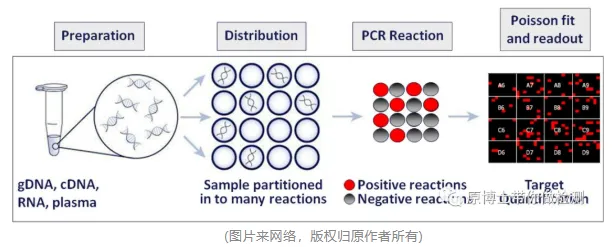
In 2011, Bio-Rad launched the QX100 dPCR instrument based on microdroplets. By using the water-in-oil technology, the sample was evenly distributed into 20,000 microdroplet water-in-oil, and the microdroplets were analyzed using a droplet analyzer. In 2012, RainDance Company launched the RainDrop dPCR instrument. Driven by high-pressure gas, it divides each standard reaction system into a reaction emulsion containing 1 million to 10 million microdroplets of different scales.
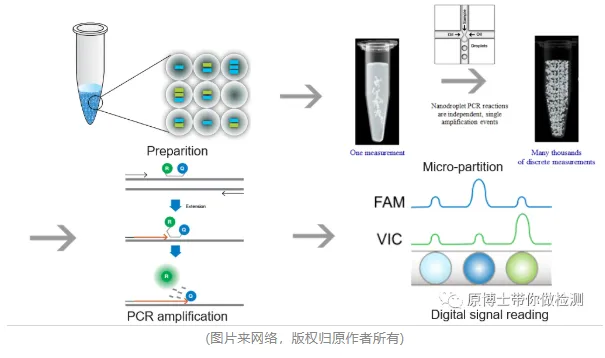
By now, digital PCR has formed two major schools: chip type and droplet type. No matter what kind of digital PCR it is, its core principle is limited dilution, endpoint PCR and Poisson distribution. The standard PCR reaction system containing nucleic acid templates is evenly distributed into tens of thousands of PCR reactions and assigned to chips or droplets, ensuring that each reaction contains as many template molecules as possible for single-molecule template PCR reactions. The presence or absence of fluorescence signals is used for counting, and absolute quantification is achieved through the calibration of statistical Poisson distribution.
Here are the features of several digital PCR platforms that I have used:
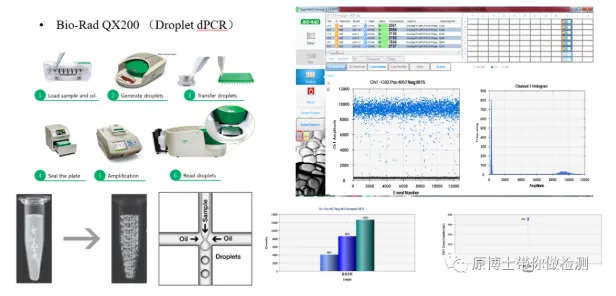
Bio-Rad QX200 droplet digital PCR
The Boluo QX200 is a very classic digital PCR platform. The basic detection process is as follows: 20,000 water-in-oil droplets are generated by a droplet generator, amplified on a regular PCR instrument, and finally the fluorescence signal of each droplet is read by a droplet reader. The operation is rather complicated and there is a risk of pollution.
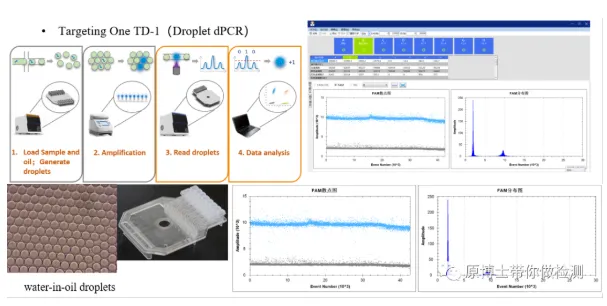
2. Xinyi TD1 Droplet Digital PCR
Xinyi TD1 is a domestic digital PCR platform. The basic detection process is as follows: 30,000 to 50,000 water-in-oil droplets are generated by a droplet generator, amplified on a regular PCR instrument, and finally the fluorescence signal of each droplet is read by a droplet reader. The droplet generation and reading of this platform are both carried out in dedicated chips, with a low risk of contamination.
3. STILLA Naica microdroplet chip digital PCR
STILLA Naica is a relatively new digital PCR platform. The basic detection process is as follows: Add the reaction solution to the chip, place the chip into the droplet generation and amplification system, generate 30,000 droplet layers and spread them evenly in the chip, and the PCR amplification is completed on the chip. Then the amplified chip is transferred to the droplet reading analysis system, and the fluorescence signal is read by taking photos. As the entire process takes place in a closed chip, the risk of contamination is relatively low.
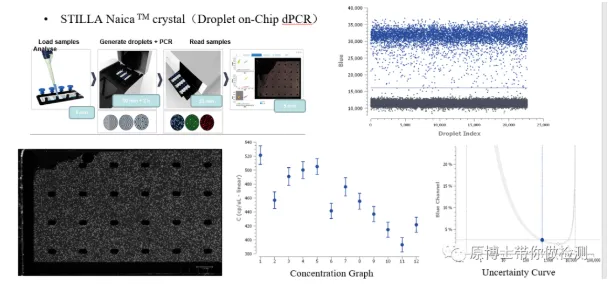
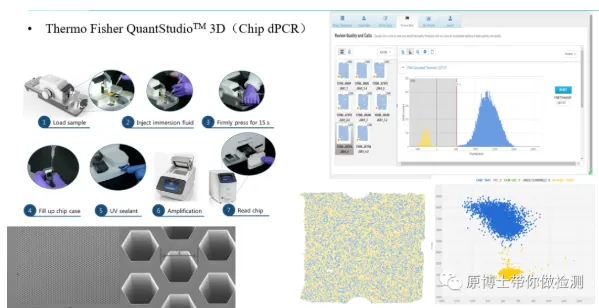
4.ThermoFisher QuantStudio 3D Chip Digital PCR
ThermoFisher QuantStudio 3D is another classic chip-based digital PCR platform. Its basic detection process is: Add the reaction solution to the coater, and evenly spread the reaction solution on the chip with 20,000 micro-wells through the coater. Place the chip on the PCR instrument for amplification, and finally put the chip into the reader to take a photo to read the fluorescence signal. The operation is rather complex. The entire process takes place in a closed chip, and the risk of contamination is relatively low.
5.JN MEDSYS Clarity Chip Digital PCR
JN MEDSYS Clarity is a relatively new chip-based digital PCR platform. Its basic detection process is: Add the reaction solution to the coater, and evenly spread the reaction solution on the chip with 10,000 micro-wells fixed in the PCR tube through the coater. The reaction solution enters the chip through capillary action. Place the PCR tube with the chip on the PCR instrument for amplification. Finally, put the chip into the reader and take a photo to read the fluorescence signal. The operation is rather complicated. The risk of pollution is relatively low.
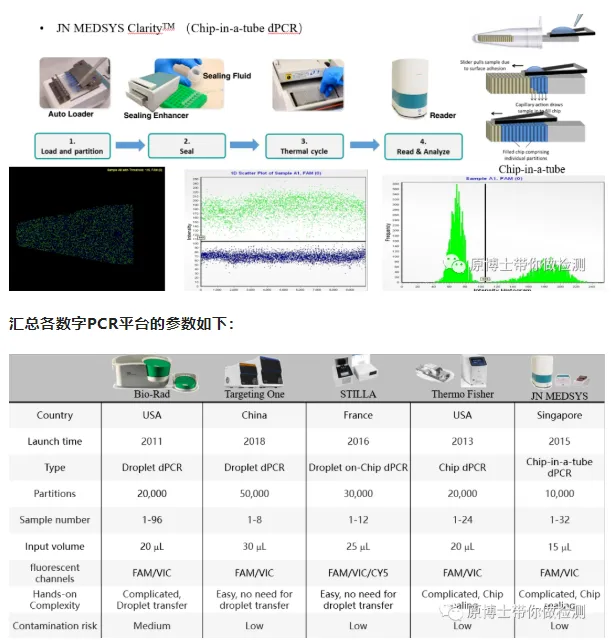
The evaluation indicators of the digital PCR platform include: the number of segmented units, the number of fluorescence channels, operational complexity and contamination risk. But the most important thing is the detection accuracy. One way to evaluate a digital PCR platform is to use multiple digital PCR platforms to verify each other, and another way is to use standard substances with accurate calibration values.
(1) Advantages of dPCR
1. Achieve absolute quantification
2. Higher sensitivity and specificity
3. It can detect low-copy samples
(2The disadvantages of dPCR
1. The instruments, equipment and reagents are expensive
2. The operation is complex and the detection time is long
3. The detection range is relatively narrow
At present, the three generations of PCR technologies each have their own advantages and disadvantages, as well as their own application fields. They are not in a relationship where one generation replaces the other. The continuous advancement of technology has injected new vitality into PCR technology, enabling it to unlock one application direction after another and making nucleic acid testing more convenient and accurate.
0756-8699969
Address: No. 88, Shuian 1st Road, Xiangzhou District, Zhuhai City, Guangdong Province
Email: marketing@biori.com
Wechat official account |
Product consultation |
Join us |
Video Account |