Article Source: IVD Learning Notes
Source: Super lab
Overview of Multiplex PCR
multiplex PCR, also known as multiplex primer PCR or composite PCR, is a PCR reaction in which two or more pairs of primers are added to the same PCR reaction system to simultaneously amplify multiple nucleic acid fragments. Its basic principle is the same as that of conventional PCR, but the difference lies in that more than one pair of primers are added to the multiplex PCR reaction system. Each pair of primers binds to the corresponding parts of the template respectively, and eventually amplifies more than one target DNA fragment.
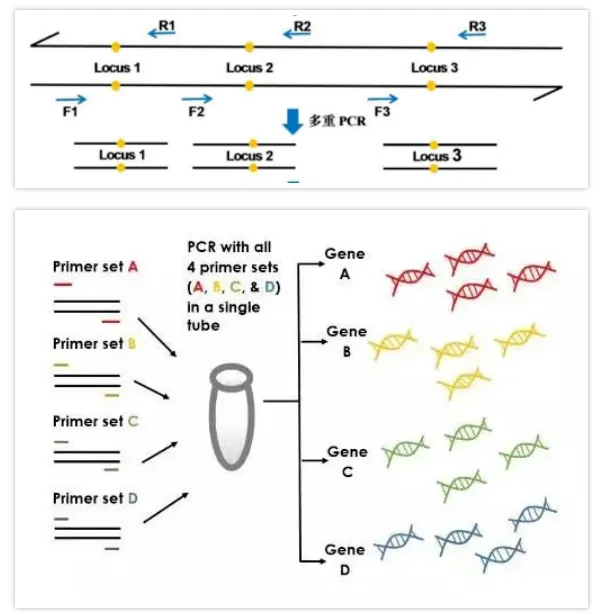
The characteristics of multiplex PCR
• High efficiencySimultaneous detection of multiple genes in the same PCR reaction tube, or typing of target genes with multiple types, especially multi-gene detection of trace samples.
• Systematic:Multiplex PCR is suitable for the detection of groups of pathogens, such as hepatitis viruses, intestinal pathogenic bacteria, sexually transmitted diseases, anaerobic bacteria without spores, war wound infection bacteria and the simultaneous detection of bacterial warfare agents.
• Economic simplicity:The simultaneous detection of multiple pathogens in the same reaction tube will greatly save time, reagents and financial expenses.
Application of Multiplex PCR
• Genetic diagnosis, tumor diagnosis, and detection of pathogenic microorganisms.
• Genotyping and linkage analysis.
• Plant molecular breeding, gene expression detection, and pest and disease detection.
Pathogen contamination detection.
• Regional capture sequencing.
The difficulty of multiplex PCR
Multiplex PCR is not merely about mixing multiple pairs of specific primers into a single system. The difficulty of multiplex PCR lies in the incompatibility of amplification conditions among multiple targets, and each target requires the cooperation of other primers beside it.
Just like a three-person two-legged game, the successful amplification of each target requires the two people (a pair of primers) bound together to work in perfect harmony. However, for multiplex PCR, all the participants need to start and arrive simultaneously, and all of them must perform at their best.
Multiplex PCR optimization
To achieve better amplification effects, optimization can generally be carried out through the following aspects.
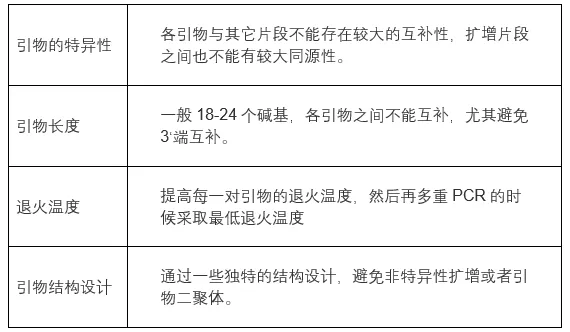
◆ Primer optimization:
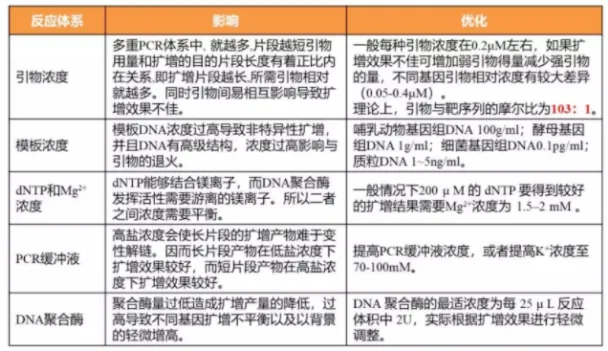
◆ Reaction system:
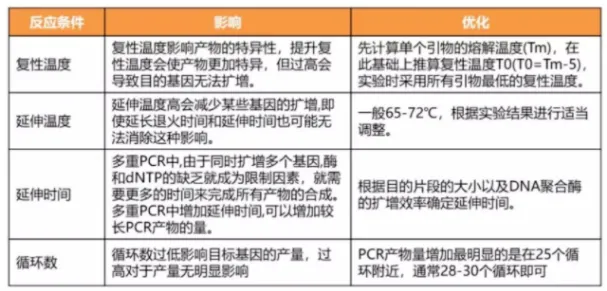
◆ Reaction conditions:
◆ Solutions to Common Problems:
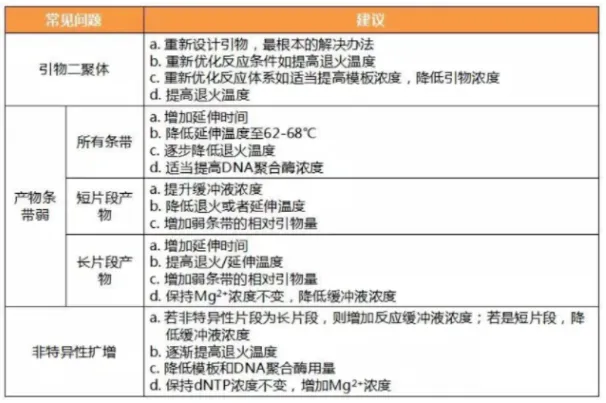
◆ Solutions to Common Problems:
Multiplex PCR requires specific amplification of multiple sites within the same reaction system. Therefore, both the pairing and competitive amplification between primers will affect the amplification effect. If an appropriate reaction system, reaction conditions and a more suitable PCR instrument can be selected, it is expected to improve the amplification effect of multiplex PCR. Therefore, when conducting multiplex PCR, one should not adhere rigidly to old ways. Instead, the experimental conditions should be continuously optimized based on one's own experimental situation to achieve the best amplification effect.