The principle of recombinant protein technology is to utilize DNA recombination technology to link exogenous protein genes to appropriate expression vectors and express them through the biological mechanisms of host cells, thereby obtaining ideal recombinant proteins. Recombinant protein expression usually enhances the solubility of the target protein and promotes the folding of the target protein by adding fusion tags. According to actual needs, some fusion tags need to be removed. Before obtaining the target protein, a specific protease is needed to remove the fusion tag. Commonly used proteases include enterokinase, thrombin, Factor Xa, etc. The optimal temperature for their enzymatic digestion is 25-37℃. This temperature range will cause some target proteins to be non-specifically enzymally digested.
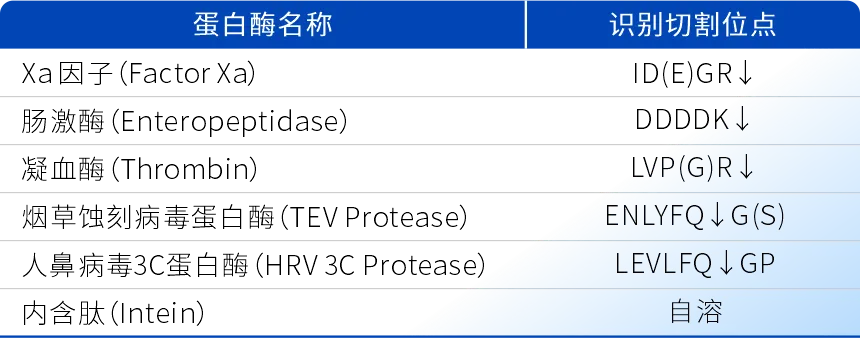
Table 1. Common proteases used for removing labels
Human rhinovirus (HRV) is a single-stranded posion-stranded small RNA virus. The 3C protease encoded by it belongs to the cysteine protease family. The HRV 3C protease can specifically recognize the heptopeptide sequence LEU-Glu-Val-LeU-Ph-GlN-Gly and perform enzymatic cleavage between the amino acid residues of Gln and Gly. It is mainly used to remove the tags of fusion proteins, such as GST, His, etc.
The HRV 3C protease mutant of Baorui Biotechnology, with a molecular weight of 40kDa, can recognize and cleave LEVLFQ↓G. After enzymatic cleavage, there is only one additional Gly amino acid residue at the N-terminal of the target protein, thereby minimizing the impact on the structure and function of the target protein. The Borui HRV 3C can also recognize and cut the LEVLFQ↓M site.
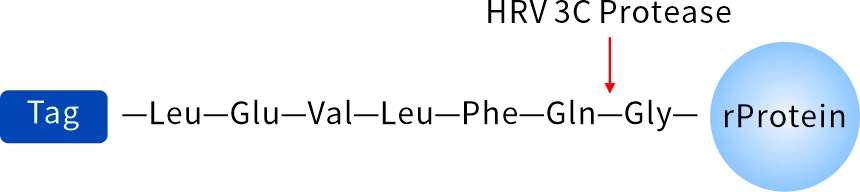
Figure 1.HRV 3C protease recognizes cleavage sequences
The optimal digestion temperature of HRV 3C Protease expressed by Baorui Biotechnology through genetic engineering is 4℃. It has strong specificity, and the products after digestion are clear, with a digestion effect comparable to that of mainstream brand products.
Efficiency verification of cutting 100µg substrate protein under different enzyme amounts:
Take HRV 3C Protease from Baorui Biology and N Company at enzyme input amounts of 4U, 2U, and 1U, react at 4 ° C overnight, and then take samples for SDS-PAGE electrophoresis and Coomatis brilliant blue staining. The reaction system is as follows:

Note: substrate protein is a fusion protein -LEVLFQ↓G- target protein, approximately 66kDa. After enzymatic digestion with HRV 3C Protease, approximately 40kDa of fusion protein and 26kDa of target protein will be obtained.
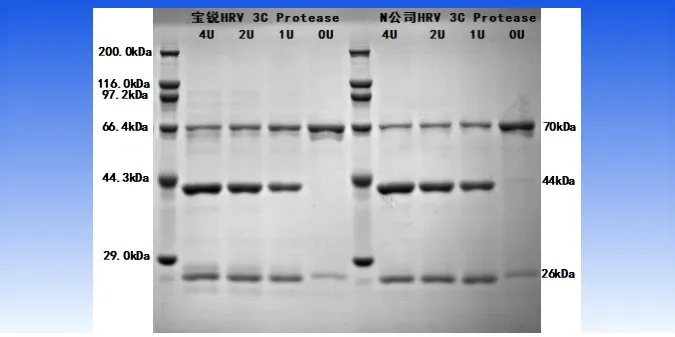
The experimental results are as follows:
The expressiveness of Baorui HRV 3C Protease is comparable to that of the imported products of N Company.
The HRV 3C Protease of Baorui Biology can complete the cleavage of substrate proteins under the condition of overnight at 4℃. The enzymatic cleavage products are clear, and the bands of the enzymatic cleavage products are consistent with those of the imported products of N Company, without non-specific cleavage.

Product consultation
Mei M , Fan X , Zhou Y ,et al.A combinatorial strategy for HRV 3C protease engineering to achieve the N-terminal free cleavage[J].International Journal of Biological Macromolecules, 2024, 265.DOI:10.1016/j.ijbiomac.2024.131066.
Xu H , Wang Q , Zhang Z ,et al.A simplified method to remove fusion tags from a xylanase of Bacillus sp. HBP8 with HRV 3C protease[J].Enzyme and Microbial Technology, 2019, 123:15-20.DOI:10.1016/j.enzmictec.2019.01.004.
Li H J , Wang W J , Shi R .Gene cloning, expression, purification and activity of human rhinovirus 3C protease[J].Chinese Journal of Biologicals, 2007, 20(4):240-243.
Zhejun D , Haijian Z , Xiaomao X ,et al.Expression,purification and cleavage activity analysis of self-processed recombinant MBP-HRV 3C fusion protease in E.coli expression system[J].International Journal of Laboratory Medicine, 2014.
Georgia,Antoniou,Irineos,et al.Optimization of Soluble Expression and Purification of Recombinant Human Rhinovirus Type-14 3C Protease Using Statistically Designed Experiments: Isolation and Characterization of the Enzyme.[J].Molecular Biotechnology, 2017.DOI:10.1007/s12033-017-0032-9.