Article source: IVD Sharing Library
There are many subfields of POCT. Classified by application scope, they include blood glucose, cardiovascular diseases, infections, blood gas, pregnancy/early pregnancy, kidneys, tumors, drugs and many other fields.
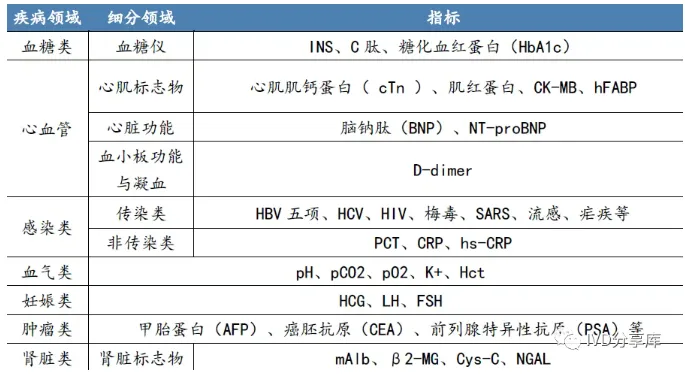
The application fields of POCT products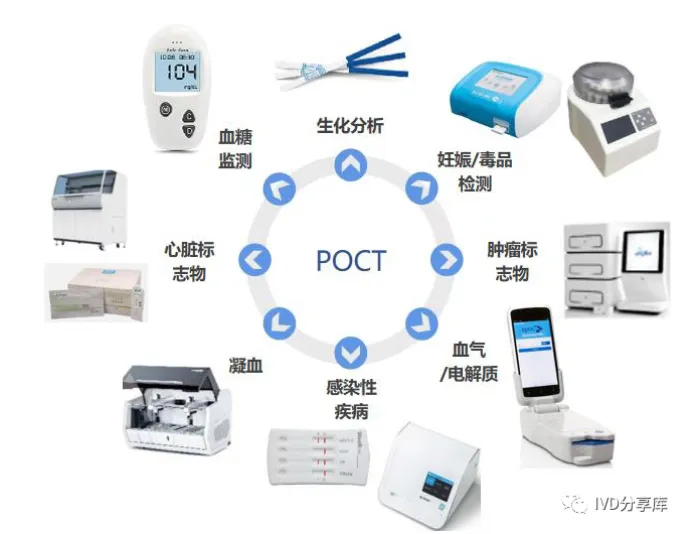
POCT niche market products
According to the identity of the tester, it can be divided into self-testing (self-testing/home testing) or Professional testing (Professional).
The household market mainly includes products for blood sugar, blood pressure, pregnancy, etc. Professional markets mainly cover various products used in hospital laboratories, clinical departments, emergency rooms, icus, operating rooms, etc. However, according to the report of kalorlama, the market share of self-testing products and professional products is approximately 1:5 (excluding blood sugar), so the main battlefield of POCT remains in professional medical institutions.
2. Infectious diseases and inflammations
Infectious diseases refer to pathophysiological diseases in which pathogenic microorganisms or conditionally pathogenic microorganisms grow and multiply in the host body and release toxic substances, causing an imbalance in the microecological balance within the body and leading to mutual transmission among hosts. Most infectious diseases have characteristics such as prevalence, regionality, seasonality and infectivity, which have attracted varying degrees of attention worldwide, such as the novel coronavirus pneumonia. The cure for most infectious diseases relies on accurate early diagnosis, including respiratory diseases such as tuberculosis, hepatitis and influenza, common diseases such as gastric ulcers caused by Helicobacter pylori, sexually transmitted diseases and tropical diseases such as malaria and dengue fever.
POCT products for infectious diseases can significantly enhance the monitoring capacity of infectious diseases, assist doctors in diagnosing and treating patients in a timely and accurate manner, and reduce the possibility of disease transmission among the population.
According to TriMark's market research, the global market size of infectious disease POCT products was approximately 1 billion US dollars in 2016. It is expected that the growth rate of the infectious disease POCT product market will remain above 10% in the future. According to the "2019 Overview of China's POCT Industry for Infectious Diseases and Infections", the domestic POCT market size for infectious diseases and infections reached 3.818 billion yuan in 2019, and the growth rate remained above 15%.
The novel coronavirus epidemic has come on with great force and speed, leaving very limited time for the disease control center and medical institutions to prepare for the battle. Due to the high requirements for technical links such as sample collection, preservation and extraction, the center's laboratory has preferred a technology platform with high accuracy and high throughput. Through a mature and stable technical platform, the impact on the results is minimized to ensure absolute safety in the screening and treatment of patients infected with the novel coronavirus.
Therefore, in the actual situation of the epidemic in the inspection laboratory, the work allocated to POCT equipment is very limited. However, POCT can complete the test in a short time in emergency scenarios. In the "anti-epidemic battlefield" of rescue and treatment, it continues to play the flexible advantage of rapid testing for individual patients and remains in a real-time standby state. To gain more time for clinical departments such as emergency and critical care, and to provide clearer guidance for the diagnosis and treatment paths of patients. COVID-19 test kits can be classified into nucleic acid tests, antigen tests and antibody tests based on different detection techniques.
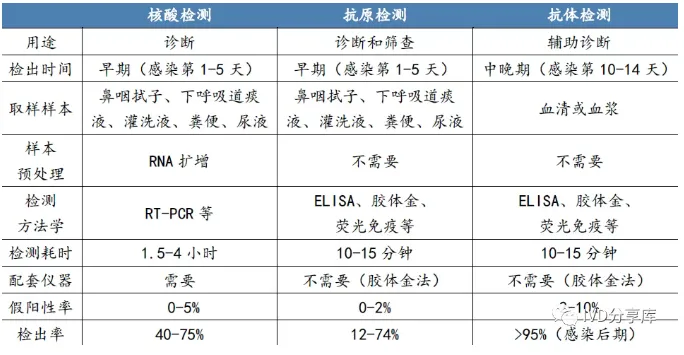
It is used for comparing different detection techniques of COVID-19 test kits
The standard for clinical detection is quantitative reverse transcription polymerase chain reaction (qRT-PCR). The detection operation has high technical requirements, needs the cooperation of a specific PCR laboratory, and the experiment time is relatively long, making it difficult to meet the demand for immediate detection. It is not suitable for the initial screening of a large number of people. Antigen and antibody tests do not require professional equipment or personnel. Results can be obtained within 10 to 15 minutes, making them suitable for on-site testing and large-scale screening. However, both antigen and antibody detection reagents require the acquisition of highly sensitive and specific antigens and antibodies for detection, which has relatively high technical requirements. Therefore, in the early stage of the epidemic, nucleic acid testing methods were mainly used, and later, antigen and antibody detection reagents were put into use.
Introduction to Nucleic Acid Testing Technology
Taking the unique gene sequence of the novel coronavirus as the detection target, through PCR amplification, the selected target DNA sequence increases exponentially. Each amplified DNA sequence can bind to a pre-added fluorescently labeled probe to generate a fluorescence signal. The more target genes are amplified, the stronger the accumulated fluorescence signal will be. Nucleic acid testing is actually to determine whether there is viral nucleic acid in the sample by detecting the accumulation of fluorescence signals.
(2) Introduction to Antigen Detection Technology
The technical principle of antigen diagnostic reagents usually involves the use of sensitive and specific binding antibodies or aptamers conjugated with a certain colorimetric label to detect viral antigens in samples through chromatographic analysis or enzymatic reactions. Lateral flow technology (LFA), also known as lateral flow immunochromatography technology, uses antibodies fixed on cellulose membranes or paper to capture the analytes in the sample, and then detects them through colorimetric labeling. The standard LFA mainly consists of four parts: sample pad, binding pad, reaction film and absorption pad. At the same time, at least two antibodies are required in the entire system: Capture antibody and Detector antibody.
The genes of the novel coronavirus encode multiple structural proteins, such as N protein, E protein and S protein, etc. These proteins include multiple antigenic epitopes. By taking advantage of the principle of specific binding between antigens and antibodies, the presence of antigens can be detected by antibodies, thereby directly proving that the sample contains the novel coronavirus. The applicable sample types for antigen test kits are generally samples from the infection site, such as throat swabs.
(3) Introduction to Antibody Detection Technology
The above-mentioned antigens of the novel coronavirus can act as immunogens. After the virus infects the human body, it stimulates plasma cells to produce specific antibodies. By taking advantage of the principle of specific binding between antigens and antibodies, the presence of antibodies can be detected through antigens, thereby indirectly proving that the human body has been infected with the novel coronavirus. The applicable sample types for antibody detection reagents are generally blood, including serum, plasma and whole blood. The antibodies detected are mainly divided into two categories: IgM and IgG. Under normal circumstances, IgM antibodies are produced early. Once infected, they are generated rapidly, last for a short time and disappear quickly. A positive test result in the blood can be used as an indicator of early infection. IgG antibodies are produced late, last for a long time and disappear slowly. A positive test result in the blood can be used as an indicator of infection and previous infection.
The applicable sample types for antibody detection reagents are generally blood, including serum, plasma and whole blood. The greatest advantage of serological testing lies in its convenience and speed, with a relatively short testing time. It can effectively break through the limitations of existing testing technologies on personnel and places, shorten the testing time, and has been included in the "Diagnosis and Treatment Protocol for COVID-19 (Trial Version 7)".
With the application of high-tech in POCT reaching a new peak, new application fields of point-of-care testing are emerging. Social sectors such as community healthcare, physical examination centers, OTC, home health care, customs, food, epidemic prevention, the military, and schools have a high demand for POCT technology. The expansion of these emerging fields will bring more demand in the next decade. Driven by new technologies, new application fields and an aging population, the POCT market is expected to maintain a relatively fast growth rate in the future. It is predicted that by 2025, the market size of POCT in China will reach approximately 22.5 billion yuan.
3. Blood glucose category
Blood glucose testing has been around since the first generation of POCT products and is a relatively mature niche field. POCT blood glucose meters, as the main detection instruments for blood glucose POCT, are widely used in clinical departments and households.
The demand for POCT for blood glucose is on the rise, which is related to the number of diabetic patients in China. According to data from the International Diabetes Federation, in 2019, the number of patients in China reached 116 million, ranking first in the world, and the number of deaths caused by diabetes each year was 834,000. According to a report by Sanocare, there are currently 240 million adult patients with hypertension, 120 million with diabetes, and 140 million with chronic kidney disease in China. It is estimated that by 2045, the top three countries with the largest number of diabetes patients will be India, China and the United States, with the numbers reaching 134.3 million, 119.8 million and 35.6 million respectively.
From the perspective of the market structure, 90% of the hospital market is still monopolized by imported equipment, mainly from Johnson & Johnson, Roche, Abbott, etc. However, the POCT technology of domestic blood glucose meters has already matured. Domestic instruments, with their high cost performance, have more advantages than imported devices in the home market and are gradually on the way to completing import substitution. At present, domestic enterprises mainly include Hangzhou Aikang, Yuyue Medical and Sanocare. Some start-ups are focusing on the household market, such as Beijing Yicheng, Aikang Biotech and Jinde Biotech.
"4 Cardiovascular"
At present, cardiovascular POCT testing products (excluding blood glucose) hold the largest share in the major global markets, including various test kits such as cTnl, Myo, CK-MB, NT-proNBP, and D-dimer.
The high growth of cardiovascular diseases is mainly driven by the rising mortality rate of cardiovascular diseases and the construction of the five major national centers. The rapid detection of POCT can reduce delays. The growth in clinical demand and the national promotion of the construction of chest pain centers have led to an increase in the demand for POCT equipment. By the end of 2019, the total number of chest pain centers that had been certified in China was 1,378, and it will increase by approximately 150 each year thereafter. According to data from Zhiyan Consulting, the domestic cardiovascular POCT market size was 3.7 billion yuan in 2019 and is expected to reach 4.8 billion yuan in 2020, maintaining a high growth rate of around 30% over the five years.
Cardiovascular products account for 10.2% of the overall market share of POCT and are the fastest-growing segment of POCT. At present, the domestic market for cardiovascular POCT in large hospitals is mainly dominated by imported products, mainly Roche, Merieux and Merieux. Among domestic enterprises, those with a relatively high market share in small and medium-sized hospitals mainly include Ji Dan Bio, Wondfo Bio and Rui Lai Bio, etc. In recent years, they have maintained a relatively fast growth rate and are gradually achieving import substitution.
According to data from the American Heart Association, cardiovascular diseases are the number one killer of humans worldwide. POCT detection products for cardiovascular diseases are mainly used for rapid quantitative or qualitative screening of common cardiovascular diseases, which are of great significance for the early diagnosis of myocardial infarction and heart failure. Meanwhile, the upgrading of cardiac markers has also driven the growth of cardiovascular POCT. Many domestic and international guidelines recommend the use of cardiac troponin (cTn) and B-type natriuretic peptide (BNP)/N-terminal pro-B-type natriuretic peptide (NT-proBNP) for the diagnosis, differential diagnosis and risk stratification of acute coronary syndrome (ACS) and acute and chronic heart failure to guide related treatments. The addition of new markers such as hypersensitive troponin It can diagnose and rule out diseases more quickly, which is helpful in alleviating the high mortality rate caused by acute coronary syndrome (ACS) and other conditions.
However, in the case of rapid acquisition of test results and short turnaround time for tests, POCT may sacrifice the accuracy of some results. There are also factors that affect the accuracy of results, such as doctors' non-standard use of POCT and interpretation of test results, as well as quality control and management. It may even lead to incorrect clinical decisions. To standardize the clinical application of POCT technology in detecting cTn and BNP/ NT-probNP, the Consensus Editorial Committee of the Cardiovascular Metabolism Specialized Disease Medical Alliance of the National Center for Cardiovascular Diseases and others have compiled the "Expert Consensus on the Standardized Application of On-site Rapid Detection of Cardiac Troponin and Natriuretic Peptide (2020)".
5. Blood gas and coagulation
Blood gas and electrolyte POCT is mainly used in the diagnosis and treatment of acute respiratory failure, surgical operations, rescue and monitoring processes. The main application sites include critical care units, cardiac care units, operating rooms and emergency departments, etc. The market space is very broad. However, as the blood being tested is arterial blood, the technical requirements are relatively high. Moreover, it is used for critically ill patients, which is of great significance and has high barriers. Previously, it was monopolized by foreign brands such as Redomite from Denmark, Abbott, Vodafone, and Roche, which restricted the development of this product in China. With the extensive academic promotion and educational efforts in the past few years, the technical method of collecting venous blood has become relatively widespread. Coupled with medical insurance cost control, hierarchical medical treatment, and the mastery of key portable technologies, domestic blood gas and electrolyte POCT products have begun to gradually increase in volume. In 2019, the market size of blood and gas POCT in China was approximately 1.4 billion yuan and maintained a rapid growth rate of around 25%. Representative enterprises include Ruibang, Wondfo, and Kangli.
The four items of coagulation are essential project before surgery, project before thrombosis, and important project for monitoring patients taking oral anticoagulant drugs in clinical practice, especially for acute and critical conditions such as myocardial infarction (acute coronary syndrome) and stroke. The blood coagulation market is a rapidly developing IVD sub-sector in recent years, with a compound annual growth rate as high as 30%. Foreign-funded enterprises have an absolute advantage in this field and are expected to account for more than 90% of the market share. The world's leading POCT coagulation tests come from Roche and Meilier. Domestic POCT coagulation enterprises mainly include Hangzhou Aikang (acquired by Alere), Shenzhen Weidian, and Wondfo Biotech, etc.
6. Pregnancy-related
Pregnancy POCT products are mainly used for early detection of pregnancy and population eugenics, and are produced through urine tests or blood tests. The main driving factors of this market include women's increasing emphasis on their own health and privacy protection needs. Other factors such as the rise in the number of infertile and late pregnancy patients and the increase in the number of gynecological disease patients have all promoted the development of the pregnancy POCT product market.
In 2019, the global market size of POCT point-of-care testing products for pregnancy was approximately 497 million US dollars. Due to the high market saturation, its industry growth rate ranked relatively low. According to Trimark's prediction, the global market size of pregnancy POCT products will reach 538 million US dollars by 2021.
There will be new increments in the number and categories of pregnancy-related tests. Its traditional detection mainly focuses on human chorionic gonadotropin, luteinizing hormone, follicle-stimulating hormone and progesterone, and the development has been relatively mature. With the relaxation of the two-child policy, the demand for POCT has been further released. Meanwhile, the release of the "Diagnosis and Treatment Guidelines for Hypertensive Disorders in Pregnancy (2020)" has promoted the early diagnosis of hypertensive disorders in pregnancy, especially preeclampsia, and there is great room for development in related POCT. At present, among domestic start-ups, companies such as Aocheng Biotech and Shuwen Biotech have all made their moves.
7. Drugs
Drug POCT instant detection products are mainly used to detect in real time whether users have taken drugs such as marijuana, cocaine, heroin, etc. They usually conduct tests by collecting samples such as urine and saliva from users. Their main features are rapidity, ease of use and portability, and high accuracy. It is widely applicable to the screening work in drug rehabilitation centers, hospitals, military conscription, customs border inspection, census of high-risk groups in highway traffic safety, special industries and physical examinations for recruitment. At present, the main domestic POCT manufacturers for drug testing include Guangzhou Wondfo, Kaichuang, Nantong Yishi, etc.
According to the "World Drug Report 2019" released by the World Health Organization, the severity and complexity of the world drug situation are increasing. The number of drug users in 2019 was 30% higher than that in 2009. Governments of all countries have taken anti-drug measures to control the spread of drugs. Therefore, from a global perspective, the immediate detection of drugs will become a significant trend in the context of global anti-drug efforts, and the future development prospects of the drug POCT product market are broad.
0756-8699969
Address: No. 88, Shuian 1st Road, Xiangzhou District, Zhuhai City, Guangdong Province
Email: marketing@biori.com
Wechat official account |
Product consultation |
Video Account |