Reprinted source: IVD Practitioner Network
In May 2026, the Laboratory Medicine Branch of the Chinese Medical Association released the "Expert Consensus on the Detection and Clinical Application of Common Markers for Lung Cancer (2026 Edition)", which is the first standardized document in China covering all dimensions of lung cancer markers, including serum markers, methylation, driver genes, immunotherapy, and liquid biopsy.
The consensus is aimed at high-risk confirmed lung cancer patients over 18 years old. It forms 16 strong recommendations/recommendations around 16 key clinical issues, unifying the detection path, technology selection, sample norms and result interpretation, thoroughly solving the pain points of "what to test, how to test and how to use" in clinical practice, and truly implementing precise diagnosis and treatment of lung cancer at the grassroots level.
I. Core Positioning of Consensus: Ensure that markers run through the entire diagnosis and treatment cycle of lung cancer
Clinical necessity: In China, there are 1.0606 million new cases and 733,300 deaths from lung cancer each year. Both the incidence and mortality rates rank first among malignant tumors. The entire chain of early screening, classification, targeting, immunity, and monitoring relies on biomarkers.
Unified standards: End the situation where serum, genes, methylation, and liquid biopsy operate independently, and establish a unified language for multiple disciplines including laboratory tests, thoracic surgery, respiratory diseases, and oncology.
Landing orientation: Prioritize the recommendation of clinically accessible technologies, clarify the operation norms for different hospitals and different samples, and directly apply them to the SOP of the laboratory department and clinical pathways.
Ii. Serum markers: The first choice for typing, combination is king
The consensus clearly states that the sensitivity of individual indicators is insufficient, and combined detection is the gold standard, directly providing the optimal combination for classification:
Small cell lung cancer (SCLC) (preferred) : ProGRP + NSE
ProGRP: It has the highest specificity. Renal insufficiency can be ruled out.
NSE: Be cautious of false positives caused by hemolysis. Serum must be separated within 1 hour after blood collection.
Non-small cell lung cancer (NSCLC) (preferred) : CYFRA21-1 + SCC + CEA
SCC: Lung squamous cell carcinoma has a high specificity. Be alert to kidney diseases, skin diseases, and specimen contamination.
CEA: It is most sensitive to lung adenocarcinoma. Smoking and liver and gallbladder diseases may slightly increase it.
Cyfra21-1: Broad-spectrum, with the highest positive rate in squamous cell carcinoma.
Consensus 1 (Strong Recommendation) : Limited individual items, joint efforts to enhance diagnostic efficiency; For SCLC, ProGRP/NSE is used; for NSCLC, CYFRA21-1 /SCC/CEA is used.
Iii. DNA methylation: A "magic tool" for Differentiating Pulmonary Nodules, Filling the Gap of high false positives in LDCT
The consensus has for the first time incorporated DNA methylation into the core protocol for the auxiliary diagnosis of lung cancer, positioning it as a key tool for differentiating benign and malignant pulmonary nodules.
Core value: It has a specificity of 85% to 87% for early-stage NSCLC, can significantly reduce false positives of LDCT, and minimize excessive surgery for benign nodules.
Domestic approved targets: SHOX2, RASSF1A, PTGER4, HOXB4, SRCIN1;
Applicable samples: Blood, sputum, and alveolar lavage fluid are all acceptable, with blood being the most convenient.
Recommended technologies: Real-time fluorescent quantitative PCR (strongly recommended), digital PCR suitable for low abundance, NGS suitable for large panels.
Consensus 2 (Recommendation) : For pulmonary nodules of unknown nature, DNA methylation testing is recommended to assist in determining their benign or malignant nature.
Iv. Driver Genes: 10 Must-Test Targets, the "Admission Ticket" for Targeted Therapy
The consensus clearly defines the list of genes that must be tested for targeting advanced NSCLC, covering the drug targets already on the market in China:
Must-check Genes (Strongly Recommended
EGFR, KRAS, ALK, HER2, ROS1, MET ex14 jumper, BRAF, RET, NTRK
Extended detection
MET amplification, NRG1 (newly added in 2025 NCCN)
Mutation rates in the Chinese population: EGFR is the highest (~50%), KRAS~10%, ALK~3% - 7%, ROS1~1% - 2%.
Sample priority: Tissue > Cytology > blood ctDNA Liquid biopsy is used only when the tissue is inaccessible.
Technology selection: Multi-gene synchronization →NGS/nucleic acid mass spectrometry; Rapid screening →qPCR Fusion →FISH/IHC initial screening + NGS confirmation.
Consensus 4/5/6/7 (Strong Recommendation) : The list of targeted mandatory testing genes is clear; "Organization first; NGS/qPCR is the preferred choice for multiple genes.
V. Immunotherapy markers: PD-L1 is the gold standard, supplemented by TMB
Pd-l1 (Strongly Recommended)
Testing method: The only gold standard of IHC;
Sample: Tissue/cell wax blocks. Cell smears are not recommended.
Clinical significance: TPS≥50% is preferred as a single immunotherapy drug. 1%≤TPS < 50% preferred immune combination; Chemotherapy can be combined when TPS is less than 1%.
TMB (Recommended
Method: NGS panel is the preferred choice for organizing TMB, with bTMB serving only as a supplement.
Positioning: It can predict therapeutic effects, but it is not recommended for routine clinical use for the time being, and the standards have not been unified.
Consensus 8/9/10/11: PD-L1 must be tested; IHC + tissue samples; TMB is measurable but needs to be standardized.
Vi. Liquid Biopsy: ctDNA+CTC, Therapeutic effect Monitoring and MRD Core
1. ctDNA (Recommended
Core uses: Companion diagnosis, therapeutic effect monitoring, MRD, drug resistance analysis;
Key value: It can indicate recurrence 3 to 6 months in advance by imaging. A negative MRD indicates a lower recurrence rate and a possible cure.
Technology: PCR/dPCR is used for known mutations. MRD uses NGS tumor prior analysis (priority).
2. CTC (Recommended
Core uses: Prognosis assessment, therapeutic effect monitoring;
Location: Not recommended for early diagnosis alone (insufficient sensitivity); The specificity of pulmonary nodules can be improved by combining imaging.
Quality control: The entire process must be standardized; otherwise, the results will be unreliable.
Consensus 13/14/15/16: Dynamic ctDNA/MRD guiding Prognosis and drug resistance; CTC is used for monitoring but not for early screening. Full-process quality control.
Vii. Selection of Detection Technology: Clinical departments can directly adopt it
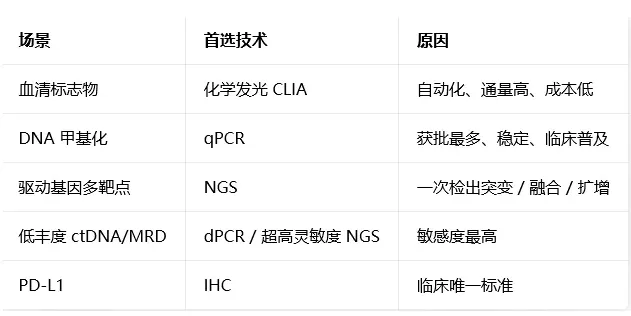
Viii. Summary of Clinical Full-Process Application (Simplified Version)
High-risk screening/pulmonary nodules: LDCT + serum triple test + DNA methylation
Confirmed classification: Pathological + serum marker classification
Advanced NSCLC: 10 Major Driver Genes + PD-L1 (Mandatory Test)
Therapeutic effect monitoring: Dynamic serum marker + ctDNA/MRD
Postoperative follow-up: Once every 3 months for the first 3 years, every 6 months for 3 to 5 years, and once a year for 5 years
Ix. Three Major Industry and Clinical Changes Brought About by Consensus
Inspection end: Establish a unified SOP, fully standardize samples, techniques, interpretations, and quality control, and further enhance mutual recognition of results.
Clinical end: Shift from "experience-based diagnosis and treatment" to "precise treatment guided by markers" to avoid missed detection, incorrect detection and excessive detection.
Patient side: Reduce unnecessary punctures, surgeries, and chemotherapy. Early detection, right medication selection, less suffering, and cost savings.
Standard literature citation
Chinese Medical Association Branch of Laboratory Medicine Expert Consensus on the Detection and Clinical Application of Common Markers for Lung Cancer (2026 Edition) [J]. The Chinese inspection medical journal, 2026, 49 (5) : 530-545. The DOI: 10.3760 / cma. J.c. n114452-20251204-00710.
0756-8699969
Address: No. 88, Shuian 1st Road, Xiangzhou District, Zhuhai City, Guangdong Province
Email: marketing@biori.com
Wechat official account |
Product consultation |
Video Account |