Preface
POCT, point-of-care testing, as one of the most important subfields of IVD (In vitro Diagnostics), has attracted much attention in recent years. The POCT technology platform is evolving rapidly, and the pursuit of rapid, simple and accurate detection is also increasing. With the repeated outbreaks of African swine fever and the COVID-19 pandemic, an increasing number of leading enterprises in various industries have begun to integrate resources to achieve POCT-oriented nucleic acid testing. The direct expansion reagent launched by Baorui Biotechnology breaks the traditional mode of nucleic acid testing. It does not require the process of nucleic acid extraction and purification, providing reagent raw material guarantee for the "sample in, result out" testing mode.
Stable/Sensitive/simple/compatible
Traditional PCR reactions require high-quality nucleic acids as templates for the reaction. If there are residual sample inhibitors or extraction reagent components in the template, it will inhibit the smooth progress of the PCR reaction. The nucleic acid testing reagent for PCR direct amplification launched by Baorui Biotechnology contains an innovative and unique formula.It can perform in-situ lysis and amplification on biological samples and ensure the accuracy of the results. This technology significantly reduces labor intensity, saves labor costs and experimental resources, and enhances detection efficiency.
Freeze-dried without extraction
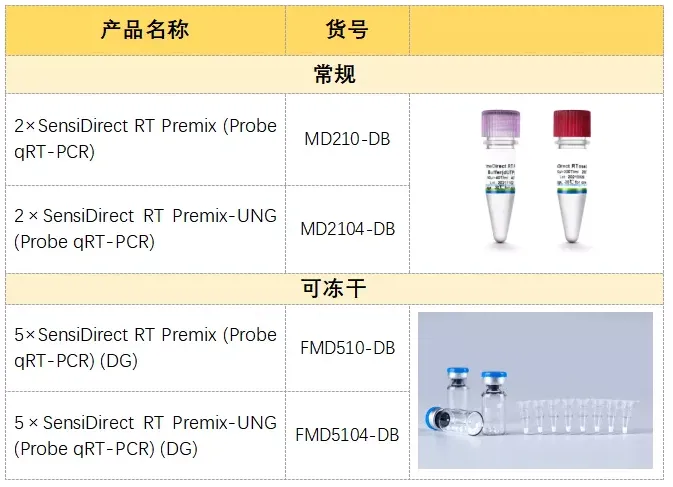
The entire process involves no heating and no nucleic acid extraction or purification. The samples can be directly used as templates for qPCR detection, and can be mixed and used immediately. We can provide conventional type/freeze-drying type/anti-pollution system formulas, and the specifications support personalized customization.
Widely applicable and highly compatible
Both DNA and RNA can be directly expanded for detection, and it is compatible with conventional fluorescence quantitative PCR instruments and rapid fluorescence quantitative PCR instruments available on the market.
RNA direct expansion reagent
HCV plasma direct diffusion test

Amplification result
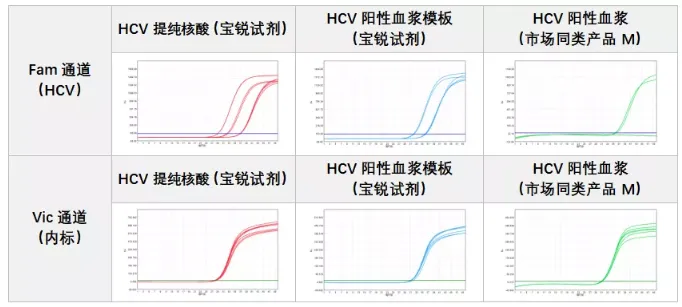
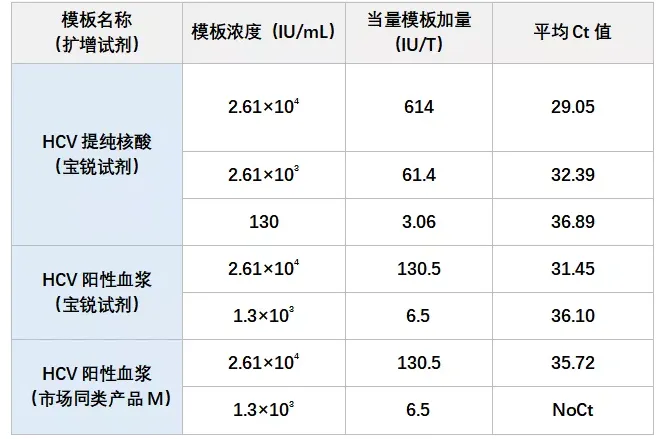
Ct value statistics
Summary
1.Calculated based on the equivalent template quantity of each hole2.61×10⁴ Theoretically, the IU/mL HCV magnetic bead extraction template should be 2.17 Ct values earlier than the direct amplification of the corresponding plasma template, but in practice, it is 2.4 CT values earlier. That is, the amplification effects of the two templates are comparable. It can be seen that the Baorui RNA direct expansion reagent has good tolerance to plasma samples。
For HCV-positive plasma with the same template concentration, the Ct value of M amplification of similar products in the market lags behind that of the direct amplification reagent of Baorui by 4.27, that is, the amplification efficiency of Baorui reagent is significantly higher than that of similar products M in the market.
Cell direct expansion test
Cell sample processing methodCentrifuge the cell culture at 1000 RPM for 10 minutes, remove the supernatant, resuspend it in 1×TE Buffer, and perform gradient dilution to obtain the sample to be tested.

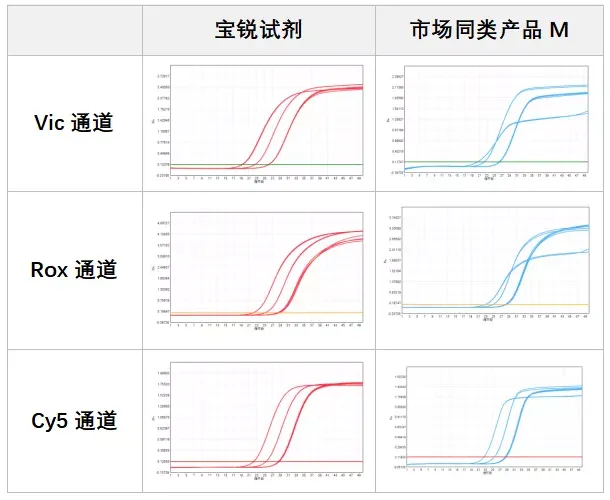
Amplification result:
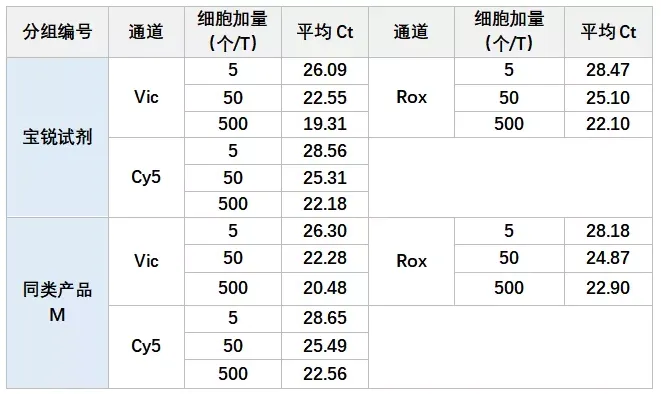
Ct value statistics
Summary
1.The Ct value gradient of the amplification of cultured cells with gradient increase by Baorui direct expansion reagent is correct, and the Rn values of the amplification curves of different gradient templates are comparable, which can reach the same plateau period.
2. The amplification of the same type of product M on medium and low concentration templates is comparable to that of the Borui direct amplification reagent, while the Rn value of the high concentration template amplification curve decreases and the Ct value lags significantly, which may be due to inhibition.
3.Baorui direct expansion reagentIt has a relatively good tolerance to cultured cellsSimilar products in the marketMBetterExpansionThe effect is even better.
Related product recommendations