Previous words
Fecal samples contain a large amount of phenols, metabolic compounds, bile salts, polysaccharides and RNase, etc., which have an inhibitory effect on PCR. Therefore, sample pretreatment is very necessary. However, the nucleic acid extraction process involves multiple steps, including cumbersome labor, expensive kits and equipment, and the recovery rate and purity of the final nucleic acid are not always satisfactory.
In response to customers' demands for rapid and efficient detection of fecal samples, Baorui Biology has been actively exploring and has recently developed a reagent that can be directly tested without extraction.
This direct expansion reagent adopts genetically modified anti-inhibitory enzymes and is combined with a deeply optimized innovative formula, featuringAntiinhibition、High sensitivityFeatures: Suitable for highly sensitive amplification of fecal samples containing fecal source inhibitor extraction templatesNucleic acid testing without extraction。Meanwhile, Baorui Biology can provide freeze-dried/pre-freeze-dried reagents for fecal direct expansion systems, comprehensively and one-stop solving the market demand for fecal direct expansion testing.

Apply for a trial
Product highlights
01 No extraction required, freeze-dried
The entire process involves no heating and no nucleic acid extraction or purification.
The samples can be directly added for qPCR detection and used immediately after mixing. We can provide conventional type/freeze-drying type/anti-pollution system formulas, and the specifications support personalized customization.
02 Widely applicable and highly compatible
Compatible with both conventional fluorescence quantitative PCR instruments and rapid fluorescence quantitative PCR instruments available on the market.
Product performance
Try it with foreign brandsComparison of the direct expansion effect of the agent
Salmonella detection

Fecal sample processing: Take 0.2g of the fecal sample and add it to 1 mL of TE Buffer, thoroughly mix and liquefy. After instantaneous centrifugation, the supernatant was taken to obtain a 20% fecal sample, which was diluted with sterile water to obtain a 1% fecal sample. Using the above 1% fecal sample as the diluent, gradient dilute Salmonella to 149.6, 14.96 and 1.496 copies/µL; Then, add it directly to the reaction system at a sample volume of 20% for amplification.
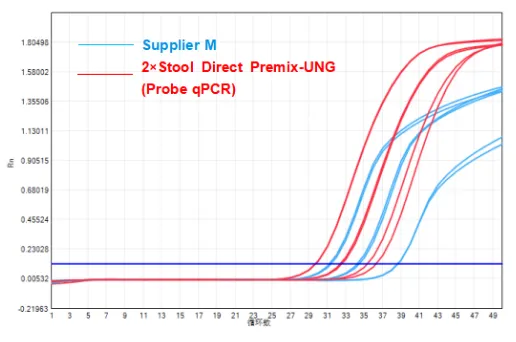
Comparison of direct expansion effect with foreign brand reagents
2. Human genome testing

Fecal sample processing: Take 0.2g of the fecal sample and add it to 1 mL of TE Buffer, thoroughly mix and liquefy. After instantaneous centrifugation, the supernatant was taken to obtain a 20% fecal sample. After dilution with sterile water, 1% and 2.5% fecal samples were obtained. Using fecal samples of the above two concentrations as diluents, dilute the human genome template to 0.0125 ng/µL; Then, add it directly to the reaction system at a sample volume of 20% for amplification.
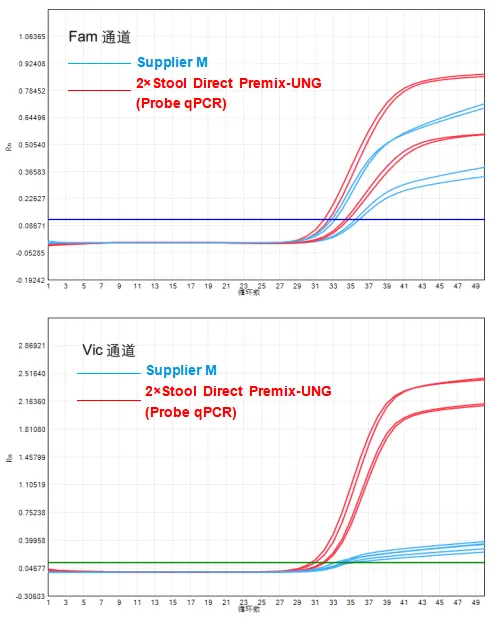
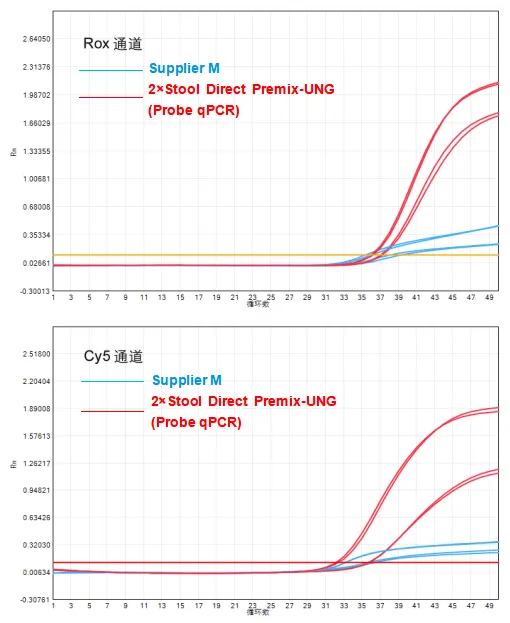
Note: In the above amplification graph, when the concentration of fecal samples is 1%, the amplification curve represents the group with a higher Rn value.
Rapid direct expansion test of fecal direct expansion system

Fecal sample processing: Take 0.2g of the fecal sample and add it to 1 mL of TE Buffer, thoroughly mix and liquefy. After instantaneous centrifugation, the supernatant was taken to obtain a 20% fecal sample, which was diluted with sterile water to obtain a 1% fecal sample. Using the above 1% fecal sample as the diluent, dilute the HBV purification template (including the internal standard gene) to 10⁴ and 10³ IU/mL; Then, add it directly to the reaction system at a sample volume of 20% for amplification.

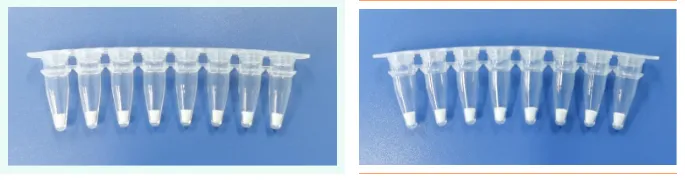
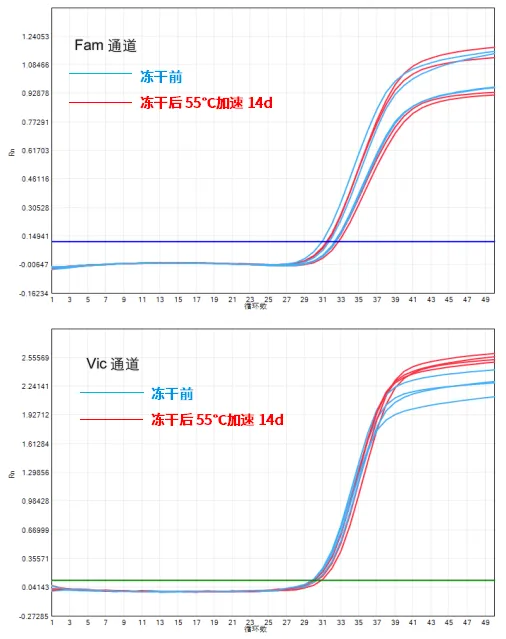
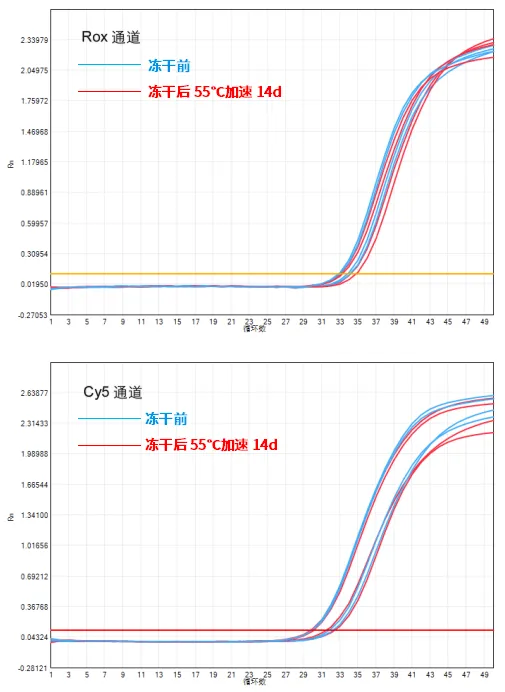
Accelerated stability test of the fecal direct expansion system after freeze-drying
(55℃ accelerated for 14 days

Fecal sample processing: Take 0.2g of the fecal sample and add it to 1 mL of TE Buffer, thoroughly mix and liquefy. After instantaneous centrifugation, the supernatant was taken to obtain a 20% fecal sample. After dilution with sterile water, 1% and 2.5% fecal samples were obtained. The human genome was diluted with fecal samples of the above two concentrations to obtain a human genome template with a concentration of 0.0125 ng/μL. Then, add it directly to the reaction system at a sample volume of 20% for amplification.
Product application
Stool Direct Premix-UNG (Probe qPCR) is specifically used for the amplification of templates containing fecal source inhibitors. This product has a strong tolerance to fecal inhibitors and can be used for direct amplification of fecal samples that do not require DNA extraction and purification. It simplifies the detection process of fecal samples while maintaining the quality and integrity of the samples.
If you are engaged in the research and development of detection reagents for pathogens or genes in fecal samples, if your extraction template is inhibited by the amplification reaction, and if you have the need to simplify the fecal sample processing operation and shorten the detection time, welcome to try the Stool Direct Premix-UNG (Probe qPCR) fecal direct expansion reagent of Baorui Biology.
Product Information
Stool Direct Premix-UNG (Probe qPCR)
Item No. : MD2111】
Stool Direct Premix-UNG (Probe qPCR) (DG)
Item Number:FMD2111】

Apply for a trial
0756-8699969
Address: No. 88, Shuian 1st Road, Nanping Science and Technology Park, Xiangzhou District, Zhuhai City, Guangdong Province
Email: marketing@biori.com
Wechat official account |
Product consultation |
Join us |
Video Account |