Source of the article: Bailige Biology
Author: BiOligo
During the qPCR experiment, whether one is a "novice" or an "experienced hand", they will more or less encounter abnormal amplification curves, which brings great trouble to the interpretation of the results. The appearance of abnormal curves may be due to a single cause (in this case, it usually returns to normal after adjusting for a single factor), or it may be the result of the combined influence of multiple causes. In such cases, careful analysis and repeated verification of control variables are required.
After summarizing the characteristics of abnormal curves, it is necessary to conduct a thorough investigation one by one following the principle of "human, machine, material, method, and environment". Although the results of abnormal curves may be "all kinds of strange", any result can be found to have its cause after careful source tracing. Therefore, clarifying the train of thought and analyzing the specific causes specifically are the keys to interpreting and resolving abnormal results.
The following is a list of common questions about probe-based qPCR compiled by our editor. These questions are provided for your reference based on common issues and application examples.
Issues with instruments, consumables and accessories
Use the consumables commonly used in PCR instruments
Common consumables usually have poor light transmittance, which can cause abnormal fluorescence amplification curves, such as discounted amplification curves.
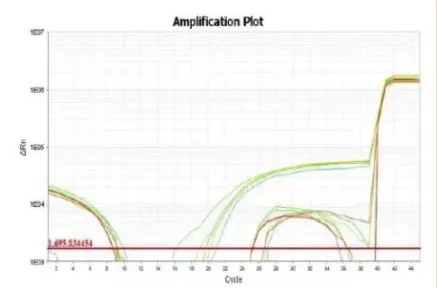
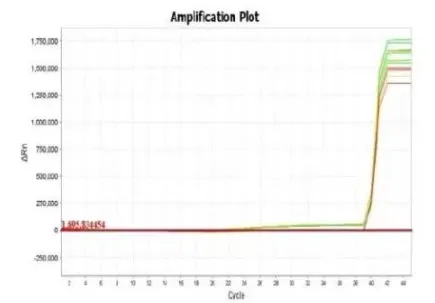
Use consumables of poor quality
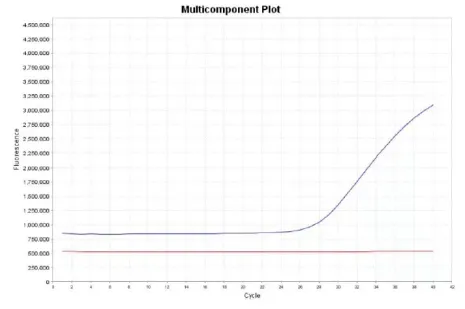
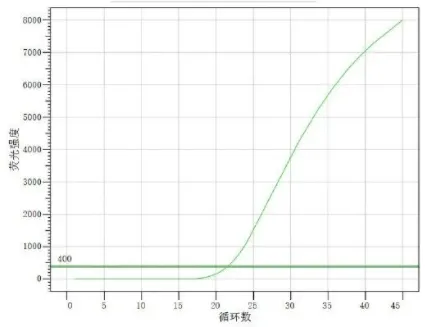
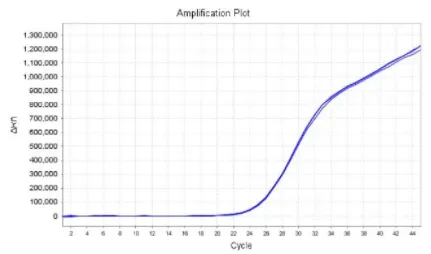
Poor-quality consumables may cause unstable fluorescence values, which can lead to incorrect automatic baseline subtraction in reaction Wells and result in inaccurate Ct values (upper figure). After replacing with high-quality consumables, the fluorescence signal returns to normal (lower figure).
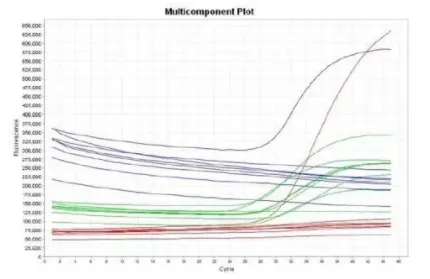
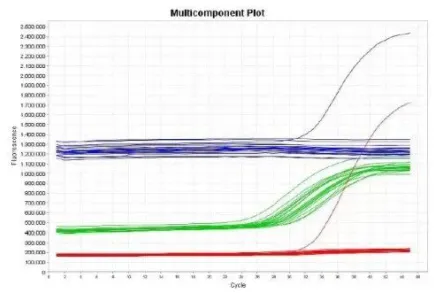
The quality of the sealing film is poor
If the sealing film quality of the 96-well plate is poor, it will be affected by water vapor during the PCR process, which is prone to deformation and may cause "optical distortion" (as shown in the upper figure). When ROX is used as the reference dye and the fluorescence signal changes are corrected, the homogenized amplification curve is normal (as shown in the lower figure).

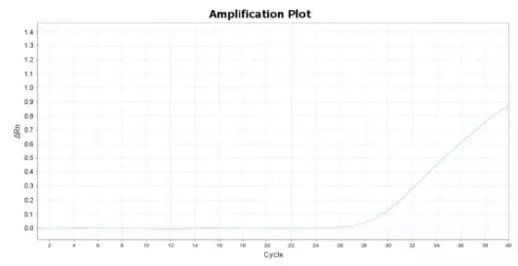
The instrument is unstable - the amplification curve has upward or downward peaks
It might be due to unstable voltage or an unstable light source that causes fluorescence fluctuations, as shown in the following figure.
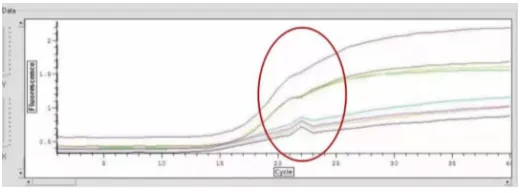
Automatic baseline setting
Setting the automatic baseline too high may lead to a decrease in amplification, as shown in the following figure. The baseline can be manually set. Set baseline end to "the previous cycle before the amplification signal appears".
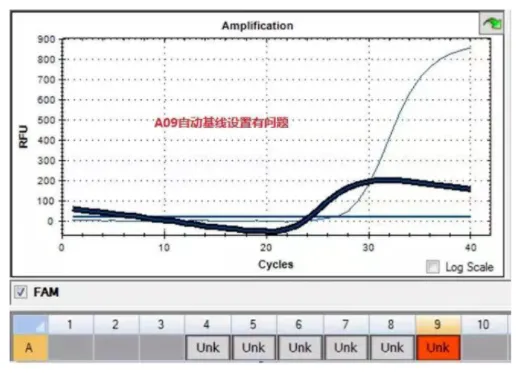
Reaction system - Sample addition issue
Evaporation occurs in the reaction system, resulting in water loss
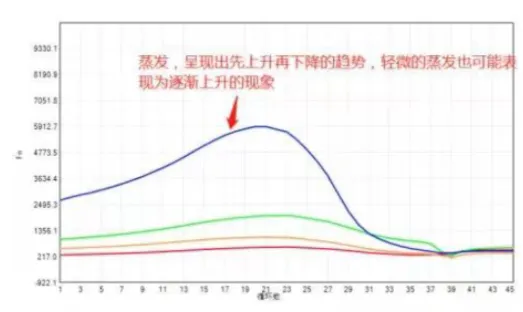
The ROX concentration will increase, and the ROX reference fluorescence will rise (upper figure), while the ROX fluorescence in normal Wells will remain unchanged (lower figure).
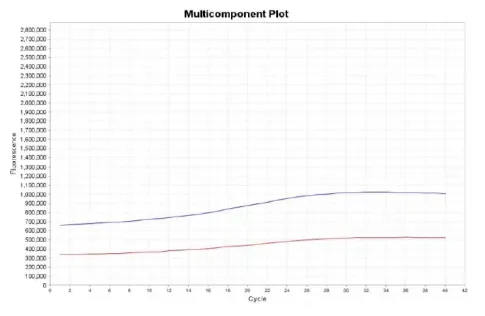
There is a severe evaporation-mountainous curve in the reaction system
Slight evaporation will be a slow rise, while severe evaporation will show a curve of first rising and then falling. These two types of abnormal curves can be distinguished by observing whether the liquid level in the reaction tube drops after detection.
There are bubbles in the reaction system
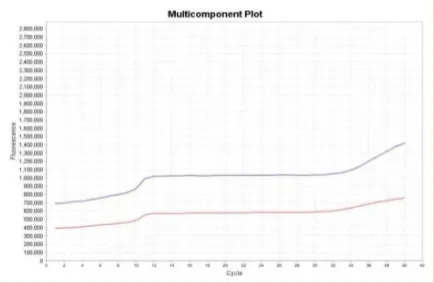
There are large bubbles in the reaction system on the machine, which are prone to refraction in the middle and interfere with the collection of fluorescence, as shown in the following figure.
In addition, if there are bubbles in the reaction system, it is possible that the amplification curve will have upward or downward peaks. The biggest difference from instrument problems is that the presence of bubbles is sporadic for a single sample, while instrument problems will show consistent fluctuations.
Reaction system - system issues
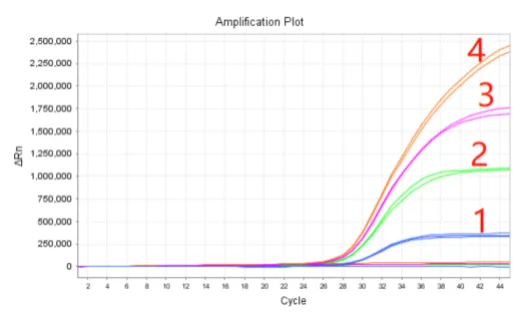
The probe extraction ratio is inappropriate
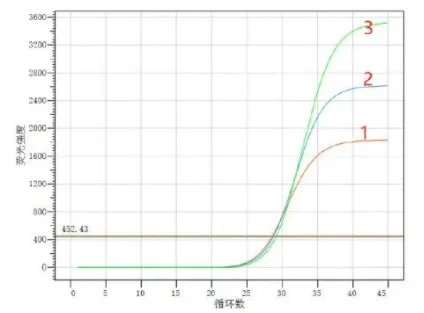
As shown in Figure 1 below, the probe volume is too small, resulting in an earlier plateau period and a low fluorescence increment. 2 and 3 represent the appropriate probing volume range. 4 indicates an excessively high probing volume, resulting in incomplete amplification and no plateau period.
Improper use of enzyme dosage
The requirements for enzyme quantity vary depending on the number of amplification repeats, the quality of the template, or the difficulty of amplification. A low enzyme quantity will result in incomplete amplification and a low endpoint fluorescence value. Excessive enzyme levels can lead to an increase during the plateau period.
Insufficient enzyme quantity amplification curve
Amplification curve for excessive enzyme content
Improper use of dNTP quantities
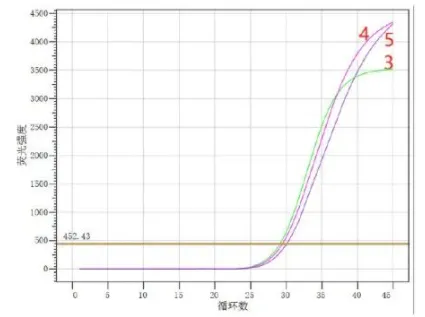
Both too little and too much dNTP will affect the amplification effect. The amplification curves of the tests from 1 to 5 show the gradual increase of dNTP quantities. The Ct values of No. 1 to No. 3 remain unchanged while the fluorescence increment gradually increases. The Ct values of No. 3 to No. 5 gradually increase, and the amplification curves of No. 4 and No. 5 deteriorate. The optimal dNTP quantity is No. 3.
Amplification inhibitors exist.
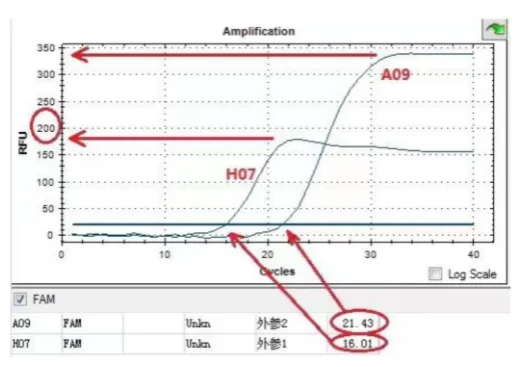
It could be that the sample itself contains too many inhibitors: structural proteins, fats, polysaccharides, etc., or it could be that there are residues of template extraction reagents: ethanol, proteinase K, phenol, etc. As shown in the amplification curve of H07 in the following figure, amplification inhibition exists. In this case, the sample can be re-extracted or diluted before amplification.
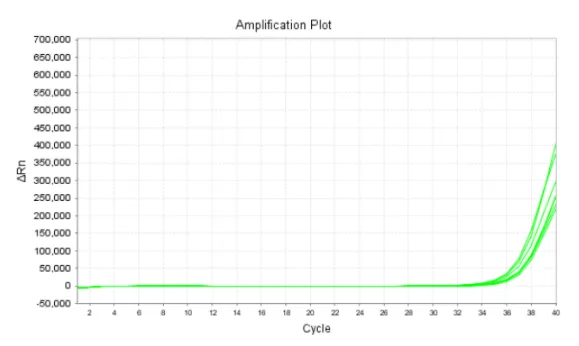
The amplification curve jumps from the end
There may be many factors for a final jump, including: 1) The presence of contamination; 2) Non-specific amplification; 3) Low sample concentration; 4) Poor enzyme specificity can be investigated one by one.
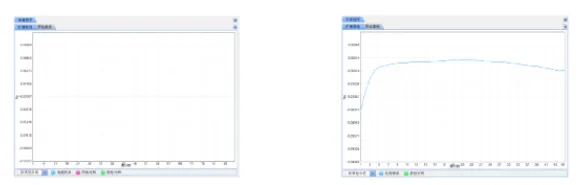
No amplification curve or no Ct value
As the most common situation, as shown in the following figure, possible reasons include: 1) Incorrect PCR parameter Settings: Fluorescence signal acquisition was not set when designing the cycle parameters; 2) Template degradation: Avoid the introduction of impurities during sample preparation and repeated freeze-thaw cycles; 2) Primer or probe degradation: Its integrity can be detected by PAGE electrophoresis; 4) The computer has been set to automatic sleep mode.
There are countless abnormal curves, but tracing back to the root cause still revolves around "people, machines, materials, methods, and environment". By checking each possible cause one by one, controlling variables, and repeatedly verifying, it's not difficult to obtain a perfect curve
0756-8699969
Address: No. 88, Shuian 1st Road, Nanping Science and Technology Park, Xiangzhou District, Zhuhai City, Guangdong Province
Email: marketing@biori.com
Wechat official account |
Product consultation |
Join us |
Video Account |