The following article is from the biological world The author is Biological World
The 2024 Nobel Prize in Physiology or Medicine was awarded to Victor Ambros (University of Massachusetts Medical School) and Gary Ruvkun (Harvard Medical School/Massachusetts General Hospital) for their discovery of microRNA and its role in post-transcriptional gene regulation, thereby revealing the genetic principles of how gene activity is regulated.
Victor Ambros was born in Hanover, New Hampshire, USA in 1953. He obtained his Ph.D. from the Massachusetts Institute of Technology in 1979 and conducted postdoctoral research there (1979-1985). In 1985, he established his own laboratory at Harvard University. From 1992 to 2007, he joined Dartmouth Medical School and has been working at the University of Massachusetts Medical School ever since.
Gary Ruvkun was born in Berkeley, California, USA in 1952. He obtained his Ph.D. from Harvard University in 1982. From 1982 to 1985, he conducted postdoctoral research at the Massachusetts Institute of Technology. In 1985, he established his own laboratory at Harvard Medical School/Massachusetts General Hospital and has been working there ever since.
The information stored in our chromosomes can be compared to an operation manual for all the cells in our body. Every cell contains the same chromosomes, so every cell contains exactly the same set of genes and exactly the same set of instructions. However, different cell types (such as muscle cells and nerve cells) have very obvious differences.
So, how do these differences come about?
The answer lies in gene regulation, which enables each cell to select only the instructions related to itself. This can ensure that only the correct set of genes in each cell type is active.
Victor Ambros and Gary Ruvkun are interested in how different types of cells develop. They discovered a previously unknown type of RNA - microRNA (abbreviated as miRNA), an endogenous RNA molecule that plays a crucial role in gene regulation.
Their pioneering discovery has revealed a completely new principle of gene regulation, which is crucial for multicellular organisms including humans.
It is currently known that the human genome encodes over 1,000 types of micrornas. The discovery of the two of them has revealed a brand-new dimension of gene regulation. microRNA has been proven to play a fundamental and significant role in the development and function of organisms.
Necessary regulation
This year's Nobel Prize focuses on discovering important regulatory mechanisms in cells that are used to control gene activity. Genetic information flows from DNA to mRNA through a process known as transcription and then enters the cellular machine for protein production. There, mRNA is translated into proteins, and in this process, the genetic instructions stored in DNA eventually generate proteins. Since the mid-20th century, some of the most fundamental scientific discoveries have explained how this process works.
The organs and tissues in our body are composed of various types of cells, and their DNA all store the same genetic information. However, these different cells express unique protein combinations.
How is this achieved?
The answer lies in precisely regulating gene activity so that only the correct set of genes is active in each specific cell type. For instance, this enables muscle cells, intestinal cells and different types of nerve cells to perform their specialized functions. In addition, gene activity must be constantly fine-tuned to enable cell functions to adapt to the constantly changing conditions within our bodies and in the environment. If gene regulation is abnormal, it may lead to serious diseases such as cancer, diabetes or autoimmune diseases. Therefore, understanding the regulatory mechanism of gene activity has been an important goal for many years.
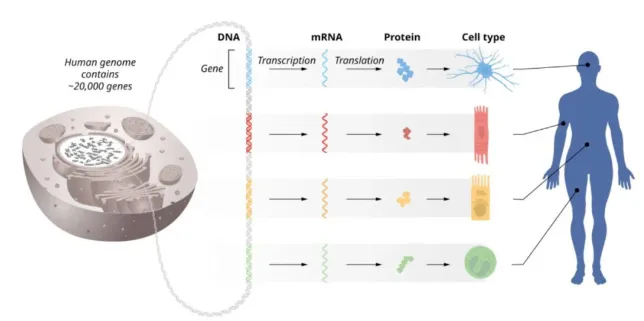
The flow of genetic information from DNA to mRNA and then to protein. The same genetic information is stored in the DNA of all cells in our body. This requires precise regulation of gene activity so that in each specific cell type, only the correct set of genes is active.
Research in the 1960s showed that a special protein called a transcription factor could bind to specific regions on DNA and control the flow of genetic information by determining which mRNA would be produced. Since then, scientists have discovered thousands of transcription factors, and it has long been believed that the main principles of gene regulation have been solved.
However, in 1993, Victor Ambros and Gary Ruvkun unexpectedly discovered a new level of gene regulation. This discovery was later proved to have extremely high biological significance and was well preserved in the process of evolution.
Tiny nematodes, major breakthroughs
In the late 1980s, Victor Ambros and Gary Ruvkun did postdoctoral research in the laboratory of Professor Robert Horvitz. Professor Robert Horvitz won the 2002 Nobel Prize in Physiology or Medicine for discovering the genetic regulatory mechanism of programmed cell death.
In the laboratory, the research subject of the two of them was an unremarkable 1-millimeter-long worm - Caenorhabditis elegans. Although Caenorhabditis elegans is small in size, it has many special cell types, such as nerve cells and muscle cells, which are also found in larger and more complex animals. This makes Caenorhabditis elegans a useful model for studying how multicellular biological tissues develop and mature.
The two of them are interested in genes that control the activation timing of different gene programs, which ensure that various types of cells develop at the right time. They studied two mutant nematodes - lin-4 and lin-14, which showed defects in the timing of gene program activation during their development. They want to identify these mutant genes and understand their functions. Previous studies by Victor Ambros have shown that the lin-4 gene seems to be a negative regulator of the lin-14 gene. However, it is still unclear how the activity of lin-14 was blocked, and they decided to set about solving this mystery.
Dr. Victor Ambros established his own laboratory at Harvard University and conducted research on the lin-4 mutant. Systematic mapping enabled them to clone the gene and lead to an unexpected discovery. The lin-4 gene generates an abnormally short RNA molecule, which lacks protein coding.
These surprising results indicate that this small RNA from lin-4 is responsible for inhibiting lin-14. How does it work?
After completing his postdoctoral research, Victor Ambros established his own laboratory at Harvard University, continued to analyze the lin-4 mutant, and made a surprising discovery: The lin-4 gene does not encode proteins but encodes a very short RNA. This small RNA from the lin-4 gene is responsible for inhibiting the lin-14 gene.
At the same time, Gary Ruvkun studied the regulation of the lin-14 gene in his newly established laboratory at Harvard Medical School/Massachusetts General Hospital. Different from the known gene regulatory functions at that time, he found that the inhibition of lin-4 on lin-14 was not to inhibit the production of lin-14 mRNA. This regulatory effect seemed to occur in the later stage of the gene expression process, inhibiting protein production. He also found that There is a fragment in lin-14 mRNA that is necessary for lin-4 to exert an inhibitory effect.
The two of them compared their respective findings and then reached a breakthrough discovery - the short lin-4 sequence matched the complementary sequence of the key fragment of lin-14 mRNA. They confirmed through further experiments that lin-4 microRNA shuts down lin-14 by binding to the complementary sequence in lin-14 mRNA, thereby blocking the production of lin-14 protein.
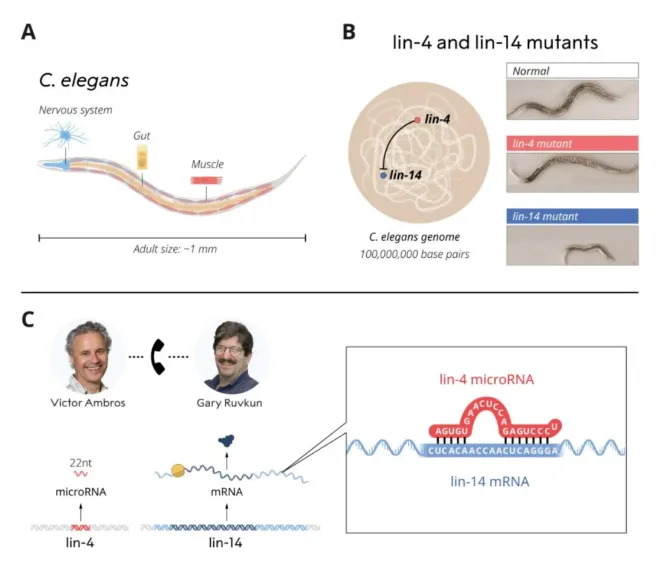
A: Caenorhabditis elegans is a commonly used model organism for understanding how different cell types develop. B: Victor Ambros and Gary Ruvkun studied the mutants of lin-4 and lin-14. Victor Ambros found that lin-4 seemed to be a negative regulatory factor of lin-14. C: Victor Ambros discovered that the lin-4 gene encodes a microRNA rather than a protein. Gary Ruvkun cloned the lin-14 gene. The two of them found that the lin-4 microRNA sequence matched the complementary sequence in the lin-14 mRNA
So far, they have discovered a brand-new gene regulatory mechanism, one mediated by previously unknown RNA (microRNA).
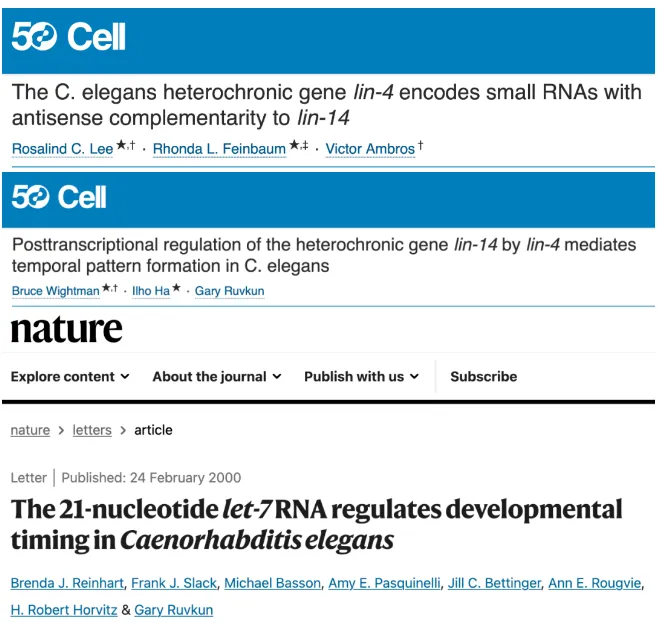
They each published a paper in the Cell journal in 1993, reporting the above findings.
However, after the publication of these two papers, they almost encountered a "deafening silence" in the scientific community. Because, although the research results are interesting, this unusual gene regulatory mechanism is regarded by the academic community as unique to Caenorhabditis elegans and may have nothing to do with humans or other complex animals.
It was not until seven years later that the situation changed. Gary Ruvkun discovered the second microRNA - let-7. Unlike lin-4, the let-7 gene is highly conserved and exists throughout the animal kingdom. This paper aroused great interest in the academic community. In the following years, hundreds of different micrornas were successively identified.
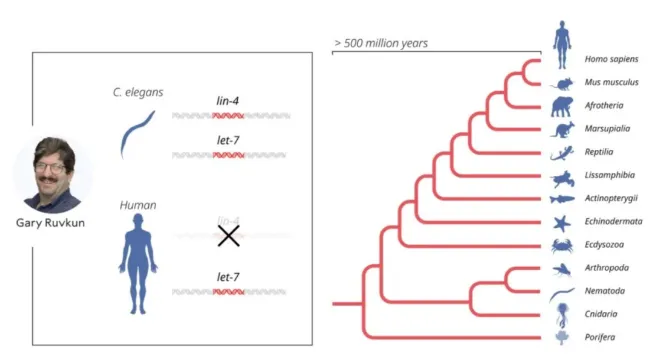
Gary Ruvkun cloned the let-7 gene, which is the second gene encoding microRNA. This gene is conserved during evolution, and microRNA regulation is widespread in multicellular organisms
Today, we know that humans have over 1,000 genes expressing different micrornas, and the regulation of genes by micrornas is widespread in multicellular organisms.
In addition to discovering new micrornas, other researchers have successively clarified the mechanism by which micrornas generate and deliver complementary target sequences in regulatory mrnas. The binding of microRNA to complementary target sequences in mRNA leads to the inhibition of protein synthesis or the degradation of mRNA. Interestingly, a microRNA can regulate the expression of many different genes, and a gene can also be regulated by multiple micrornas, thereby coordinating and fine-tuning the entire gene network.
Micrornas, however, have profound physiological significance
The microRNA gene regulatory role, which was first revealed by Victor Ambros and Gary Ruvkun, has existed for hundreds of millions of years. This regulatory mechanism enables increasingly complex organisms to evolve.
From genetic research, we know that without microRNA, cells and tissues cannot develop normally. Abnormal regulation of microRNA can lead to cancer. In addition, mutations in the genes encoding microRNA can also cause congenital hearing loss, eye and bone diseases, etc. Mutations in an enzyme (Dicer1) required for the production of microRNA can lead to DICER1 syndrome, a rare but serious syndrome associated with cancers in various organs and tissues.
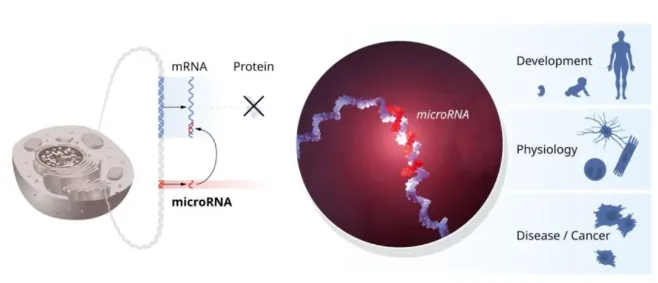
The pioneering discovery of microRNA was unexpected, revealing a new dimension of gene regulation
Core Paper
The Nobel Prize official website listed three core papers of the two laureates. The first two were published in the Cell journal in 1993. These two papers discovered the first microRNA - lin4 and revealed its gene regulatory mechanism. The third paper was published in the journal Nature. This paper discovered the second microRNA - let7, confirming that microRNA is not only present in nematodes but is widespread in the animal kingdom.

0756-8699969
Address: No. 88, Shuian 1st Road, Nanping Science and Technology Park, Xiangzhou District, Zhuhai City, Guangdong Province
Email: marketing@biori.com
Wechat official account |
Product consultation |
Join us |
Video Account |