What is MEIA?
While the COVID-19 pandemic has affected people's living habits, it has also been quietly promoting the rapid development of the disease rapid testing industry. Whether the pathogen can be detected efficiently in the shortest time and with the simplest operation method is an important prerequisite for humanity to defeat COVID-19 and other infectious diseases.
However, traditional nucleic acid diagnostic techniques have disadvantages such as long detection time and expensive equipment, making it difficult to respond quickly to the demands of epidemic prevention and control. The market urgently needs new molecular diagnostic products that are efficient and convenient.
Based on its advanced molecular biology technology and development platform, Baorui Biotechnology has, through repeated technical verification and innovation, developed a new generation of nucleic acid Isothermal Amplification technology with leading performance - Multi-Enzyme isothermal amplification (MEIA). This technology achieves an amplification reaction time of 3 to 15 minutes at a relatively mild reaction temperature of 35 to 42℃ through the synergistic action of multiple enzymes. The results can be interpreted in combination with various methods such as agarose gel electrophoresis, fluorescent probes and colloidal gold test strips.
The principle of MEIA technology
The MEIA raw material enzymes of Baorui Biology are derived from various organisms such as bacteriophages and bacteria. The proteins screened out after mutation and evolution through genetic engineering technology have an extremely high matching degree and meet the requirements of our MEIA technology.
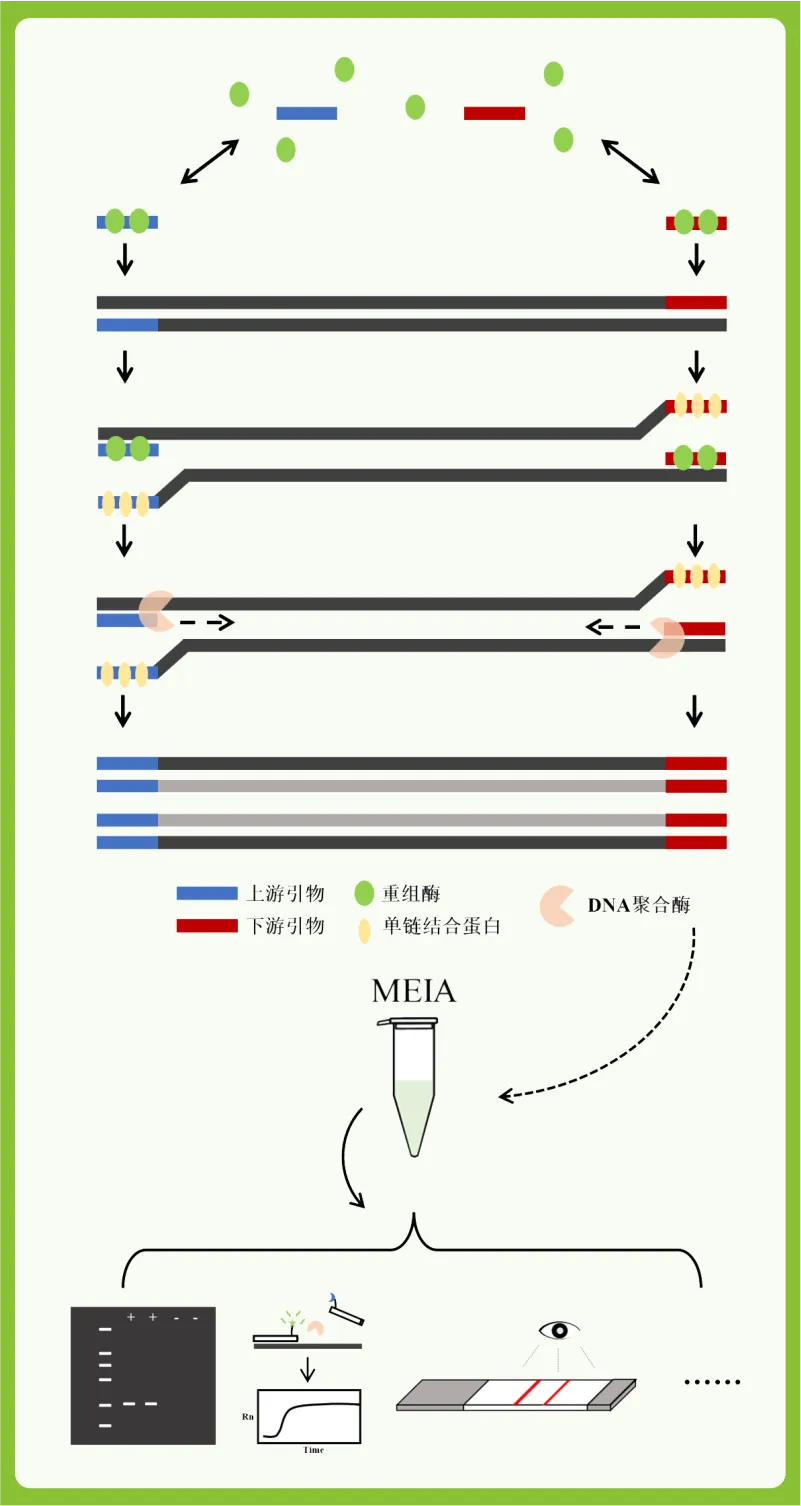
Its technical principle is similar to that of recombinant enzyme polymerase amplification RPA technology. The modified recombinant enzyme can closely bind to primer DNA at room temperature, forming a recombinant enzyme-primer complex that invades the double-stranded DNA template. At the invasion site, the recombinase opens the double strand into a single strand, and at the same time, the single-strand binding protein binds to the opened single strand, keeping the double-strand template in an open state.
The recombinase-primer complex begins to scan the double strands. When the primers find complementary sequences on the template, the recombinase-primer complex disintegrates, and the DNA polymerase binds to the 3 'end of the primers, initiating the synthesis of a new strand. The newly synthesized strand can also serve as a template, and the final amplification product grows exponentially, completing the amplification of the target gene. The fluorescently labeled probe combines with the amplification product. When the probe is cleaved by exonucidase and emits a fluorescence signal, a fluorescence signal will be emitted. The fluorescence signal is detected by the instrument to monitor the amplification in real time.
Schematic diagram of MEIA technology
Characteristics of MEIA
Simple operation
Non-professionals can complete the experimental operation with simple guidance. The reaction does not require thermal circulation and is completely free from the constraints of instruments. Even incubation with human body temperature can achieve amplification reactions.
Highly efficient reaction
The amplification reaction time is 3 to 15 minutes, which is more efficient compared with the traditional PCR technology.
Low-temperature amplification
The reaction temperature is between 35 and 42 degrees Celsius, with mild conditions and a constant temperature throughout the process. A single incubation temperature reduces the demand for equipment. Constant-temperature devices such as water baths can be used to replace expensive PCR instruments for incubation, significantly lowering the detection cost.
Freeze-dried
The combination of MEIA technology and freeze-drying technology forms freeze-dried MEIA nucleic acid amplification reagents. Freeze-dried reagents can be transported at room temperature, which is more convenient to use and conducive to on-site rapid detection, improving detection efficiency.
Widely applied
It can be combined with CRISPR technology to develop highly sensitive reagents. Combined with colloidal gold technology, develop portable detection cards; Combined with fluorescent probes, develop real-time fluorescent detection reagents with ultra-high sensitivity.
test kit
Based on the MEIA technology platform, Baorui Biotechnology has developed an ultra-high sensitivity real-time fluorescence detection reagent: the Rapid isothermal amplification kit (MEIA Probe), which can be used for highly sensitive detection of DNA and RNA templates.
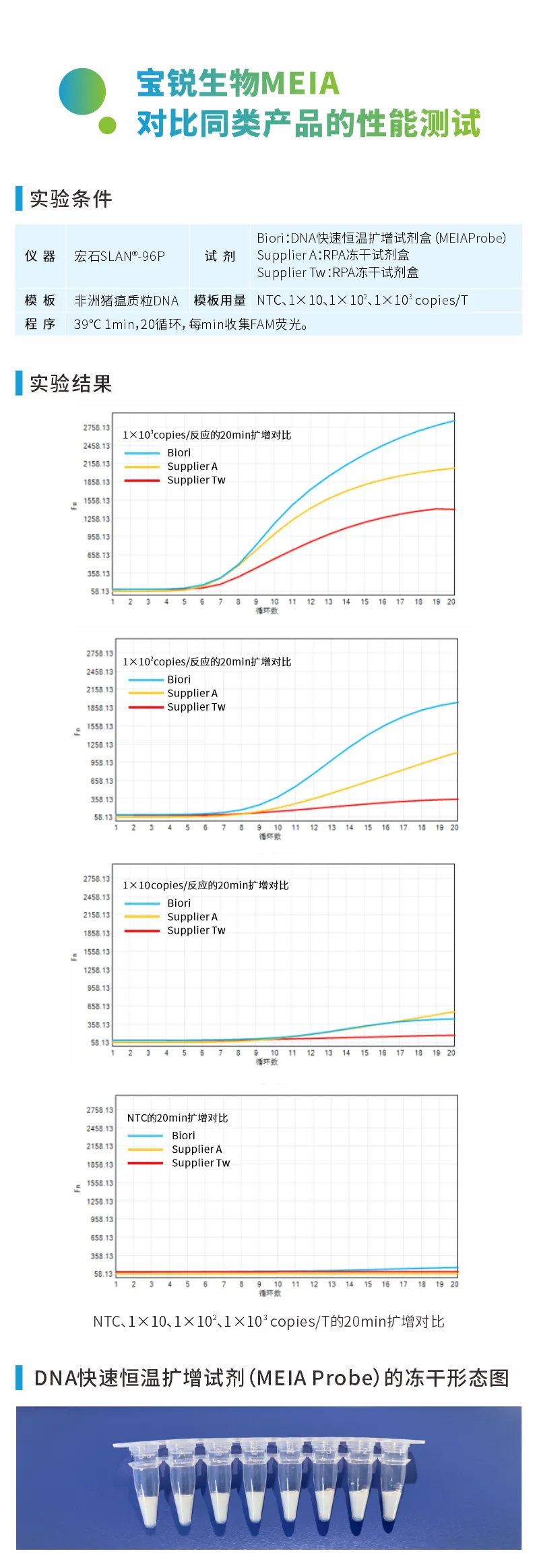
MEIA isothermal amplificationProduct Recommendation


Apply for a trial
0756-8699969
Address: No. 88, Shuian 1st Road, Nanping Science and Technology Park, Xiangzhou District, Zhuhai City, Guangdong Province
Email: marketing@biori.com
Wechat official account |
Product consultation |
Join us |
Video Account |