I.The connotation of lean production
Lean production is a systematic approach that identifies and eliminates waste throughout the entire process from customer pick-up to the source of the product, making it increasingly perfect. The essence is to eliminate labor without added value and labor that generates added value due to excessive use of resources, so as to generate added value by using resources to the minimum extent.
The core idea of lean production lies in "eliminating waste" and "continuous improvement".
The operational principle of lean production can be summarized as: value - value stream - flow - pull - perfection. Value is determined from the perspective of customers to identify the links that create value and those that do not. The value stream refers to all activities that transform raw materials into finished products and achieve value-added. Flow refers to the flow of value streams and constantly eliminates waste caused by interference, waiting, bypassing, backflow and waste products, etc. Pulling refers to the process where customer demand pulls the value stream and responds promptly to changing demands, providing timely supplies. Perfection refers to continuous improvement and constant elimination of waste.
Ii.The development history of lean production
After World War II, market demand entered a new stage of diversified development, and industrial production gradually shifted from the single-variety and large-batch assembly line production mode to the multi-variety and small-batch direction. In response to the demands of The Times, Eiji Toyoda of the Japanese Toyota Motor Corporation and his partner Naichi Ohno conducted a series of explorations and experiments. In practice, they created a production method that is of high quality and low consumption under the mixed production conditions of multiple varieties and small batches - the Toyota production system (TPS). Subsequently, researchers from the Massachusetts Institute of Technology in the United States, after investigation and study, summarized it as "lean production".
The two pillars of the Toyota Production System: just in time and automation have been inherited into the lean production system.
The development of lean production has gone through the formation stage, the systematization stage, and the new development stage. In the new stage of development (at the end of the 20th century), with the deepening of research and the wide dissemination of the lean production theory, various new theories and methods emerged one after another. Such as the combination of Mass Customization and lean Production, Cell Production, new developments of 5S, new developments of Total Productive Maintenance (TPM), etc.
At this stage, lean thinking has moved beyond manufacturing and spread and been applied as a universal management philosophy in various industries. The emergence of forms such as lean construction, lean software development, and lean healthcare has made the lean production system more complete.
Iii.The Application of Lean Production in the Medical device manufacturing industry
At present, the competition among global medical device manufacturing enterprises is not only a competition of product quality and reliability and other product use values, but also a competition of product price, product delivery and other manufacturing costs, logistics costs and service costs. Meanwhile, with the strengthening of government control measures and the deepening of forms such as government-organized procurement and bidding, the profitability of enterprises has gradually declined.
Therefore, in order to rapidly enhance their market competitiveness, especially to gain greater profits in the high-end market, domestic medical device enterprises can make efforts in the following two aspects:
We should have a global perspective, seek blue oceans in the industry, increase investment in product research and development, enhance the technological level of products, and develop more high-end products with independent intellectual property rights.
Medical device manufacturing enterprises should seek manufacturing management models that are suitable for the nature of the industry and the product process. Among various management models, the lean production model stands out in controlling product manufacturing costs and increasing product turnover speed, and has gradually become the preferred production model in the medical device industry at present.
The following takes a certain medical device manufacturing enterprise as an example to specifically analyze the overall design and implementation of the lean production management model.
The operation models of different industries and enterprises vary, as do their personnel reserves, equipment and facilities, product categories, and management levels. The implementing units of the lean production model must base themselves on their own personnel quality, material foundation, equipment automation level and other conditions to design and implement a lean approach that suits them. The picture shows the lean production house structure of Wang Pin from Tianjin University of Science and Technology (Figure 1).
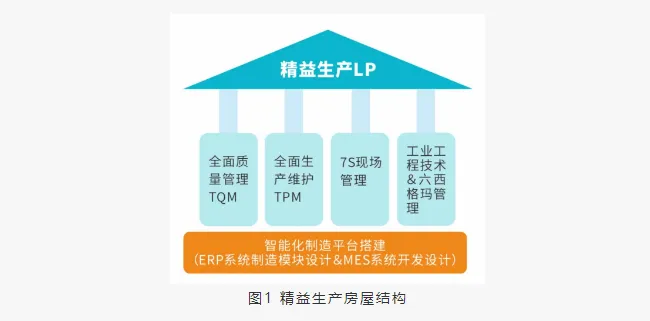
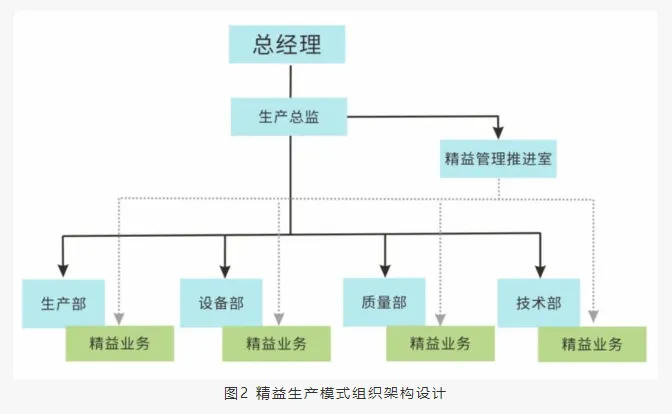
To ensure the smooth implementation of its lean production model, a lean management promotion room can also be added to the organizational structure, and lean business can be included in the scope of responsibilities of each functional department. The heads of each functional department can serve as the group leaders for the implementation of lean business in their respective departments.
For instance, the production department and the Equipment department are mainly responsible for the promotion and implementation of 7S on-site management and Total Productive Maintenance (TPM), while other departments assist in the implementation. The quality department is responsible for promoting and implementing Total Quality Management (TQM), while other departments provide corresponding support. The Technology Department is mainly responsible for promoting and implementing industrial engineering technology and Six Sigma management, and focuses on participating in the early planning and system formulation of 7S on-site management.
All progress, support and results of lean business implementation are summarized, followed up and coordinated by the Lean Management Promotion Office (as shown in Figure 2).
FourOutlook
The lean production model is a continuous improvement process. Among the numerous lean implementation tools and methods, if an enterprise relies solely on a single management approach to a certain extent, it will be difficult to achieve significant breakthroughs.
Lean implementation units need to rationally select and apply numerous management methods in order to achieve the goal of lean production and eliminate waste.
References
[1] Zhao Chuan. Research on the Application of Lean Production in Medical Equipment Manufacturing Enterprises [J]. Value Engineering, 2017, 36(16), 247-250
[2] Sun Kaifeng. Design and Implementation of Lean Production Mode for A Medical Device Manufacturing Enterprise [D], Shandong University, 2016.
0756-8699969
Address: No. 88, Shuian 1st Road, Nanping Science and Technology Park, Xiangzhou District, Zhuhai City, Guangdong Province
Email: marketing@biori.com
Wechat official account |
Product consultation |
Join us |
Video Account |