Article Source: Carefully Selected IVD Raw Materials
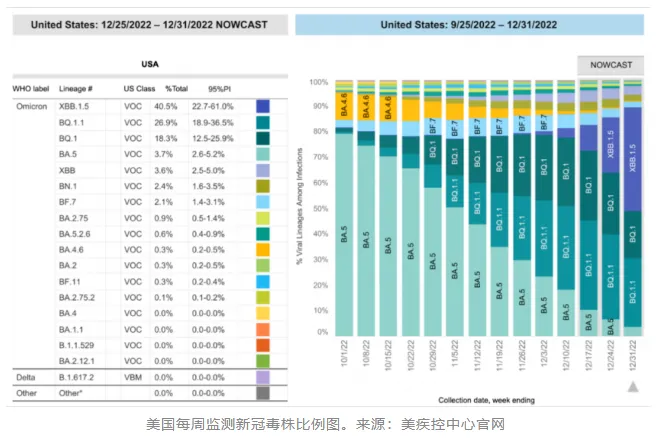
Recently, the US Centers for Disease Control and Prevention released the latest distribution map of the novel coronavirus strains. According to the chart, in the US epidemic situation, the BA.5 and BF.7 strains have basically withdrawn, and BQ.1.1 and BQ.1 have reached their peaks. Meanwhile, XBB rose to prominence.
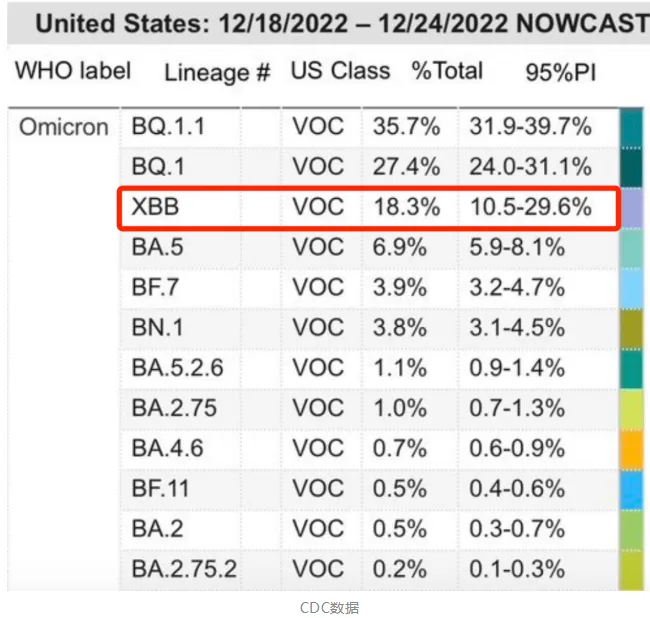
According to the data released by CDCon December 30th, 40.5% of the COVID-19 cases in the United States that week were caused by the highly contagious Omicron subvariant XBB.1.5.
The infection rate of the XBB.1.5 strain in that week nearly doubled compared with the previous week. Scientists say that due to its extremely high "immune escape" ability, XBB.1.5 has rapidly replaced BQ.1.1 and BQ.1 to become the dominant strain in the United States.
The main prevalent strains of the domestic epidemic at present are BA.5.2 and BF.7. According to the latest news, XBB has been detected in Shanghai. Among the 30 major subtypes of Omicron that have emerged in Shanghai recently, there are the BQ.1 and XBB families that are widely prevalent in Europe and America. Among the 25 cases of the XBB family monitored this time, there were 3 cases of XBB.1.5. Fortunately, all of them were imported cases from abroad and did not cause local transmission.
From a forward-looking perspective, it is highly likely only a matter of time before XBB becomes popular in China. For this newly introduced variant strain into our country, we still need to have a further scientific understanding.
What are the characteristics of the XBB strain?
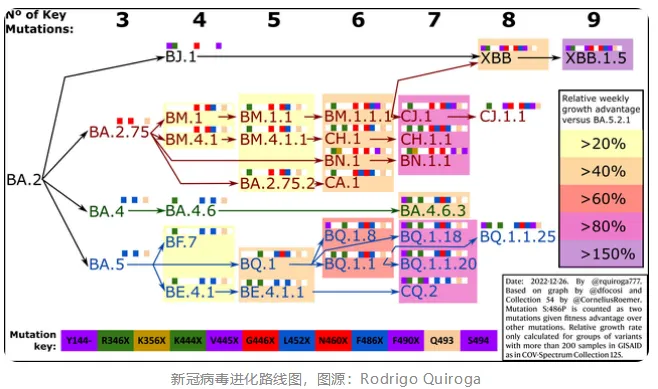
BQ.1 and XBB are currently the two most prevalent mutant strain families in Europe and America. BQ.1 is the sixth-generation subbranch of the Omicron BA.5 variant, and its subline BQ.1.1 has become the dominant strain globally.
XBB, a recombinant of two descendants of the Omicron BA.2 variant, has an extremely strong immune escape ability and has become the dominant strain in Singapore within just two weeks of its emergence.
However, XBB is not a newly emerged variant. As early as August 2022, this strain was first discovered in India. It then spread rapidly. By October, it had been detected in 35 countries and soon became the dominant strain in Singapore, Malaysia and other countries. Subsequently, the XBB mutant strain gradually evolved into the Omicron subbranch, including XBB.1 and XBB.1.5.
Research indicates that the pathogenicity of XBB has not significantly increased, but due to the mutation of the strain, it can better bind to human cell receptors, and XBB.1.5 has a higher immune escape ability. The immune escape ability of XBB.1.5 is comparable to that of XBB.1. Trials have shown that even with at least two doses of mRNA vaccines, breakthrough infection BF.7 cannot induce high levels of neutralizing antibodies against XBB.1 and XBB.1.5, making it difficult to prevent reinfection.
According to Xu Wenbo, director of the Institute for Viral Disease Control and Prevention of the Chinese Center for Disease Control and Prevention, at a press conference on December 20th, BQ.1 and XBB are mainly characterized by increased transmissibility and immune escape ability.
However, its pathogenicity is not significantly different from other series of Omicron variants, and the rates of severe cases and deaths have not increased significantly in these countries. So far, no reports have been found that BQ.1 and XBB have caused an increase in severe cases and deaths both at home and abroad.
Will the secondary infection rate increase after XBB becomes the prevalent strain?
Wang Xinyu, deputy director of the Department of Infectious Diseases at Huashan Hospital Affiliated to Fudan University, said that the pathogenicity of XBB, BQ.1 and BQ.1.1 is similar to that of previous strains, but their immune escape ability has increased.
Therefore, the speed at which the virus spreads may be faster than before. If one encounters these strains, the probability of reinfection mainly depends on two aspects. On the one hand, it is about how much overlap the strain encountered again has with BA.5 and BF.7. If the virus keeps mutating and the cross-protection effect decreases, it may cause infection. On the other hand, it depends on the person's own antibody level.
Generally speaking, the antibody level in the body is relatively high for a period of time after recovery from COVID-19, and it is not easy to be reinfected during this period. However, as time goes by, antibody levels decline, which may increase the possibility of reinfection. Overall, when there are certain antibodies in the body, the symptoms of reinfection are relatively milder and the recovery speed is faster. In the rare cases where the virus mutation leads to an increase in pathogenicity, the condition may only be more severe than the first time.
The evolution characteristics of the novel coronavirus and global prevention and control factors have led to the continuous emergence of new variants of the virus.
The overall trend of the Alpha, Delta, Omicron and other variants is that they are spreading faster and faster, their immune escape ability is gradually increasing, and their virulence is getting weaker and weaker. However, it cannot be ruled out that some individual mutations may still cause severe cases. To survive, viruses undergo an iterative evolutionary process, but each mutation is not necessarily a complete iteration. The direction of future strain changes is still uncertain at present, but enhanced transmissibility and improved immune escape ability are the major directions of change.
At present, BQ.1 and XBB have not yet formed a dominant transmission in China. The domestic epidemic situation is still dominated by BA.5.2 and BF.7, but their transmission dominance will gradually increase. The contacts of the epidemic in Beijing or Guangzhou mainly carried the BF.7 and BA.5.2 sub-strains. The population movement between urban and rural areas during the Spring Festival travel rush will greatly affect the trend of the epidemic. According to current research, the novel coronavirus will not disappear and may eventually evolve into a seasonal flu that occurs frequently throughout the year, with possible outbreaks in winter and spring.
During the process of dealing with the novel coronavirus, the antibodies present in the human body will gradually be metabolized and reduced. Strengthening vaccines, good hygiene habits and a healthy lifestyle remain the long-term preparations we need to make in the face of COVID-19. In addition, a calm and scientific psychological construction is also indispensable.
Whether it's BQ.1 or XBB, or the highly contagious strains in China at present, don't panic and stockpile medicine. Only scientific prevention and control can provide the best protection.

0756-8699969
Address: No. 88, Shuian 1st Road, Xiangzhou District, Zhuhai City, Guangdong Province
Email: marketing@biori.com
Wechat official account |
Product consultation |
Video Account |