Article Source: IVD Learning Notes
Source: Super lab
RNA concentration and purity
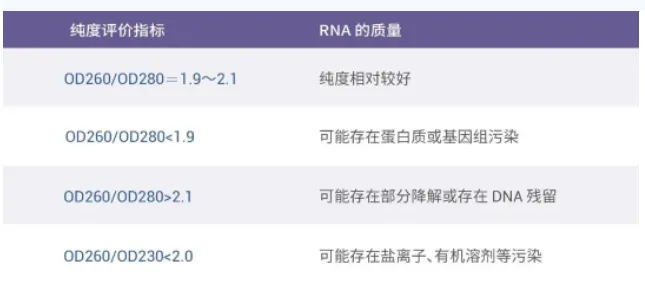
RNA has a continuous absorption spectrum and its highest absorption peak is at 260 nm. The protein has a maximum absorption peak at 280 nm. The absorbance at 230 nm can reflect the content of ethanol, GTC, GuHCl, EDTA, etc. Therefore, in the quality inspection parameters of RNA, the absorbance at 260, 280 and 230 nm respectively represents the values of nucleic acids, proteins and organic solvents, etc. Under normal circumstances, when conducting RNA purity tests, we mostly only look at the numerical range within the OD260/OD280 ratio. A small amount of protein, salt or genomic contamination is acceptable to us.
RNA integrity assessment
mRNA accounts for approximately 3% of the total RNA, while rRNA makes up over 80% of the total RNA. The integrity of RNA (mainly rRNA) can generally be evaluated by gel electrophoresis. Then, how can we analyze these various contamination "bugs" through the gel diagram of RNA?
Take eukaryotes as an example: after electrophoresis of complete total RNA, rRNA bands at 28S, 18S, and 5.8S will be produced. The approximate ratio of band intensities at 28S to 18S should be 2:1 (Figure 3a). The appearance of a 5.8-second rRNA band in electrophoresis indicates slight degradation. RNA itself is "sensitive" and needs to be "well-prepared". Therefore, in general experiments, the appearance of a 5.8-second band is quite normal. However, if there is only this one band and it shows obvious diffusion (Figure 3b), it is still recommended to "stop the loss in time" for subsequent reverse transcription.
If there are extra bands above 28 seconds and they are extremely bright, it is undoubtedly gDNA contamination (Figure 3b)! If there are still bright "holdouts" in the sample Wells, it is highly likely to be protein contamination and a conviction can be made.
The target bands of the eukaryotic gel diagram are 23S, 16S and 5S. The quality inspection methods can be referred to the above.
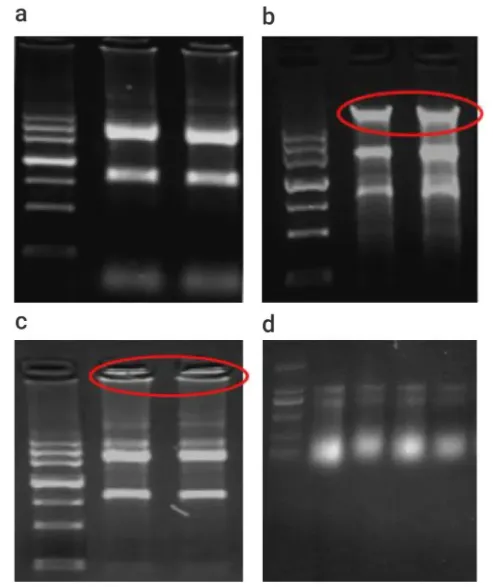
Figure 3. RNA gel electrophoresis diagram.
a. High-quality RNA; b. Residual gDNA; c. Protein residue; d. RNA degradation.
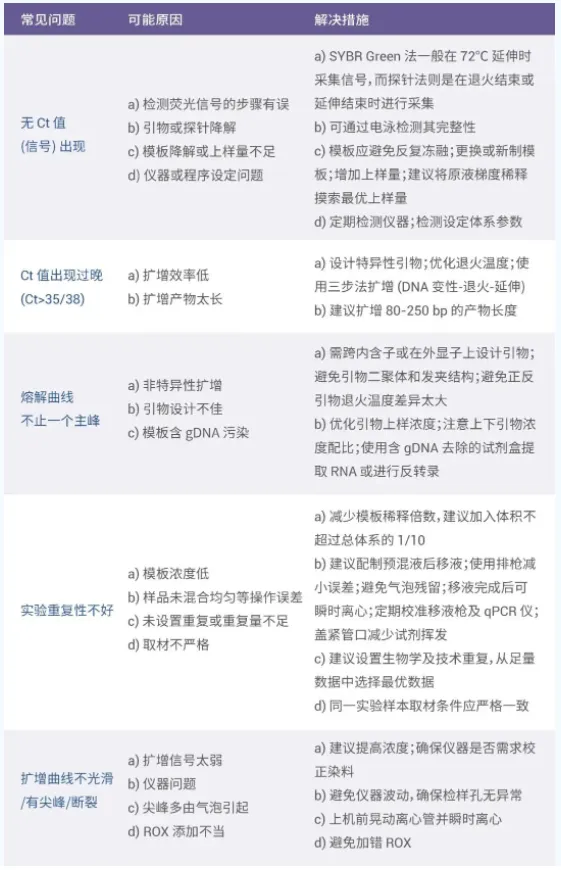
You should be more careful about these qPCR operations
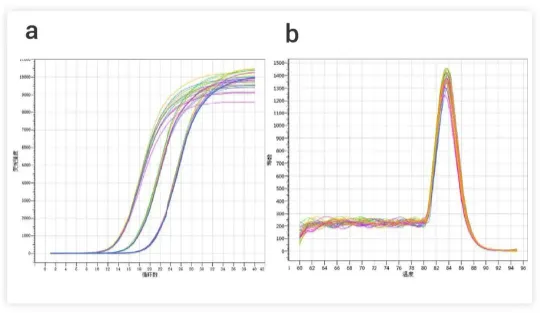
Figure 3. Standard amplification curve (a) and Dissolution curve (b)