Article Source: IVD Research SocietyMedical Industry Observation
(Selected
Digital PCR has been around for 30 years and there are over 30 related enterprises worldwide. In the past three years, more than 300 articles on digital PCR have been written on various platforms. It can be roughly divided into three categories: First, pure technology, which covers the formulas, charts, curves of digital PCR, as well as product analysis, etc. Generally, the authors are technical R&D personnel. Two: Pure Market, covering the history, development pattern, company introduction and market share of digital PCR. Generally, the author is a market, media or industry analyst. Three: Pure application, discussing the clinical and research applications of digital PCR, usually authored by marketers or doctors.
Technology, market and application respectively correspond to the three stages before, during and after the product cycle. Naturally, three styles of articles also emerged. Engineer Huang wants to integrate the three and write something different. There are so many articles about digital PCR. How can I write something new? To be honest, it's quite difficult. Fundamentally, it lies in having differentiated innovative thinking on the premise of respecting the origin of things.
This article focuses on addressing several key issues: First, what is digital PCR, its development history, and what systems does it consist of? Second, globally, which manufacturers are engaged in the research and development of digital PCR, how are they developing, and what is their temporal and spatial distribution? Three, what are the global digital PCR technology routes, product iterations, and technical parameters like? Four, what is the capital activity status and market share change trend in the digital PCR sector? Five, what are the backgrounds and experiences of the leading figures in digital PCR?
The concept and system of digital PCR
What is digital PCR? Mr. Huang's understanding is: The third-generation PCR, microfluidics + real-time fluorescent PCR. Moreover, since the final detection is based on the reading of negative/positive signals, namely 0 and 1, which are digital signals recognizable by the computer, it is an absolute quantitative DNA detection method that can accurately count. From this perspective, it can also be understood as digital PCR. (The above is a common explanation.
In professional terms, digital PCR divides DNA or cDNA samples into many individual, parallel PCR reactions. Each reaction well serves as an independent reactor, containing or not containing one or more copies of the target molecule (DNA template), thereby achieving "single-molecule template PCR amplification". By conducting statistical analysis on the number and proportion of negative and positive signals presented, the template copy number in the original sample is calculated to achieve precise quantification.
In 2006, the first commercial digital PCR system, Biomark HD, was officially released. It has been nearly 20 years since then. The first-generation PCR system was put into commercial use in 1987. The second-generation PCR system was put into commercial use in 1996. The third-generation PCR was commercially launched in 2006. That is to say, it is iterated on average once every ten years. The launch of commercial use refers to the fact that the PCR system has solved key technical and process issues and begun large-scale sales. The invention (concept proposal) of the technology, however, occurred several years earlier. The technological inventions of the first to third generations of PCR were in 1983, 1992 and 1999 respectively. It took 4 to 7 years from the birth to the industrialization of PCR technology.
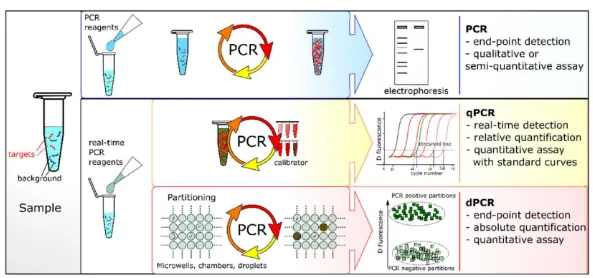
Figure: The development history of digital PCR technologyThe digital PCR reaction process generally includes: sample preparation, droplet preparation, PCR amplification, and fluorescence signal detection and analysis. From the perspective of the reaction process, the system composition of digital PCR consists of three core components: the liquid path system, the temperature control system, and the optical path system. The liquid path system mainly addresses the issue of microdroplet preparation. There are generally several methods, including oil-liquid/gas-liquid heterogeneous separation, regular vibration separation, and microfluidic physical separation. The temperature control system mainly addresses the issue of heating and cooling in PCR reactions. The optical path system mainly addresses issues such as light source excitation, optical signal collection, conversion, and analysis.
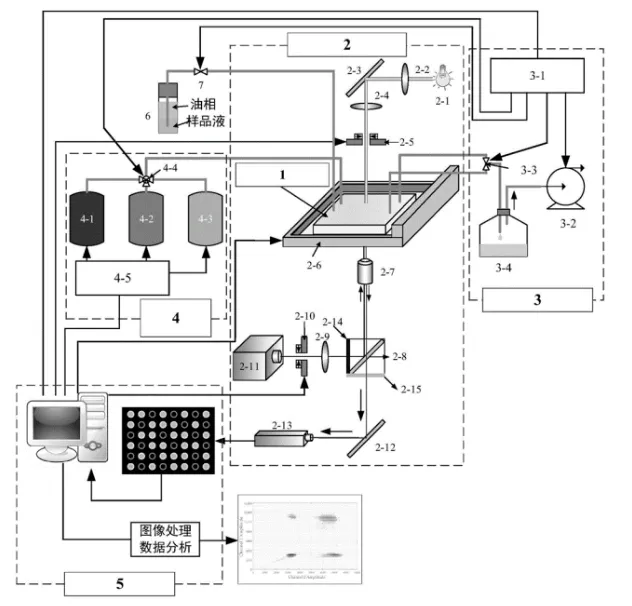
Figure: Digital PCR System of Chongqing University (Patent: CN202010863328)
Digital PCR technology route
The technical route is mainly classified from the perspective of the form of microdroplet preparation. At present, there are mainly two directions. Firstly, droplet digital PCR (ddPCR) essentially separates liquid samples with an oil phase, regardless of the tools, carriers, materials, forms, or actions used. Secondly, chip digital PCR (cdPCR) essentially involves directly aliquot and inject the sample to be tested and reagents into a formed, fixed-volume chip chamber to create individual droplets. Both of these routes have their advantages and disadvantages. Ultimately, it still depends on the user's choice, which will be proven by time.
A digital PCR system is not just one device. Before the advent of the digital PCR all-in-one machine, the entire system was composed of 3 to 4 devices. It generally includes: droplet preparation instrument, PCR cyclic amplification instrument, microplate sealing instrument, droplet reader (biochip analysis/reading instrument), etc. Since the first digital PCR was commercially launched in 2006, no less than 37 products have been released both at home and abroad over the past 17 years.
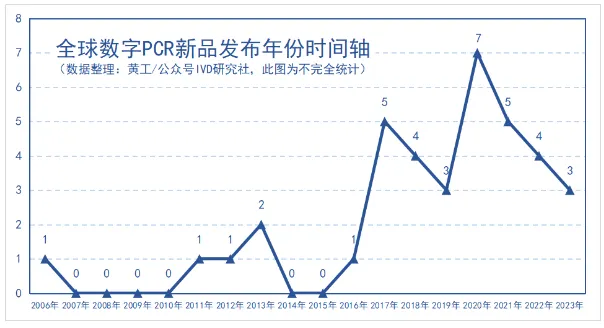
From the perspective of the new product release timeline, the global digital PCR market has been in an active state since 2016, with frequent new product launches. In 2020 alone, up to seven new products were released. There must be omissions in these data statistics. Apart from some leading enterprises, the data and information of start-ups abroad may be overlooked due to geographical and information differences. Some universities and research institutes also have new products, but the information available for retrieval is limited, which will also have an impact on the above picture. Overall, this timeline does not affect our view of the overall trend. It took ten years to go from the first digital PCR to large-scale commercial use.A search for digital PCR patents reveals thousands of them. Many universities, research institutes, hospitals and other institutions have been actively engaged in the research and development of digital PCR instruments, but few have actually launched commercial products. Here, only a few well-known enterprises are listed. Overall, the digital PCR system has shifted from discrete to integrated machines, and the number of enterprises adopting the droplet and chip technology routes is roughly the same. From the perspective of the product release timeline, let's sort out the release process of digital PCR products over the past 20 years.In 2006, Fluidgm: Digital PCR system Biomark HDIn 2011, Bole Bio-Rad: Droplet digital PCR system QX100In 2012, RainDance: Digital PCR system RaindropIn 2013, Bole Bio-Rad: Droplet digital PCR system QX200Thermo Fisher: Digital PCR System QuantStudio 3DIn 2016, Stilla, France: Digital PCR system NaciaIn 2017, Shanghai Little Turtle: Chip Digital PCR BioDigital• HuaIn 2017, Guangzhou Yongnuo Biology: Micro Drop digital PCR instrumentIn 2017, Nanjing Kewei Si: Biochip Reader IA-1In 2017, Beijing GENETRON: Biochip reader GENETRON 3DIn 2017, Beijing Novogene: Biochip Reader Digital PCR NGIn 2018, Beijing Xinyi Biotechnology: Microdroplet digital PCR system TD1In 2018, Beijing Kayudi: Digital PCR product DX100In 2018, Shanghai Zhenzhun Bio: Digital PCR system Accu One-100In 2018, Hangzhou Linghang Gene: Chip digital PCR system C2400In 2019, Guangzhou Yongnuo Bio: Digital PCR system MicroDrop-100In 2019, Beijing Da Microbiology: Digital PCR All-in-one machine Osci DropIn 2019, Beijing Zhiyu Biology: Digital PCR System ZY/VD-100In 2020, Bole Bio-Rad: Digital PCR All-in-one Machine System QX ONEIn 2020, Suzhou Ruixun Bio: RainSure DropDx-2044 systemIn 2020, QIAGEN: Digital PCR all-in-one machine QIAcuityIn 2020, Suzhou Sinafu: Digital PCR all-in-one Machine Sniper DQ24In 2020, Shenzhen Borui Biotechnology: Digital PCR platform DropXpert FD 640
In 2020, Hangzhou Linghang Gene: Digital PCR system AP10+AD16In 2020, Shanghai Zhenzhun Bio: Digital PCR system Accu One-200In 2021, Thermo Fisher: Digital PCR all-in-one machine QuantStudio AbsoluteQIn 2021, Roche: Digital Lightcycler Digital PCR SystemIn 2021, Suzhou Aipubai: Digital PCR system Naica CNIn 2021, Guangzhou Yongnuo Bio: Digital PCR System MicroDrop-20
In 2021, Hangzhou Linghang Gene: CS series of Biochip readersIn 2022, Shenzhen Zhongke Xianjian: Digital PCR Integrated Movement JX-PIn 2022, Shenzhen Borui Biotechnology: Droplet digital PCR platform DropXpert S6In 2022, Zhejiang Dapu Biotech: Nebula Digital PCR SystemIn 2022, Shanghai Zhenzhun Bio: digital PCR AccuMini seriesIn 2023, Bole Bio-Rad: Droplet digital PCR System QX600In 2023, Suzhou Ruixun Biology: Digital PCR all-in-one Machine: RS32 seriesIn 2023, Shanghai Little Turtle: Digital PCR All-in-one Machine SCI DigitalThe above information is sourced from the official accounts and websites of various enterprises, as well as articles written by industry insiders. If there are any mistakes or omissions in the organization, please feel free to leave a message for correction."The global digital PCR landscape
Digital PCR technology originated in the United States and finally spread in Europe and America. In recent years, especially in China, it has received significant development and promotion. This is driven by policy-level factors, capital, and the demands of scientific research and clinical clients, which also account for a portion. From the perspective of the global digital PCR market, North America remains the largest dominant market for digital PCR, followed by Asia and Europe. Growth in Africa and South America is sluggish. According to a survey by the renowned institution Allied Market Research, the global digital PCR market was valued at 508.82 million US dollars in 2020 and is projected to reach 1.3053 billion US dollars by 2030, growing at a compound annual growth rate of 8.6% from 2021 to 2030.
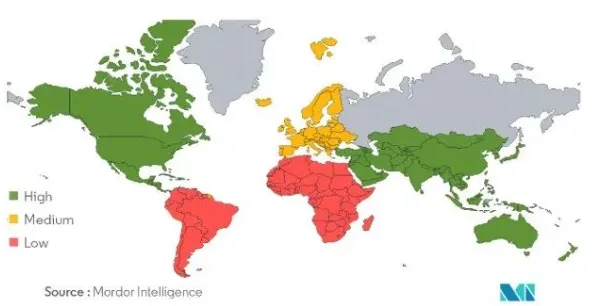
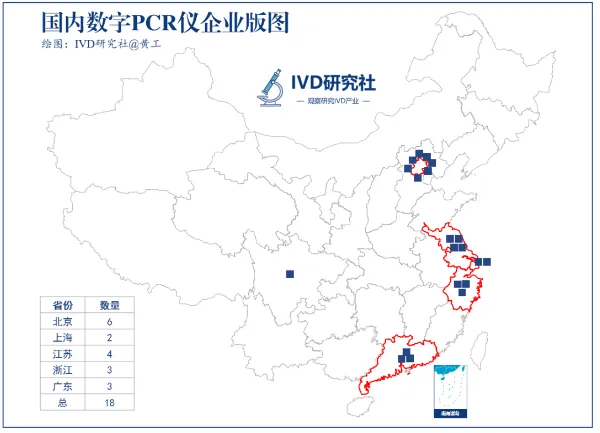
Figure: Growth Areas of the digital PCR market (Green: High, Yellow: medium, Red: Low)The domestic digital PCR landscape can roughly be referred to in the following figure. There are no less than 18 domestic digital PCR enterprises, including 5 in Beijing, 4 in Jiangsu, 3 in Guangdong, 3 in Zhejiang and 2 in Shanghai. One of them is in Beijing, which can also be said to be from Sichuan.
Capital dynamics in the Digital PCR fieldSince its inception, digital PCR has been favored by capital. Existing life science giants acquire and integrate small enterprises to quickly obtain technology, talent and markets. There is also capital support for innovative enterprises to accelerate technological iteration in order to counter the competition from giants. Overall, in the past decade or so, there have been over 40 investment, financing and merger and acquisition activities in the global digital PCR sector, with a total transaction value exceeding 100 billion RMB. It is worth noting that among domestic listed IVD enterprises, four have completed investment and acquisition of innovative digital PCR enterprises. These are respectively Mike Bio - Da Microbial, 100% holding, that is, wholly-owned subsidiaries; Kingmed Diagnostics - Kayudi New Industry - Borui Biology, holding 17.2% of the shares; Anbiping - Dapu Biology.In 2011, Bio Rad spent 162 million US dollars to acquire QuantaLife.In 2013, Thermo Fisher acquired Applied Biosystems; It spent 13.6 billion US dollars and inherited 2.2 billion US dollars of debt to acquire Life Technologies.In 2014, Kayudi completed its Series A financing of 30 million yuan, with SAIF Partners Asia leading the investment.In 2015, Kewei Si completed its Series A financing, with investment from China Creation Ventures.In 2015, Kayudi completed its Series B financing of 80 million yuan, led by Northern Light Venture Capital, with participation from SAIF Partners Asia and Legend Star.In 2016, Zhenzhun Biotech completed a strategic financing of tens of millions of yuan, led by Anlong Fund.In 2017, Bio Rad acquired Rain Dance Technologies.In 2017, Xinyi Biology completed its Series A financing.In 2017, Ruixun Biotech completed a $1 million angel round of financing, led by ZhenFund and Volcanic Stone Capital.In 2018, StillaTechnologies received A Series A investment of 16 million euros (approximately 100 million RMB) from Illumina Ventures.In 2018, Zhiyu Bio completed its Series A financing round, led by Taiyu Investment.In 2018, Ruixun Biotech completed a Pre-A round of financing of 13 million yuan, led by ZhenFund, Morningside Capital and Volcanic Stone Capital.In 2018, Borui Biology completed an angel round of financing amounting to tens of millions of yuan.
In 2019, QIAGEN acquired the American company Formulatrix.In 2019, Borui Biotech completed a Pre-A round of financing worth tens of millions of yuan, led by Baochuang Biotech (with a 10.1% stake) and Yuanhe Yuantian.In 2019, Yongnuo Biotech completed a strategic financing round, led by Sanze Capital.In 2019, Ruixun Biotech completed its Series A financing of tens of millions of yuan, led by Yuansheng Venture Capital, with existing investors Morningside Capital and Volcanic Stone Capital following up.In 2020, Illumina Ventures invested 20 million euros (approximately 150 million RMB) in StillaTechnologies.In 2020, Mike Bio invested 5 million yuan to subscribe for 3.4722% of the equity of Da Microbial.In 2020, Kayudi completed its Series D financing of nearly 600 million yuan, led by Hillhouse Capital, with strategic investment from Jinhe Capital, and follow-on investments from Huiyuan Capital and Fengrui Capital.In 2020, Dapu Biotech completed two angel rounds of financing totaling 20 million yuan.In 2021, Dapu Biotech successively completed its Pre-A and Series A financing rounds, with investments from Xinzheng Capital, Jiufite Capital and Detong Capital.In 2021, Thermo Fisher acquired Combinati.In 2021, Borui Biotech completed a strategic financing round, with New Industry (Xinwei Capital) making a strategic investment, holding a 17.2% stake.In 2021, Bio Rad acquired Dropwork.In 2021, Ruixun Biotech completed a B1 round of financing worth tens of millions of yuan, led by Zero2IPO Asset Management, with Kaitai Capital following up. Existing shareholders, Morningside Capital and Volcanic Stone Capital, also continued to increase their investment.In 2021, Xinyi Biotech completed a B-round financing of 150 million RMB. Eli Lilly Asia Ventures led the investment, with participation from China Growth Capital, Hillhouse Capital, and existing investors Qingdao Yufeng and Chongyuan Huichen.In 2021, Sinafu completed a Series B financing round of nearly 200 million yuan, led by Huimei Capital, with Xingze Capital and Huangpu Medical Fund following up. Existing shareholders Kaifeng Venture Capital, Yahui Investment, and Hetang Capital also continued to increase their investment.In 2021, Leading Gene completed A Series A+ financing round of 120 million yuan, led by Share Investment, with follow-on investment from Puxin Capital. Existing shareholders continued to increase their investment.In 2022, Mike Bio acquired 96.5278% of the equity of Da Microbial for a total price of 166 million yuan. As a result, it has now acquired 100% of the equity.In 2022, Zhenzhun Biotech completed its Series A financing of over 100 million yuan, with investment from Huiyuan Capital.In 2022, Ruixun Biotech completed a C1 round of financing amounting to tens of millions of yuan, led by Qian Dao Fund.In 2022, Dapu Biotech completed a strategic financing of tens of millions of yuan, with strategic investment from Anbiping.