Article Source/Author: Scientific Research Migrant Worker Cheese Strawberry
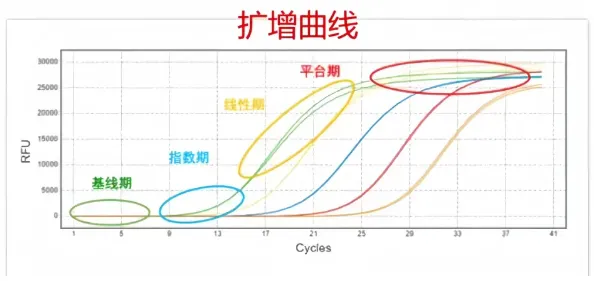
I. Amplification Curve
The amplification curve is a curve that describes the dynamic process of PCR, with the number of cycles as the abscissa and the real-time fluorescence signal intensity during the reaction as the ordinate. A typical amplification curve can be divided into four periods: the baseline period, the exponential period, the linear period and the plateau period.
Baseline period: The horizontal part of the amplification curve, usually within the first few cycles (3-15 cycles) of the PCR reaction. The fluorescence signal amplified at this stage is masked by the fluorescence background signal, making it impossible to determine the change in the amount of product generated. The instrument software will calculate the baseline range based on the fluorescence signal at this stage.
Exponential phase: The exponential growth stage of PCR amplification, during which the amplification curve peaks. During this period, all reaction reagents were in surplus, DNA polymerase maintained a high level of activity, and the amount of product in each cycle conformed to an exponential relationship with the initial template amount. This is the best time for quantitative analysis because there is a linear relationship between the logarithm of the PCR product quantity and the initial template quantity.
Linear phase: With the consumption of raw materials, the accumulation of products, and the loss of enzyme activity, the amplification of DNA no longer shows exponential amplification, the growth of fluorescence signals gradually slows down, and the reaction efficiency decreases. The product quantity no longer conforms to the exponential relationship with the initial template quantity.
Plateau period: Due to factors such as substrate depletion and reduced enzyme activity, the fluorescence signal no longer increases and tends to stabilize. The time when each reaction enters a plateau and the height of the plateau vary.
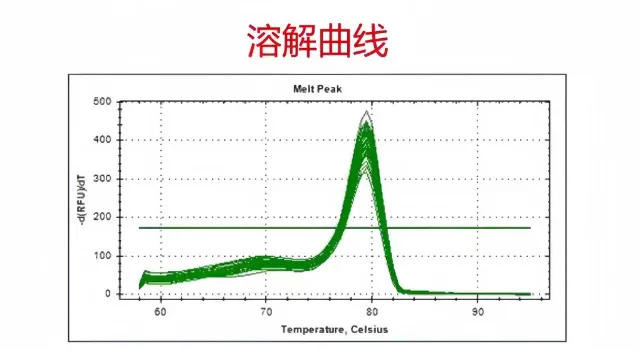
Ii. Melting Curve
The Dissociation curve is a curve that shows the degree of degradation of the double helix structure of DNA as the temperature rises. It is used to analyze the concentration, characteristics and purity of PCR products.
Principle: After the PCR reaction is completed, a melting curve is generated by gradually increasing the temperature while monitoring the fluorescence signals at each step. As the temperature rises, the double strands of DNA gradually unbind, and the fluorescent dye is released from the double strands, reducing the fluorescence signal. When the temperature reaches 50% of the DNA double-stranded cleavage, the corresponding temperature is called the melting temperature (Tm).
Curve analysis: Unimodal curve: If the qPCR product is highly specific, the melting curve will form a unimodal peak between 80 and 90 degrees Celsius. This indicates that only the target gene was amplified, and there were no non-specific amplification products.
Pre-spike: There is a frontrunner in front of the main peak, which may be a non-specific fragment shorter than the target fragment and can unwind the double strand at a lower temperature, or it may be a primer dimer.
Post-heteropeak: Hidden behind the main peak are non-specific fragments longer than the target fragment, which can only untangle the double strands at a higher temperature.
Wide peak: If the Tm value of the non-specific product is close to that of the target band, a wide peak may appear on the melting curve.
Cycle Threshold (Ct) is a key parameter in qPCR(real-time fluorescence quantitative PCR), representing the number of amplification cycles corresponding to when the fluorescence signal reaches the set fluorescence threshold during the PCR amplification process.
The definition of Ct value
Ct value: The full name is CycleThreshold, which refers to the number of cycles that each fluorescence signal in the PCR reaction tube undergoes when it reaches the set threshold. In simple terms, it refers to the number of cycles corresponding to the inflection point when the fluorescence signal begins to transition from the background to the exponential growth stage.
The significance and range of Ct values
The relationship between Ct value and template quantity: There is a linear relationship between ct value and the logarithm of the initial template quantity. The higher the initial template quantity concentration is, the smaller the ct value will be. The lower the initial template quantity concentration, the greater the ct value.
The range of Ct values: Under normal circumstances, the range of Ct values is usually between 15 and 35. A Ct value less than 15 May indicate that the amplification is within the baseline range and has not reached the fluorescence threshold. If the ct value is greater than 35, it may indicate that the initial copy number of the template is too low, the amplification efficiency is poor or there is non-specific amplification, and the result is meaningless.
0756-8699969
Address: No. 88, Shuian 1st Road, Xiangzhou District, Zhuhai City, Guangdong Province
Email: marketing@biori.com
Wechat official account |
Product consultation |
Join us |
Video Account |