Introduction
Seamless cloning offers a more flexible and direct construction path when there are no suitable enzyme digestion sites on the vector, additional sequences are not desired at the junction, or multiple fragment assemblies are desired to be completed at once.
01
Why are more and more laboratories choosing seamless cloning?
The traditional enzyme digestion ligation scheme is mature and reliable, but the experimental design is often limited by the enzyme digestion sites in the vector and the inserted fragment. To avoid internal sites, researchers may need to introduce additional connectors, adjust clone positions, and even add intermediate vectors and multiple rounds of operations.
The core idea of seamless cloning is to design a homologous sequence that matches each other at the end of adjacent DNA fragments. Fragments are assembled in the reaction system in the designed direction, and no additional restriction restriction sites or linker sequences need to be retained at the junctions.
✔ It does not rely on specific restriction endonuclease sites, making the selection of cloning sites more flexible.
The connection boundaries can be designed according to the target sequence, making it suitable for scenarios such as label fusion and open reading box connection.
It can be used for single-fragment targeted cloning and can also be expanded to multi-fragment assembly based on product capabilities.
The premixed system reduces component preparation and operation steps, facilitating routine experiments and high-throughput construction.
02
Where can seamless cloning be used?
Seamless cloning is not only a method of "loading fragments into carriers", but also a universal DNA sequence engineering tool. Typical applications include:

03
From Single fragments to complex assemblies: How to Choose Products?
The requirements for the number of fragments, assembly complexity and efficiency vary among different experiments. The BR1C10 series forms a clear product matrix based on the number of assembly segments:

04
Focus on BR1C103: Making Single-fragment Cloning Simpler
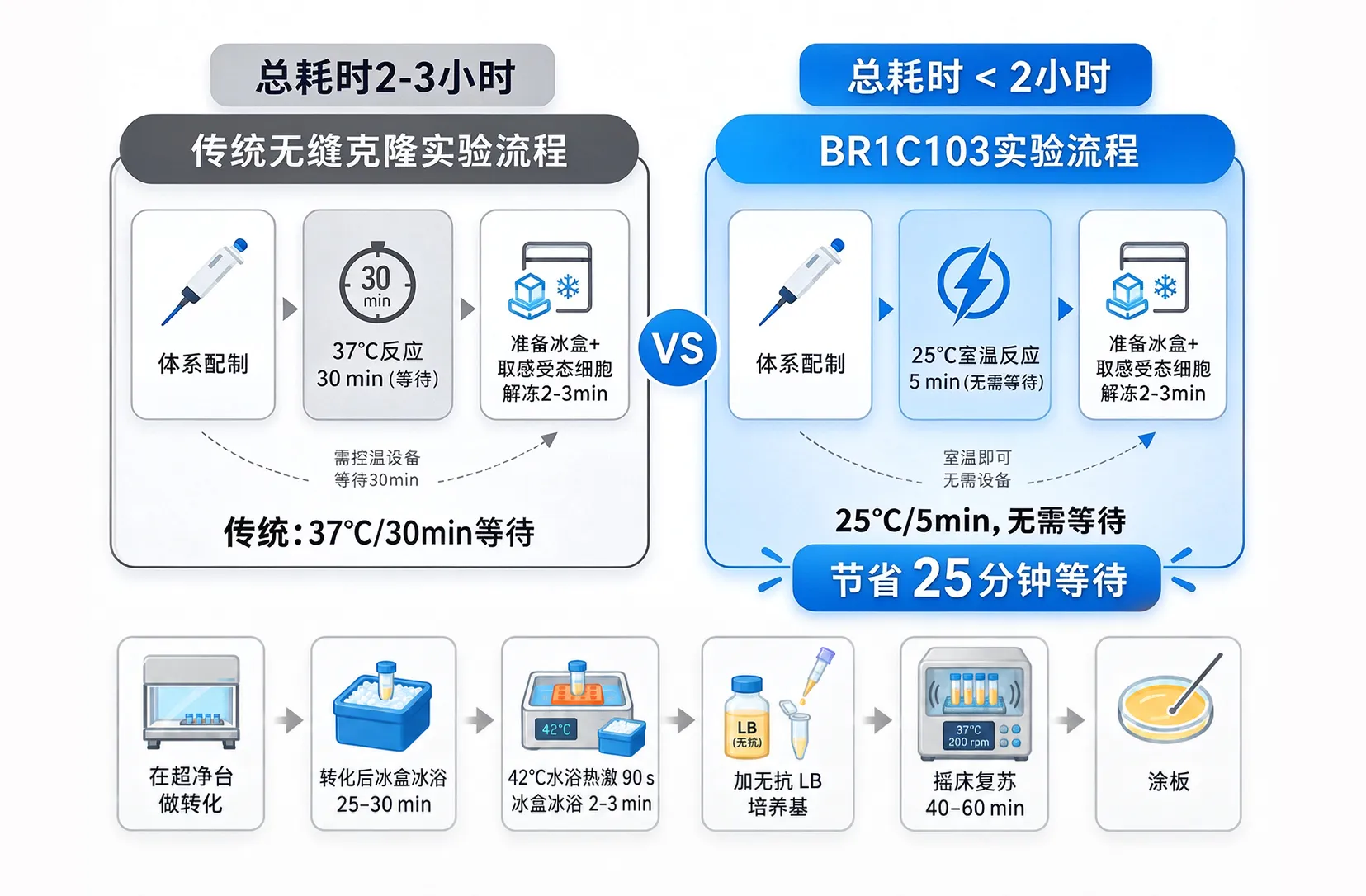
VellixClonTMAmbient Seamless Cloning Mix is a new generation of seamless cloning reagent specially designed for single-fragment directed cloning. Based on the independently developed room-temperature homologous recombinase system, the reaction can be carried out at room temperature (23-30℃), reducing the reliance of traditional seamless cloning on temperature control equipment such as PCR instruments and water baths, and allowing the cloning reaction to be directly completed on the laboratory bench.
Product features
Room temperature fast
This product is suitable for directed cloning of 0.1-10 kb fragments. Homologous recombination can be completed within 5 minutes at room temperature (23-30℃), which is significantly faster than the traditional reaction time of 30 minutes. It can complete the recombination reaction of conventional fragments in a relatively short time, greatly simplifying the cloning process.
Compatible with low investment and unpurified:
It has a wide range of applicable DNA input amounts. When the amplification product is single and there is no obvious non-specific band, it can be compatible with the unpurified PCR product, thereby simplifying the experimental steps.
Applicable to single-segment scenarios:
A new generation of seamless cloning reagent specially designed for single-fragment targeted cloning, optimized for single fragments, especially suitable for short fragments, with clear application boundaries.
Application directionFields such as rapid cloning, high-throughput cloning, seamless cloning and DNA site-directed mutagenesis.
05
What information does performance testing provide?
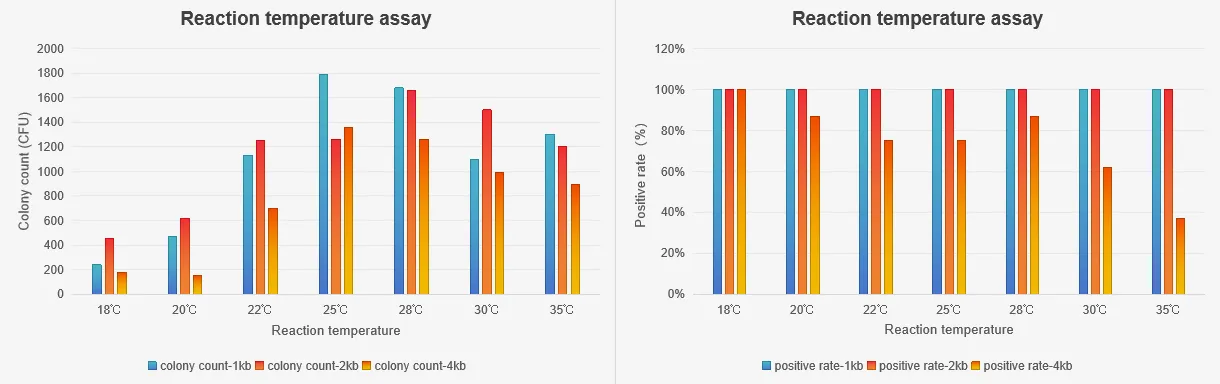
Single-fragment seamless cloning reagentBR1C103 It has a relatively wide reaction temperature range, and the reaction can occur within the room temperature range of 23℃ to 30℃. Considering the number of colonies and positive rate of different fragment lengths, 25℃ is taken as the more universal reaction temperature for this reagent.
Single-fragment seamless cloning reagentBR1C103 Single-fragment cloning of inserted fragments of different lengths can be completed under rapid reaction conditions at room temperature. The 1 kb fragment maintained efficient cloning within 5 to 30 minutes. Effective cloning results can also be obtained for 4kb and 10kb fragments in a short reaction time. Data shows that BR1C103 is suitable for rapid and seamless cloning of fragments of different lengths at room temperature.
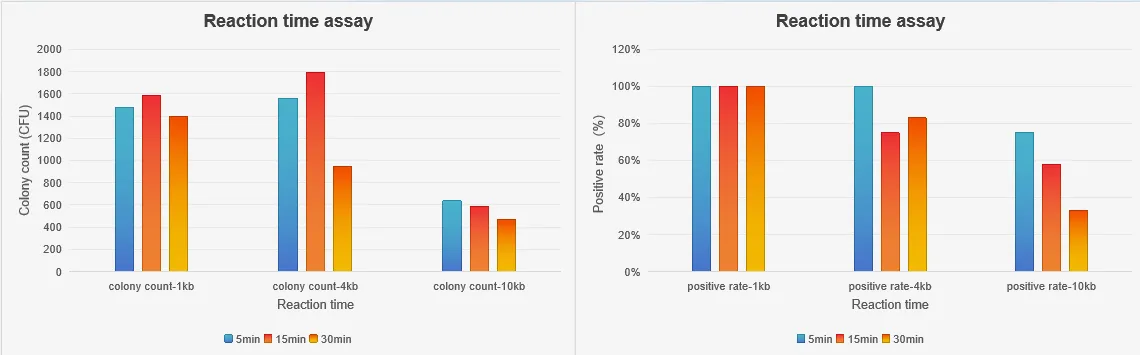
Note: The comparison of colony numbers should be based on the premise that the connection system, competent state, transformation, recovery and coating conditions are consistent. The above are the results of this test.
06
If you do well in these five points, the success rate will be more guaranteed
• Homologous arm design:
The recommended length is 15-25 bp, with a GC content of 40% - 60%. Avoid obvious repetition and stabilize the secondary structure.
• Carrier linearization:
Give priority to ensuring adequate enzymatic digestion; It is recommended to use high-fidelity enzymes during reverse PCR and reduce the background of the circular template through DpnI.
• DNA quality:
Try to obtain single, low-salt carriers and insertion fragments without ethanol residue; For low-concentration samples, it is recommended to use the fluorescence method for quantification.
• Molar ratio:
When the carrier is longer than the inserted fragment, it is recommended that the ratio of carrier to fragment be 1:2. When the carrier is shorter than the inserted fragment, a ratio of 2:1 is recommended.
• Transformation and Identification:
The volume of the recombinant product should not exceed 1/10 of the competent volume, and the results should be confirmed in combination with negative controls, colony PCR, enzyme digestion and sequencing.
Special reminder: The standard reaction temperature in the instruction manual is 25℃. Temperature gradient testing can help understand the temperature tolerance of the system, but the results of exploratory tests cannot replace the recommended conditions in the product manual.
Conclusion: Let the construction plan return to the sequence design itself
Seamless cloning shifts the focus of cloning design from "finding suitable enzyme digestion sites" to "designing correct homologous boundaries". From conventional single-fragment construction to multi-fragment pathway assembly, choosing matching products, ensuring DNA quality and following reasonable molar ratios can significantly enhance the controllability of experiments.
BR1C103 provides a clear standardized solution for single-fragment cloning aimed at being fast, flexible and having a low operational burden. When the experiment is further expanded to multi-fragment assembly, BR1C102 can be selected based on the number of fragments.
VellixClon Ambient Seamless Cloning Mix | ||
Product item number | Number of applicable fragments | Specification |
BR1C103 | Single fragment | 20T/40T/20Tx5 |
Seamless Cloning Plus Master Mix | ||
Product item number | Number of applicable fragments | Specification |
BR1C102 | Fragments 1-5 | 20T/40T/20Tx5 |
Data description
This article is compiled based on the BR1C103 product manual, product training materials, product matrix, and internal performance test results. The product is for research purposes only and not for clinical diagnosis.
0756-8699969
Address: No. 88, Shuian 1st Road, Xiangzhou District, Zhuhai City, Guangdong Province
Email: marketing@biori.com
Wechat official account |
Product consultation |
Video Account |