Article source: red red sea Super Lab
In qPCR experiments, primer design is a very important step. Whether the primers are suitable or not is closely related to whether the amplification efficiency meets the standard, whether the amplification products are specific, and whether the experimental results are usable.
Are you confused about the design of qPCR primers: How to achieve the best primer specificity? Is there any once-and-for-all solution? When designing qPCR primers, the following points are usually noted:
Primers should be designed across introns as much as possible
The product length is 100-300 bp
The TM value should be as close as possible to 60℃ and the upstream and downstream primers should be as close as possible
The primer ends are preferably G or C
The first step: Search for genes
Query the gene of Homo GAS6 through NCBI. Here, it is necessary to compare the gene names and species to ensure they are all consistent.
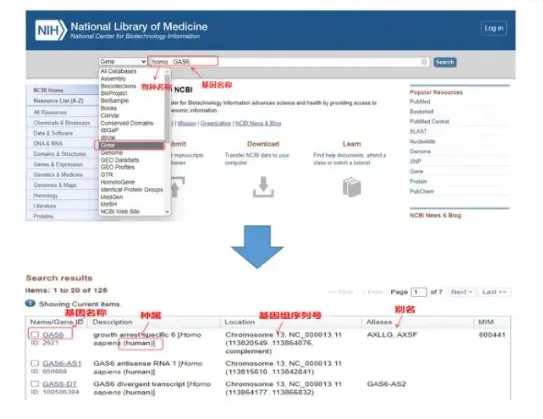
Step 2: Locate the gene sequence
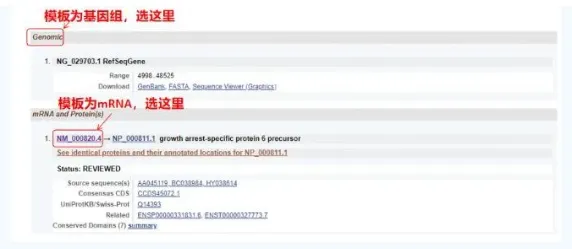
If the target sequence is genomic DNA, then select the first one, which is the genomic DNA sequence of this gene. If the target sequence is mRNA, then choose the second one.
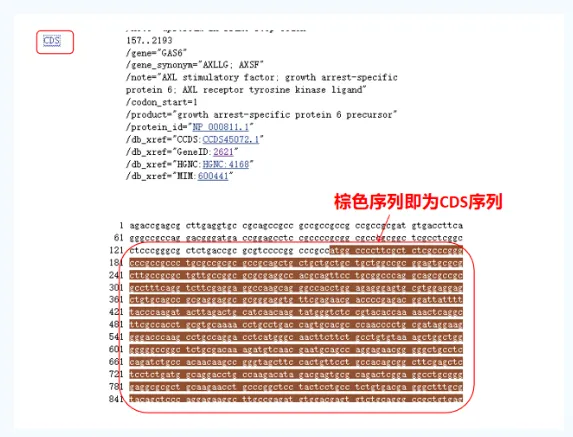
2. After entering, click on "CDS" in the table below. The sequence with a brown background is the coding sequence of this gene.
Step 3: Design primers
1. Enter the Primer-BLAST interface.
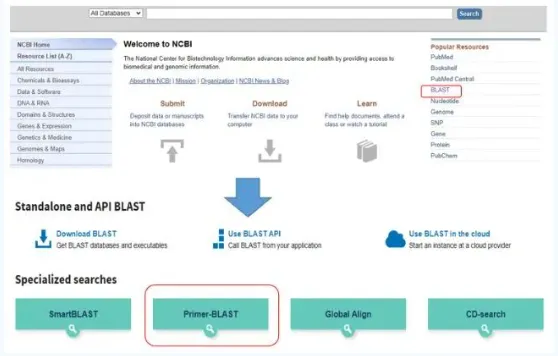
2. Enter the gene serial number or the sequence in Fasta format in the upper left corner and fill in the relevant parameters.
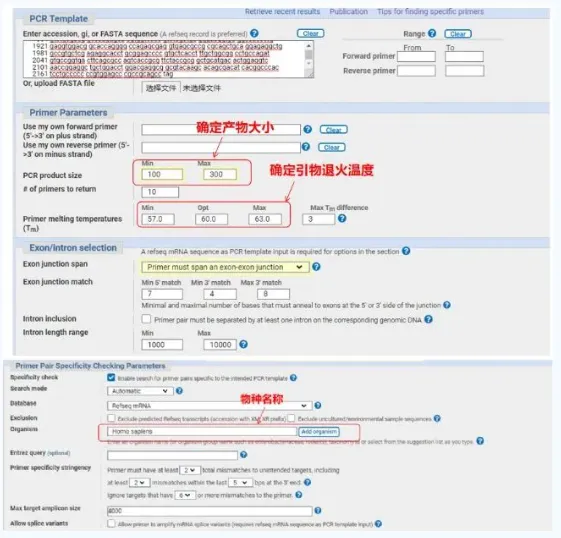
3. Click "Get primers" and NCBI will pop up to tell you that such parameter selection will be extended to other clipping variants. We select different clipping variants and submit them to obtain the appropriate primers. That's it! (As shown in the following figure
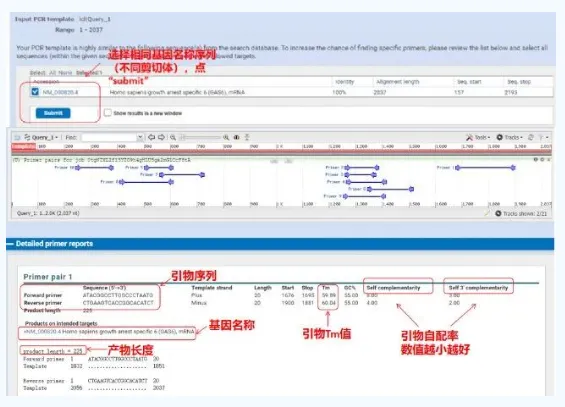
The annealing temperatures of these primer pairs are all around 60℃. According to the experimental purpose, primers with moderate length, good specificity and less self-complementarity are selected for the experiment. The success rate is still quite high!
Step 4: Primer specificity verification
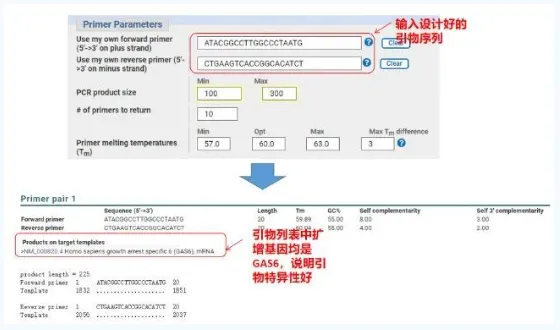
Primer-Blast can not only design primers but also evaluate the primers we have designed ourselves. Return to the primer design page, enter the upstream and downstream primers we have designed, and do not adjust other parameters. After submission, you can see whether this pair of primers also exists in other genes. If all of them are displayed in the gene we want to amplify, it indicates that the specificity of this pair of primers is excellent! (For example, the primer search result is only this one!)"
Step 5: Judgment of primer quality
What kind of primer can integrate "amplification efficiency meeting standards", "good amplification product characteristics" and "reliable experimental results"?
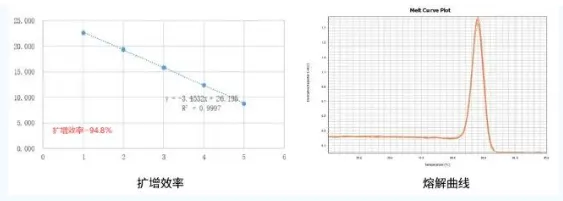
When the amplification efficiency of the primer reaches 90%-110%, it is considered to have a good amplification efficiency. If the melting curve is single-peak and Tm is usually greater than 80℃, it is considered to have good amplification specificity. It's quite simple, isn't it? Do you feel like you've bid farewell to your status as a complete novice in scientific research and instantly mastered the ultimate trick of qPCR primer design?