Article source: GMP Office
Recently, the National Standard Information Public Service Platform released the draft of the new version of GB/T 25915.3-202X "Cleanrooms and Associated Controlled Environments - Part 3: Testing Methods". After this document comes into effect, it will replace GB/T 25915.3-2010 "Cleanrooms and Associated Controlled Environments - Part 3 The "Detection Method" has the following changes compared with the old version:
a. Modify the term "discrete particle counter" to "light scattering discrete particle counter" (see 3.6.4);
b. Added the term descriptions of "controlled environment" (see 3.1.3), "resolution" (see 3.1.6), "sensitivity" (see 3.1.7), and "air volume hood with flowmeter" (see 3.6.3);
c. Removed "Large particles", "M descriptor", "U descriptor", "ultrafine particles", "standard leakage permeability", and "average air volume" Terms such as "non-isokinetic sampling", "cascade impact sampler", "coagulation nucleus counter", "counting efficiency", "differential mobility analyzer", "diffusion element", "pseudo-counting", "air volume hood", "coaxial sampling", "isokinetic sampling", "particle size limiter", "threshold particle size", "time-of-flight particle size measurement" and "virtual impactor";
d. The "Mandatory project" have been changed to "General Testing", and the specific content has been updated (see 4.1.1, 2010 Edition 4.1.1).
e. The "Optional test project" have been changed to "Supportive Tests", and the test project have been updated (see Table 2,2010 edition Table 2).
f. The air pressure difference detection (see 4.2.1, 2010 edition 4.2.3), airflow detection (see 4.2.2, 2010 edition 4.2.2), and airflow direction detection and visualization (see 4.2.3) have been modified. (2010 Edition 4.2.5), self-cleaning detection (see 4.2.4,2010 edition 4.2.9), temperature detection (see 4.2.5,2010 edition 4.2.6), humidity detection (see 4.2.6,2010 edition 4.2.6), leak detection of installed filtration systems (see 4.2.7) (2010 Edition 4.2.4), maintenance structure airtightness leakage test (see 4.2.8, 2010 Edition 4.2.10), electrostatic and ion generator test (see 4.2.9, 2010 edition 4.2.7), particle sedimentation test (see 4.2.10, 2010 edition 4.2.8);
g. The count of airborne particles has been removed (see version 4.2.1 of 2010);
h. The three major items of "Air Suspended Particle Count belonging to Cleanliness Classification and Routine Testing", "Air ultrafine Particle Count" and "air Large Particle Count" in the list of testing procedures have been deleted (see Table A.1, 2010 edition Table A.1).
i. The ten major items in the inspection procedure list, namely "Pressure Difference", "Airflow", "Airflow Direction and Visible Inspection", "Self-cleaning", "Temperature", "Humidity", "Leak Detection of Installed Filters", "Leakage Detection of Enclosure Structure Airtightness", "Electrostatic and ion Generator", and "Particle Sedimentation", have been revised (see Table A.1, 2010 edition Table A.1).
j. "Isolation testing" has been added (see Table A.1);
k. Added the "Inspection and Verification Plan" (see A.3);
l. The detection methods such as "Air Suspended Particle Count belonging to Cleanliness Classification and Routine Testing", "Air ultrafine Particle Count", "Air Large Particle Count", and "Airflow Direction Detection and visual Inspection" in the original Appendix B have been deleted.
m. The detection methods for differential pressure detection, airflow detection, self-cleaning detection, temperature detection, humidity detection, leak detection of installed filter systems, airtightness leakage test of enclosure structures, and particle sedimentation detection have been modified (see Appendix B).
n. Isolation detection methods have been added (see Appendix B.11)
o. The terms "Air Suspended Particle Count", "Ultrafine Particle Count" and "Large Particle Count" in the original Appendix C have been deleted (see Appendix C of the 2010 edition).
p. Add Appendix C: Test Instruments, Overview, which describes the basic requirements of the instruments;
q. The differential pressure detection, airflow detection, airflow direction and visualization, self-cleaning detection, temperature detection, humidity detection, leak detection of installed filtration systems, leakage detection of enclosure structure airtightness, electrostatic and ion generator detection, particle sedimentation detection, etc. have been modified (see Appendix C, 2010 Edition Appendix C).
r. Requirements for isolation test instruments have been added (see Appendix C)
The full text is as follows
Cleanrooms and related controlled environments
Part 3: Detection Methods
1 Range
This document provides testing methods that support the operation of cleanrooms and clean areas to meet air cleanliness levels, other cleanliness attributes and related control conditions.
Performance testing is aimed at cleanrooms and clean areas of unidirectional and non-unidirectional flow types under three possible occupancy states: empty state, static state and dynamic state.
This document recommends the testing instruments and procedures for determining performance parameters. Some detection methods are limited by the type of cleanroom or clean area. Therefore, this document recommends several alternative methods.
To meet the requirements of different users, this document recommends several different methods and instruments for certain detection project. If the customer and the supplier agree through consultation, other alternative methods not introduced in this section may also be used. Alternative methods may not yield the same measurement results.
This document is not applicable to the measurement of products or processes within clean rooms or isolation devices.
Note: This document is not intended to explain the safety precautions related to its use (for example, when using hazardous materials, operations and equipment).
The user of this document is responsible for formulating appropriate safety and health practices before use and determining the applicability of regulatory restrictions.
2. Normative quotationsa
This document contains no normative references.
3 Terms and Definitions
The following terms and definitions apply to this document.
3.1 General Terminology
3.1.1
cleanroom
A room in which the quantity and concentration of airborne particles are controlled and classified is designed, constructed and used in a way that can control the particles entering, being generated and stagnant within the room.
Note 1: The grades of airborne particles have been specified (3.2.4).
Note 2: The levels of other cleanliness attributes can also be specified and controlled, such as the concentrations of chemicals, microorganisms or nanoscale in the air, as well as the concentrations of particles, nanoscale, chemicals and microorganisms in terms of surface cleanliness.
Note 3: Other related material parameters can also be controlled when necessary, such as temperature, humidity, pressure, vibration and static electricity.
[Source: GB/T25915.1:20212021 21 3.1.1]
3.1.2
clean zone
The defined space where the number and concentration of airborne particles are controlled and classified, and whose design, construction and usage methods can control the particles that enter, are generated and stagger within the space.
Note 1: The grades of airborne particles have been specified (3.2.4).
Note 2: The levels of other cleanliness attributes can also be specified and controlled, such as the concentrations of chemicals, microorganisms or nanoscale in the air, as well as the concentrations of particles, nanoscale, chemicals and microorganisms in terms of surface cleanliness.
Note 3: The clean area can be a designated space within a clean room or can be achieved through isolation devices. This device can be located either inside or outside a clean room.
Note 4: Other related material parameters can also be controlled when necessary, such as temperature, humidity, pressure, vibration and static electricity.
[Source: GB/ T25915.1-2021 2021, 3.1.2]
3.1.3
Facility installation
Cleanrooms (3.1.1) or one or more clean areas (3.1.2), as well as all related structures, air handling systems, service facilities and public utilities.
[Source: GB/ T25915.1-2021, 3.1.3]
3.1.4
Separation device
A device that uses structural and dynamic methods to create reliable isolation levels within and outside a determined volume.
Note: Some industry-specific isolation devices include: clean air hoods, isolation boxes, glove boxes, isolators, and micro-environments.
[Source: GB/ T25915.7-2010 3.17]
3.1.5
resolution
The smallest measurable variable, that is, the one generated in the corresponding display. Recognizable changes.
Note 1: Factors such as noise (internal or external) or friction can determine resolution, and the measured quantity value can also determine resolution.
[Source: GB/ T25915.1-2021, 3.4.1]
3.1.6
sensitivity
The ratio of the change value indicated by the measurement system to the corresponding change value of the measured quantity.
3.2 Terms related to airborne particles
3.2.1 airborne particles
Liquid or solid active or inactive dust particles suspended in the air, ranging from 1 nm to 100 μm.
Note: For the classification of cleanliness grades, please refer to GB/ T25915.1-2021, 3.2.1.
3.2.2 count median particle diameter
CMD
The particle size value of the particle at the median when arranging particles by particle size.
Note: The particle size of half of the quantity is smaller than the median particle size of the quantity, and the particle size of the other half of the quantity is larger than the median particle size of the quantity.
3.2.3 mass median particle diameter
MMD
The particle size value of the particle at the median when arranging particles by mass.
Note: Particles accounting for half of the total mass have a particle size smaller than the median mass, while particles accounting for the other half of the mass have a particle size larger than this median mass.
3.2.4 particle concentration
The number of particles in a unit volume of air.
[Source: GB/ T25915.1-2021, 3.2.3]
3.2.5 particle size
The diameter of the sphere measured by the given particle size analyzer, which is equivalent to the response of the particle being measured.
Note: The optical equivalent diameter is provided by the light scattering discrete particle counter.
[Source: GB/ T25915.1-2021, 3.2.2]
3.2.6 particle size distribution
The functional relationship between particle concentration and particle size expressed in cumulative distribution.
[Source: GB/ T25915.1-2021, 3.2.4]
3.2.7 test aerosol
A gaseous suspension of solid and/or liquid particles with a known and controlled particle size distribution and concentration.
3.3 Terms related to air filters and filtration systems
3.3.1 aerosol Dust challenge
The process of applying the detection aerosol to the filter and the installed filtration system.
3.3.2 Leakage Limit designated leak
The maximum allowable transmittance of facility leakage agreed upon by the customer and the supplier, which can be detected by scanning with a light scattering discrete particle counter (LSAPC) or an aerosol photometer.
3.3.3 dilution system
A device that mixes aerosol with particle-free diluted air in a known volume ratio to reduce the concentration of aerosol.
3.3.4 filter system
A system composed of filters, mounting frames and other supporting devices or boxes.
3.3.5 Terminal filter final filter
The filter at the very end position before the air enters the clean room or clean area.
3.3.6 installed filter system
The filtration system that has been installed on the ceiling, side walls, devices and air ducts.
3.3.7 installed filter system leakage test
A test was conducted to confirm that the filter was installed properly, there was no bypass leakage into the facility, and that both the filter and its installation frame had no defects or leaks.
3.3.8 leak
Due to poor sealing or defects in the filtration system, contaminants leaked out, resulting in the downwind concentration exceeding the expected value.
3.3.9 scanning
The method of moving the sampling port of an aerosol photometer or a light scattering discrete particle counter through a slightly overlapping reciprocating stroke over the specified detection area to detect leaks in filters and other components.
3.4 Terms related to air flow and other physical states
3.4.1 air exchange rate
The air change rate per unit time is calculated by dividing the volume of air delivered per unit time by the volume of the clean room or clean area.
3.4.2 measuring plane
A cross-section used for detecting or measuring performance parameters such as wind speed.
3.4.3 non-unidirectional airflow
The air distribution in a cleanroom or clean area where the supply air is mixed with the indoor air in an induced manner.
[Source: GB/ T25915.1-2021, 3.2.8]
3.4.4 supply Air rate
The amount of air entering the clean room or clean area from the terminal filter or air duct within a unit of time
3.4.5 总风量 total air volume flow rate
The volume of air passing through a cleanroom or clean area within a unit of time
3.4.6 unidirectional airflow
A controlled airflow with stable and parallel wind speed passing through the entire cross-section of a cleanroom or clean area.
[Source: GB/ T25915.1-2021, 3.2.7]
3.4.7 airflow uniformity uniformity of airflow
The percentage of wind speed values (velocity and direction) at each point of unidirectional flow within the specified average airflow velocity.
3.5 Terms related to electrostatic measurement
3.5.1 discharge time
The time required for the voltage (positive or negative) on the insulated conductive monitoring board to drop to the initial voltage.
3.5.2 Compensation voltage offset voltage
The voltage accumulated on an uncharged insulating conductive plate when it is placed in ionized air.
3.5.3 Electrostatic Dissipation property: static-dissipative property
The ability to reduce the static charge on the working surface or product surface to a specified value or nominal zero charge by conduction or other mechanisms.
3.5.4 surface voltage level
The positive or negative electrostatic voltage measured on the working surface or product surface by an applicable instrument.
3.6 Terms related to measuring instruments and measuring conditions
3.6.1 aerosol generator
A device capable of generating particulate matter with an appropriate size range (e.g., 0.05 micrometers to 2 micrometers) at a constant concentration, which can be produced by thermal, hydraulic, pneumatic, ultrasonic or electrostatic methods.
3.6.2 aerosol photometer
theAn instrument for measuring the mass concentration of airborne particles based on the principle of light scattering and using a forward scattering light cavity.
3.6.3风量罩 airflow capture hood with measuring device
A device that can fully cover filters or air diffusers and collect air for direct measurement of air volume flow. 3.6.4 light scattering airborne particle counter (LSAPC
An instrument that counts and measures the diameter of individual particles in the air based on their optical equivalent diameters.
Note 1: GB/T 29024.4-2017 provides the specification of LSAPC.
[Source: GB/ T25915.1-2021, 3.5.1, Revised]
3.6.5 witness plate
A material with a specified surface area that serves as a substitute for the surface to be measured when a specific surface is inaccessible or too sensitive to treatment to be directly measured.
3.7 Terms related to occupancy status
3.7.1 Empty as-built
The condition where all service facilities in a cleanroom or clean area are in place and in operation, but there are no equipment, furniture, materials or personnel.
Source: GB/T25915.1 -"March 3.1, 2021
3.7.2 Static at-rest
The state where a cleanroom or clean area is completed, the equipment is in place, and it operates in the agreed manner, but no personnel are present.
[Source: GB/ T25915.1-2021, 3.3.2]
3.7.3 Dynamic operational
The state in which the facilities of a cleanroom or clean area operate in the prescribed manner and a prescribed number of personnel work in the agreed manner.
[Source: GB/ T25915.1-2021, 3.3.3]
4 Testing Procedures
4.1 Cleanroom testing
4.1.1 General Testing
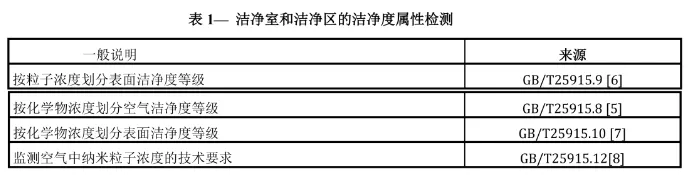
The concentration of air particles in cleanrooms or clean areas should be classified in accordance with GB/T25915.1[1]. If necessary, other cleanliness attributes should be selected (see Table 1).
Note: Each standard includes test method specifications based on specific attribute characteristics, test data evaluation guidelines, and test instrument specifications.
4.1.2 Supportive Testing
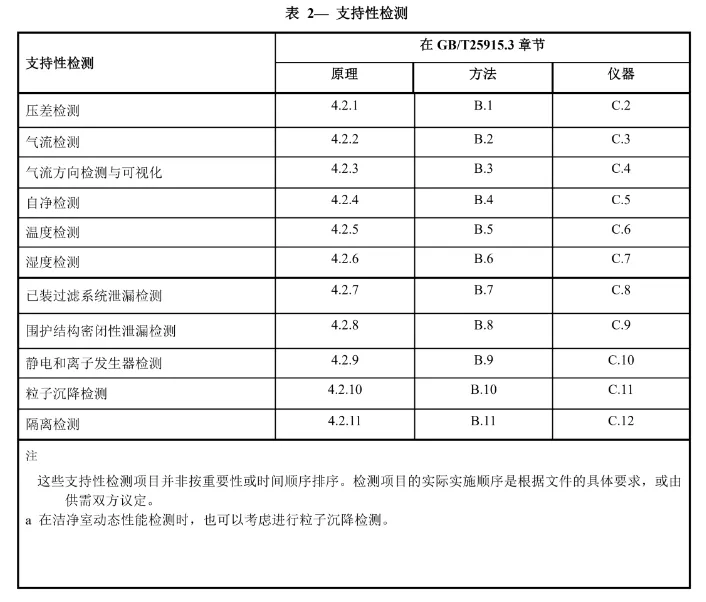
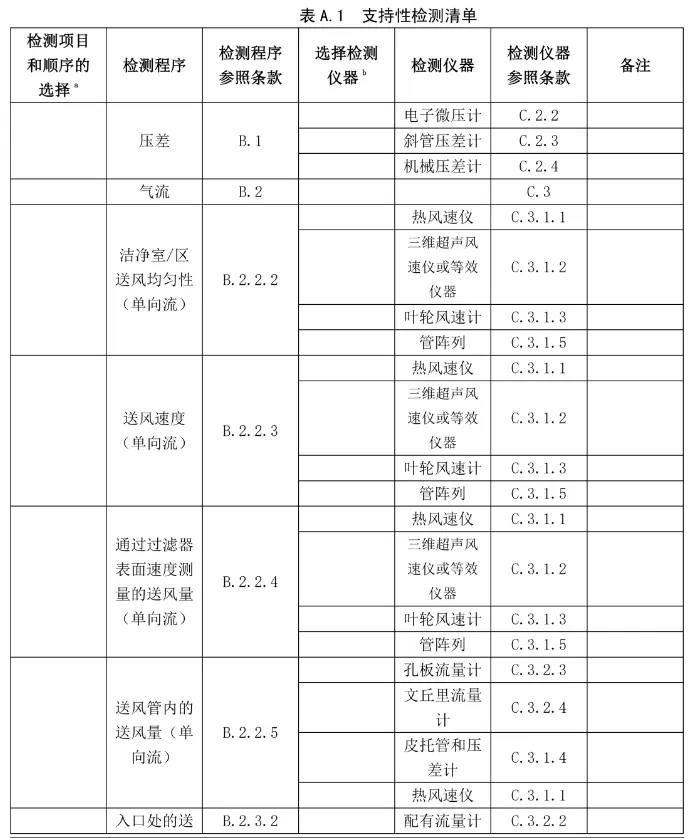
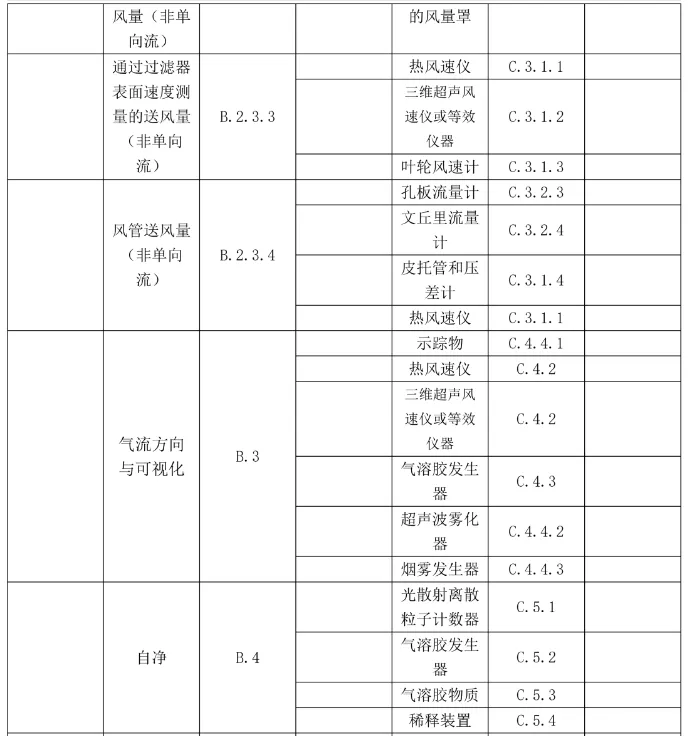
Table 2 lists other applicable test project that can be used to measure the performance of cleanroom or cleanarea equipment. These detections can be carried out in each of the three specified occupancy states. The suggested applications are detailed in Appendix B. These tests may not include all tests, nor may they require all tests for any specified project. The detection and detection methods should be selected in the manner agreed upon by the customer and the supplier. The selected tests can also be repeated regularly as part of routine monitoring or regular tests. The test selection guide and test list are presented in Appendix A. The detection method is shown in Appendix B.
Note: The testing methods described in Appendix B are only in outline form. Specific methods can be developed to meet the needs of particular applications.
4.2 Principles
4.2.1 Differential Pressure detection
The purpose of differential pressure detection is to verify the ability of the cleanroom system to maintain the specified differential pressure between its facilities and the surrounding environment. The differential pressure test is carried out after the completion of the following work: the air velocity or volume, air flow uniformity and other applicable test project in the clean room have met the acceptance criteria. For a detailed introduction to differential pressure detection, please refer to B.1.
4.2.2 Airflow Detection
This test is used to measure the supply air flow in unidirectional and non-unidirectional cleanrooms or clean areas. In unidirectional flow, the supply air velocity can be measured using a single-point reading, thereby measuring the flow velocity and determining the uniformity of the flow velocity. The average value of the single-point flow velocity readings can be used to calculate the supply air volume and the air change rate (the number of air changes per hour). In non-unidirectional flow, it is usually not necessary to measure the wind speed at a single point because uniform flow velocity is typically not required. In this case, the air volume can be directly measured and then used to calculate the air change rate (the number of air changes per hour) in the clean room or clean area. The airflow detection procedure is described in B.2.
4.2.3 Airflow Direction Detection and Visualization
This test aims to prove that the uniformity of the airflow direction and flow rate meets the design and performance requirements. The airflow direction test can be conducted under static conditions to determine the airflow pattern of the cleanroom foundation, or it can be repeated under dynamic conditions simulating actual operations. The detection method is shown in B.3.
4.2.4 Self-cleaning time detection
Self-cleaning time testing aims to determine the ability of a cleanroom/area to return to the specified cleanliness level within a limited time after short-term exposure to air-suspended particle challenge sources. Unidirectional flow systems are not recommended for testing. The test procedure is shown in B.4. If artificial aerosols are used, the risk of residual contamination in the clean room/area should be taken into consideration.
4.2.5 Temperature detection
This test aims to verify that the air temperature level in the area to be tested is within the controlled range during the time period specified by the customer. The test procedure is shown in B.5 Test.
4.2.6 Humidity detection
This test aims to verify that the air humidity (expressed as relative humidity or dew point) level in the area to be tested is within the controlled range during the time period specified by the customer. The test procedure is shown in B.6.
4.2.7 Leakage detection of installed filtration systems
This test aims to verify that there is no bypass leakage in the cleanroom facilities and that the filters have no defects (small holes, damage on the filter material and frame, and leakage on the filter frame), thereby confirming that the terminal high-efficiency filters are installed properly. This test does not examine the filtration efficiency of the system. Detection is carried out by introducing aerosol challenges upstream of the filter and scanning downstream of the filter and support frame, or by sampling in the downstream pipeline. The leakage detection method is described in B.7.
4.2.8 Leakage detection of enclosure structure airtightness
This test aims to determine whether unfiltered air has invaded the cleanroom/area from outside the cleanroom/area through joints, seams, door gaps and pressurized ceilings. The detection procedure is shown in B.8.
4.2.9 Detection of electrostatic and ion generators
This test aims to evaluate the electrostatic voltage of objects, the electrostatic dissipation characteristics of materials, and the performance of ion generators (i.e. Ionizers) used for electrostatic control in clean rooms or clean areas. Electrostatic detection aims to evaluate the electrostatic voltage on the working surface and product surface, as well as the electrostatic dissipation characteristics of the floor, workbench surface, etc. Ion generator testing aims to evaluate the performance of ion generators in eliminating surface static electricity. The testing procedure is shown in B.9.
4.2.10 Particle sedimentation detection
This test aims to verify the quantity and size of particles that settle on the surface from the cleanroom air within the specified time. The procedure for this test is described in B.10.
4.2.11 Detection isolation detection
This test is designed to evaluate the isolation effectiveness of the specified airflow. The detection uses particles to challenge the lower-level area and determine the particle concentration in the protected area on the other side of the partition. The testing procedure is shown in B.11.
5 Test Report
Each test result should be recorded in the test report. The test report should contain the following information:
a) The name, address and testing date of the testing institution;
b) The number and promulgation year of this part, namely GB/T25915.3: [The year of the current version];
c) Clearly indicate the specific location of the cleanroom or clean area to be measured (refer to the adjacent area if necessary), and mark the specific coordinates of all sampling points;
d) Standards specified for cleanrooms or clean areas, including ISO grades, corresponding occupancy status, and particle size of concern;
e) Detailed description of the testing methods used, including special testing conditions and deviations from the prescribed testing methods; The specification and model of the testing instrument, and the latest calibration certificate of the instrument;
f) Test results, including the report data required in the relevant items of Appendix B, as well as explanations of meeting the requirements;
g) Other specific requirements related to the items in Appendix B for specific test project.
Appendix A
(Informative
Support the selection of detection and forms
A.1 Overview
Special attention should be paid to the testing sequence of the performance of cleanrooms, clean areas or controlled areas.
The project and the sequence of inspection should be agreed upon by the customer and the supplier. Non-conformities should be detected as early as possible and should not affect subsequent other inspections.
A.2 Inspection List
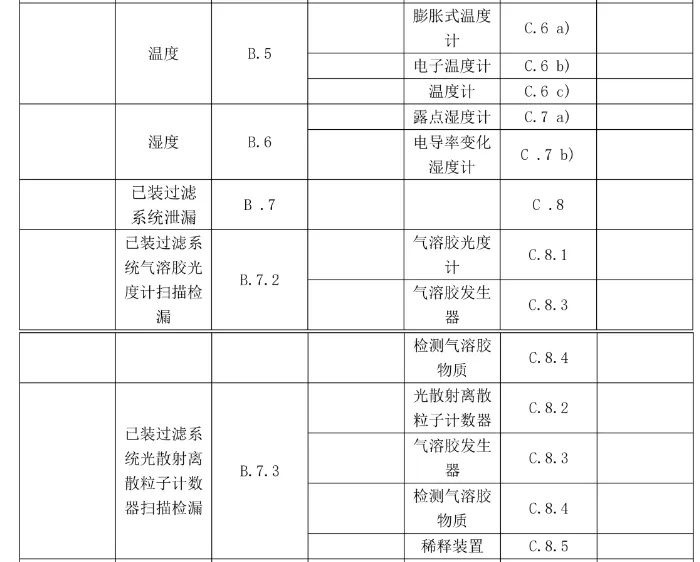
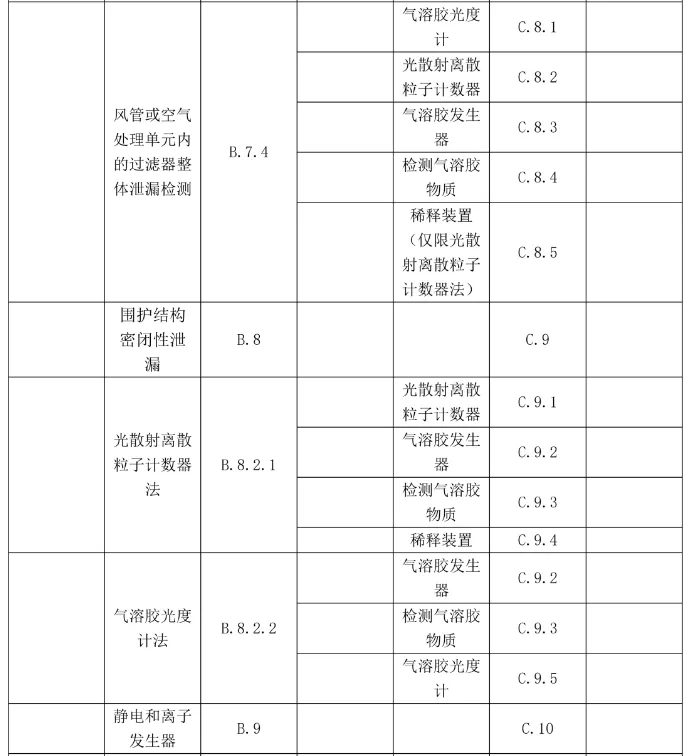
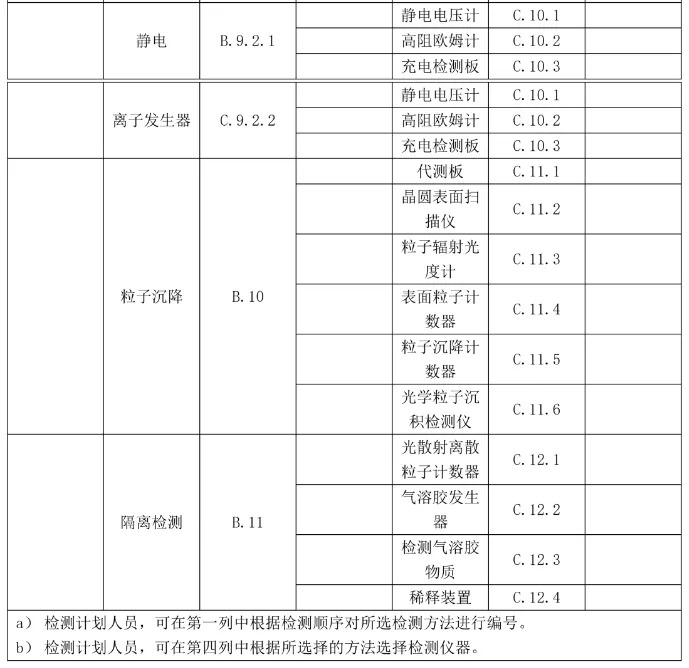
A.3 Inspection and Verification Plan
At least tests should be conducted:
a) Classify in accordance with GB/T 25915.1(ISO14644-1);
b) Verification should be carried out during the start-up period;
c) Verify after confirming and correcting the fault;
d) Verify after debugging;
e) During the regular testing period.
A risk assessment should be conducted to determine the cycle of regular testing.
The detection cycle of the selected detection should be confirmed based on the monitoring data, trends and detection results. It can be adjusted if necessary.

0756-8699969
Address: No. 88, Shuian 1st Road, Nanping Science and Technology Park, Xiangzhou District, Zhuhai City, Guangdong Province
Email: marketing@biori.com
Wechat official account |
Product consultation |
Join us |
Video Account |