Plasmids are circular double-stranded DNA molecules in microorganisms such as bacteria and yeast, which can replicate independently and carry certain specific genes. These genes are usually related to the survival, reproduction and certain special functions of cells, such as antibiotic resistance. In genetic engineering, plasmid vectors are commonly used to introduce target genes into recipient cells. The structure of plasmids typically includes replication initiation sites (ori), resistance genes, and sometimes transfer genes, etc.
It is mentioned in "Research on Quality Control Testing of CAR-T Cell Therapy Products and Key Considerations for Non-clinical Research" that the quality control of purified viral vectors usually refers to the requirements of gene therapy products with viral vectors as the final product. One of the main quality control project is the detection of plasmid DNA residue. In the "Technical Guidelines for Pharmaceutical Research and Evaluation of In Vivo Gene Therapy Products (Trial)", it is mentioned that process-related impurities are mainly introduced by the production process, such as packaged plasmids, etc. The impurity removal performance of the production process and the residual level of impurities should be studied. It is mentioned in the "Technical Guidelines for Pharmaceutical Research and Evaluation of In Vitro Gene Modification Systems (Trial)" that residual impurities (such as plasmid DNA) should be effectively removed to a level lower than the quality standard range or the level verified through research.

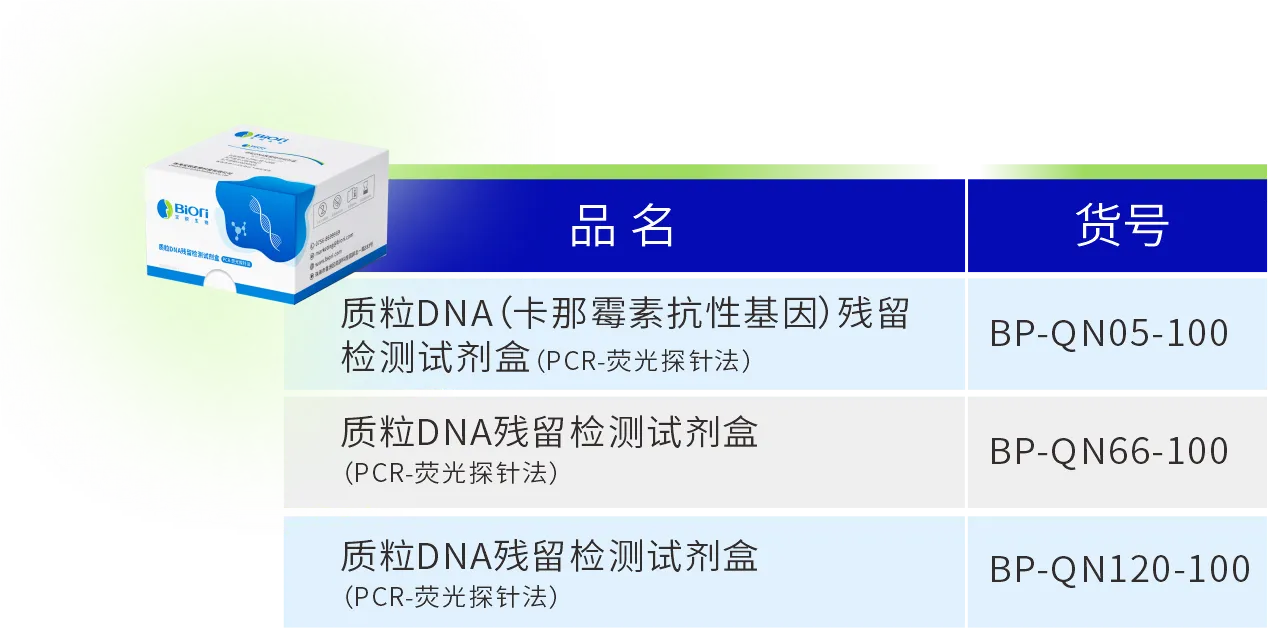
The Baorui Biomass Pellet DNA Residue Detection Kit adopts the PCR-fluorescence probe method. Primer probes are designed for the common sequences derived from plasmids. The calibrators of the kit are ready-to-use calibrators that have been calibrated by digital PCR technology and do not require dilution before use. Baorui Biotech offers two types of kits to choose from: one based on the kanamycin resistance gene for designing primer probes, and the other based on the plasmid replication start site for designing primer probes. Both of these kits have the following features:
Good precision
Repeatability (intra-analytical precision), intermediate precision (inter-instrument, inter-day, inter-personnel, inter-reagent batch) and reproducibility (total imprecision), the quantification limit CV≤20%, and the CV≤15% for medium and high concentrations.
Seven genomes, namely BHK21, CHO, SP2/0, VERO, Escherichia coli, Pichia pastoris and MDCK, do not interfere with this kit.Convenient and fast operationSingle-tube PCR reagents are easy to access and do not require preparation when in use.2. Calibrators do not need to be diluted, and the finished products can be assembled conveniently and quickly.From sample extraction to the completion of the test, it takes less than 2 hours.The UDG enzyme anti-contamination system is adopted to effectively avoid the risk of contamination of amplification products.
Freeze-thaw stability: The performance of the reagent remains unaffected after being repeatedly freeze-thawed 3 times, 5 times, 7 times, and 10 times.
2. Instrument applicability: The performance is not affected on different models of equipment such as ABI 7500, ABl QuantStudio™ 5, Bio-Rad CFX96, SLAN-96P, SLAN-96S, and Roche Light cycler 480 Ⅱ.
References
Research on Quality Control Testing of CAR-T Cell Therapy Products and Key Considerations for Non-clinical Research
2. Technical Guidelines for Pharmaceutical Research and Evaluation of Gene Therapy Products in Vivo (Trial)
3. Technical Guidelines for Pharmaceutical Research and Evaluation of In Vitro Gene Modification Systems (Trial)