
The concept of RNase
Ribonuclesae (RNase) are a type of nuclease that catalyzes the degradation of RNA into small fragments. The RNase family includes RNase A, RNase B, RNase C, RNase H, S-RNase, RNase P, RNase T, etc. Among them, RNaseA is a widely used endonuclease. Rnase A efficiently and specifically catalyzes the cleavage of phosphodiester bonds on the single-stranded RNA chain skeleton at the 3' ends of pyrimidine nucleotide residues C and U, forming oligonucleotides with 2', 3' -cyclic phosphate derivatives.
The hazards of RNase contamination
Ribonuclease is similar to deoxyribonuclease (DNase) and is widely present in experimental environments. From the experimental operations and laboratory environments in the research and development stage to the commercial reagents and biochemical preparations in the production stage, RNase contamination is highly likely to occur. Therefore, monitoring the activity of ribonuclease is a routine quality control (QC) step.
RNase detection method
At present, common RNase residue detection methods mainly include radioactive isotope method, spectrophotometry, fluorescence quenching method, electrochemical method, etc. Spectrophotometry has the disadvantages of low detection sensitivity and being unsuitable for the activity detection of trace amounts of nuclease residues. Electrochemical method is limited by the instrument and equipment. In contrast, The fluorescence probe method is highly sensitive, has a fast detection speed and can achieve quantitative detection of nuclease activity. Therefore, it is regarded as one of the best choices for detecting residual nuclease activity.Baorui Biology independently developed a product based on the fluorescent probe methodThe RNase residue detection kit can be used to detect the RNase residue in the environment, consumables and raw materials, providing important data references for related quality inspections.
The principle of RNase residue detection
RNase substrate is a synthetic RNA oligonucleotide probe, with a FAM Fluorophore, also known as the Donor, at one end and a TAMRA Quencher, also known as the Acceptor, at the other end. The absorption spectra of these two groups have a certain overlap. When the distance between these two fluorescent groups is appropriate, the fluorescence energy is transferred from the donor to the acceptor, resulting in the attenuation of the fluorescence intensity of the donor's fluorescent molecule itself. When the substrate is cleaved by RNase, the two ends of the substrate are separated, and the two groups are separated. The fluorescence of FAM is no longer quenched by TAMRA, and the fluorescence of FAM can be detected. The increase rate of the fluorescence signal is positively correlated with the quantity and activity of the enzyme.Use a fluorescence microplate reader inex/em =49Measurement at a wavelength of 0/520nm(RNase) can determine whether the sample is contaminated with RNase. Thus, the enzymatic activity of nucleases can be detected very sensitively through fluorescence detection.
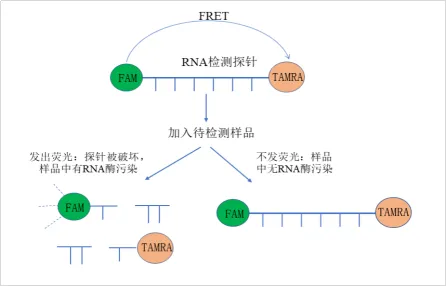
Figure 1 shows the detection principle diagram of the Baorui RNase nuclease Residue Detection Kit
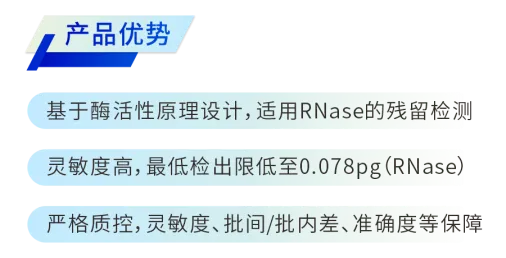

It has been verified that the sensitivity of this reagent can reach 0.078pg.
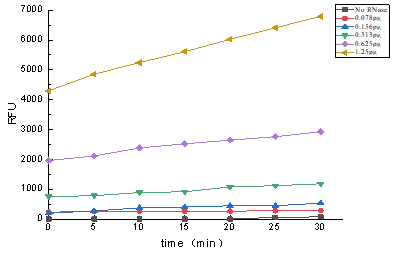
Figure 2. Sensitivity detection effect of the Baorui RNase Residue Detection Kit

It has been verified that RNase A has A good linear relationship within the range of 0-10pg, with R²>0.99. The activity of RNase A in the sample can be calculated by setting a standard curve. The detection results of RNase A enzyme using this kit are shown in Figure 4.
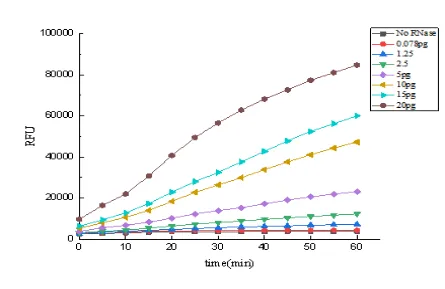
Figure 3. Fluorescence intensity changes of different amounts of RNase A detected by this kit within 60 minutes
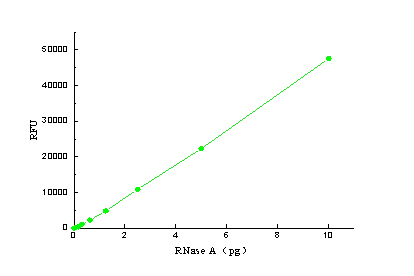
Figure 4. Detection effect of the Baorui RNase Residue Detection Kit on the RNase A standard

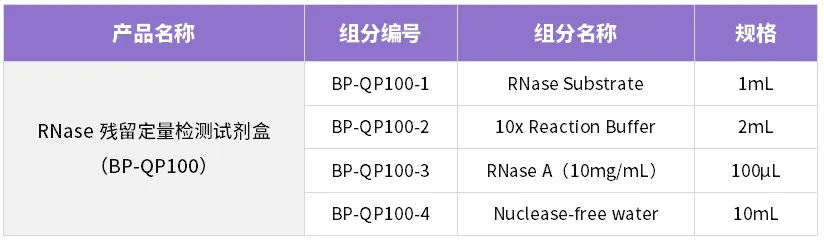

Scan the QR code to apply for a trial