Robustart Taq QS Ⅱ is a hot-start rapid amplification Taq enzyme product developed by our company. This product not only can better suppress the non-specific reactions caused by the non-specific annealing of primers or primer polymers during the preparation and amplification of PCR systems, but also has excellent specificity, making it more effective for the amplification of low-concentration templates and suitable for multiplex PCR amplification reactions. Moreover, this product has excellent system applicability and can achieve stable amplification effects in various types of PCR reactions.


1.5 U/µL Robustart Taq QS Ⅱ
2.10×PCR Buffer Ⅱ (Mg2+ free (Optional)
3.25 mM MgCl₂(Optional
*10×PCR Buffer Ⅱ (Mg2+free of dNTP and Mg2+When preparing the reaction system, please add dNTPs and MgCl₂Use.

Antibody modification, 95℃, hot start for 1-5 minutes.
2. Fast amplification speed, no less than 1kb per 10 seconds.
3. It has strong tolerance to inhibitors from sources such as blood and swabs.

Endpoint method, quantitative PCR.
2. Rapid amplification, direct amplification, and nucleic acid testing POCT applications.
1. Accelerate stability testing
Experimental conditions
Product item number | E20 |
Reaction system | Triple detection system for total human RNA |
Template concentration | 23.2pg/μL;2.32pg/μL;0.232pg/μL; |
Reaction procedure | 50℃ 15min;95℃ 1min;50 Cycles(95℃ 15s,56℃ 45s) |
Experimental results
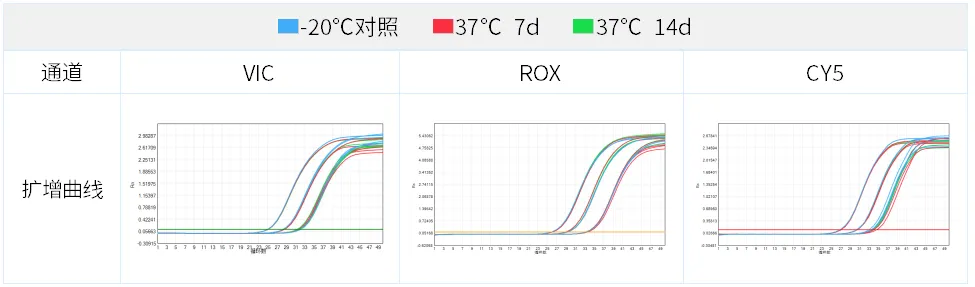
Test method: After accelerating the single enzyme at 37℃ for 7 days and 14 days, the experimental group stored at -20±5℃ was used as the control group, and the comparative test was conducted in the MD2084-4 system.
Summary: After being accelerated at 37 ° C for 7 days and 14 days, the amplification performance of single-enzyme E20 was consistent with that of the unaccelerated reagent and could remain stable.
2. Freeze-thaw stability test
Experimental conditions
Product item number | E20 |
Reaction system | Triple detection system for total human RNA |
Template concentration | 23.2pg/μL;2.32pg/μL;0.232pg/μL; |
Reaction procedure | 50℃ 15min;95℃ 1min;50 Cycles(95℃ 15s,56℃ 45s) |
Experimental results
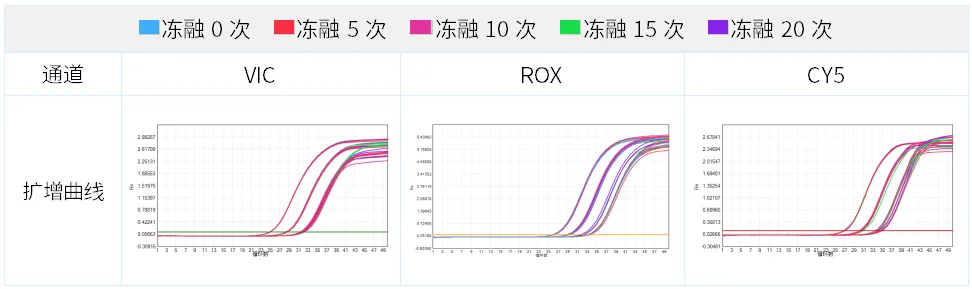
Test method: The single enzyme was frozen and thawed 5, 10, 15, and 20 times. With 0 times of freezing and thawing as the control, amplification tests were conducted in the MD2084-4 system.
Summary: After being frozen and thawed 5, 10, 15, and 20 times, the amplification performance of single-enzyme E20 was consistent with that of unfrozen and thawed reagents and could remain stable.
3. Transportation stability test
Experimental conditions
Product item number | E20 |
Reaction system | HBV-MLN detection system |
Template concentration | 50 IU/mL,2T;1000 IU/mL,2T;10000 IU/mL,4T;10μl/T。 |
Reaction procedure | 50℃ 2min;95℃ 5min;50 Cycles(95℃ 10s,55℃ 40s) |
Experimental results
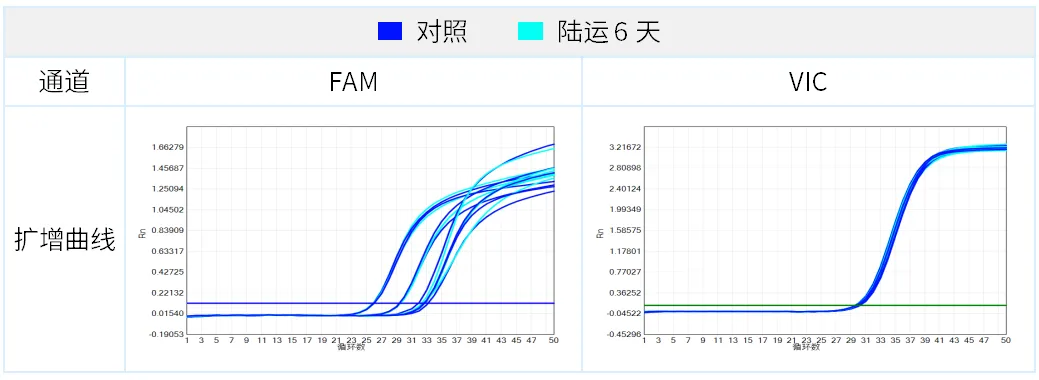
Test method: Pack the single enzyme in accordance with the "TS-OS4001 Finished Product Delivery and Packaging Operation Instruction Manual". Transport it by land for 6 days in a sealed state with 11 ice packs and foam boxes. Use the samples stored at -20±5℃ as the control to test whether there are any functional differences.
Summary: After being transported by land for 6 days, the amplification performance of single-enzyme E20 was consistent with that of samples stored at -20±5℃, and it could remain stable.
4. Closed/hot start effect
Experimental results
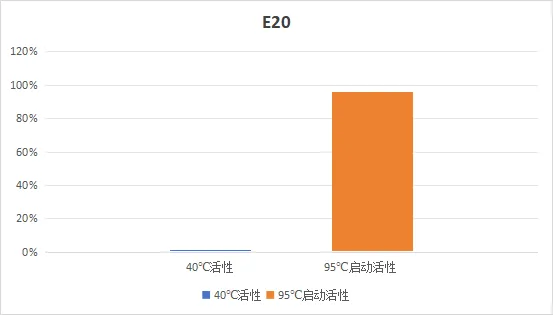
Summary: The activity of E20 is blocked at 40℃ and can be basically completely released at 95℃.