Fast Direct Premix-UNG (Probe qPCR) is a dedicated reagent specifically designed to bypass the nucleic acid extraction and purification steps of the sample and directly conduct fluorescence quantitative (probe method) DNA amplification detection of the target gene. It contains DNA polymerase that has been genetically modified and screened for rapid amplification. The PCR reaction can be completed within 30 minutes.
This product has a strong tolerance to inhibitors and can be used for direct DNA amplification detection of anticoagulated whole blood, plasma, serum, throat swabs and other samples without DNA extraction and purification. In addition, this reagent adopts an optimized formula of qPCR dedicated Buffer and UNG/dUTP anti-contamination system, which can effectively prevent false positive amplification caused by residual PCR products and aerosol contamination.


2×Fast Direct Premix-UNG (Probe qPCR)
This reagent already contains hot start enzyme, UNG, PCR Buffer and MgCl2Ingredients such as dNTPs and stabilizers.

Antibody modification, 95℃, hot start for 1 to 5 minutes.
2. It supports the mixing of primers, probes and reagents in one tube to maintain good stability.
3. It has excellent tolerance to inhibitors from sample sources such as blood, swabs, and tissue homogenates, and the direct sample addition ratio is completeblood≤5%,blood"PulpbloodClear ≤30%.

Detection of DNA viruses related to humans and animals.
2. POCT application scenarios.
1. Plant starch direct expansion test -1
Experimental conditions
Product | MD2071 |
"Template | Corn starch |
Template increment | 5μL/T |
Program | 50℃ 2min;95℃ 5min;50 Cycles(95℃ 10s,55℃ 40s) |
Sample processing: Dissolve 1g of corn starch in 2 mL of DNA protective solution, shake and mix well for 10 minutes, then centrifuge at 9000r/min for 4 minutes.
Extraction template: Take 200μl of the supernatant and extract it using a magnetic bead extraction kit. Elute with 80μl and add 5μl/T of sample.
Direct expansion template: Take 20μl of the supernatant and mix it evenly with 60μl of ddH2O, then directly add the sample. The sample addition volume is 5μl/T.
Experimental results
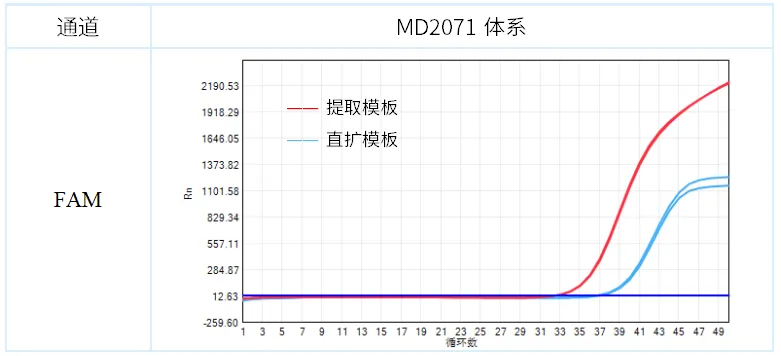
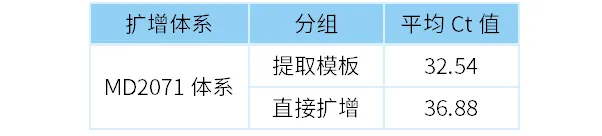
Summary: In this test, compared with direct amplification, the sample amount added per reaction template of the extracted template is 10 times that of the latter. Theoretically, the difference in Ct values should be 3.3, but in reality, it is 4.34. Note: The Baorui MD2071 product can be used for the direct amplification of corn starch.
2. Oral swab direct expansion test -2
Experimental conditions
Product | MD2071-X |
"Template | Oral swab |
Template increment | 5µl/T, 10µl/T, each 3T |
Program | 50℃ 2min;95℃ 5min;50 Cycles(95℃ 10s,55℃ 40s) |
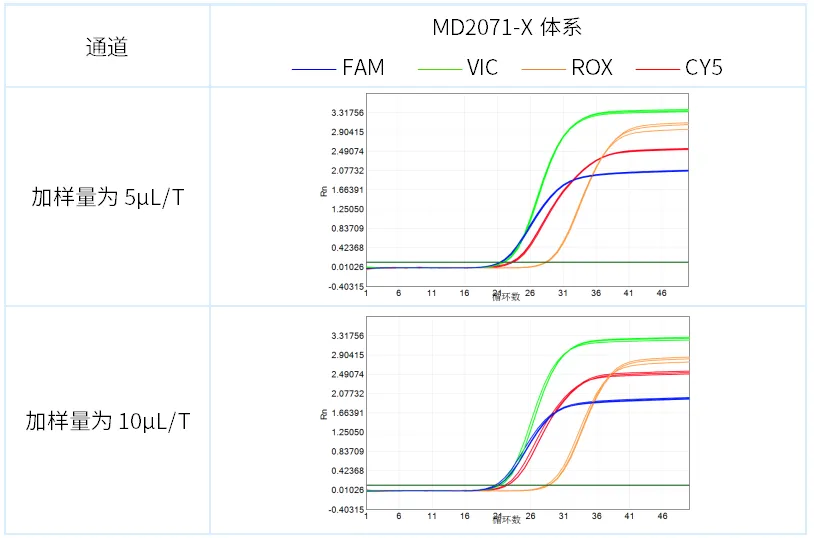
Sample processing: Scrape the left and right sides of the inner wall of the oral cavity 10 times with a cotton swab, then elute in 1 mL H2O, centrifuge at 2500 r/min for 10 minutes, remove the supernatant, leaving approximately 100 μL, mix well and directly add the sample, with the sample addition amounts being 5 μL and 10 μL/T respectively.
Experimental results
Summary: The MD2071-X system can directly amplify oral swabs, with normal Ct values and a good amplification curve.
3. Stability test of fully premixed DNA single tubes at room temperature for 1 meter
Experimental conditions
Product | MD2071-X |
"Template | DNA quadruple detection system |
Template increment | 0.025ng/μL;0.0025ng/uL |
Program | 50℃ 2min;95℃ 5min;50 Cycles(95℃ 10s,55℃ 40s) |
Experimental results
Summary: The MD2071-X(including DNA quadruple priming) fully premixed reagent has good single-tube stability when stored at room temperature for one month.