Ribonuclease (RNase) is a type of nuclease that catalyzes the degradation of RNA into small fragments. The RNase family includes RNase A, RNase B, RNase C, RNase H, S-RNase, RNase P, RNase T, etc. Among them, RNase A is A widely used endonuclease. RNase A efficiently and specifically catalyzes the cleavage of phosphodiester bonds on the single-stranded RNA skeleton at the 3' ends of pyrimidine nucleotide residues C and U, forming oligonucleotides with 2', 3' -cyclic phosphate derivatives. At present, common RNase residue detection methods mainly include radioisotope method, spectrophotometry, fluorescence quenching method and electrochemical method, etc.
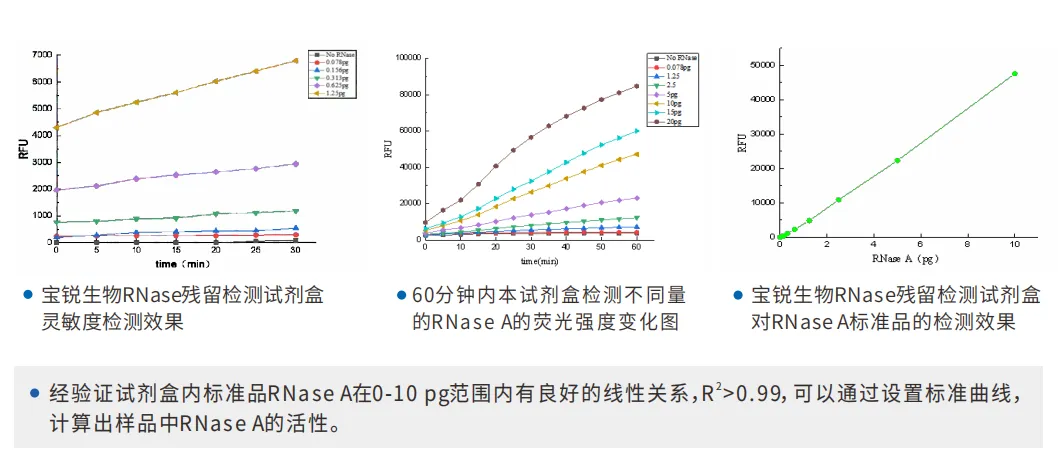
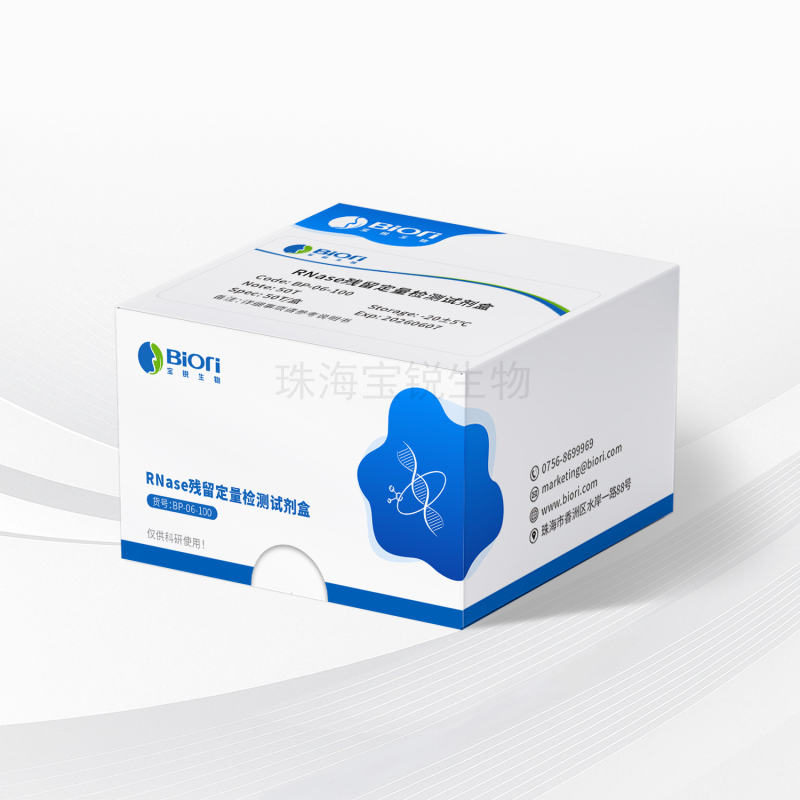
The RNase residue quantitative detection kit developed by Baorui Biotechnology is a kit that uses fluorescence to rapidly and highly sensitively detect the activity of RNaseA. It has high sensitivity and a minimum detection limit as low as 0.078pg of RNase. The substrate is a synthetic RNA oligonucleotide probe, with a FAM Fluorophore, also known as the Donor, at one end and a TAMRA Quencher, also known as the Acceptor, at the other end. The absorption spectra of these two groups have a certain overlap. When the distance between these two fluorescent groups is appropriate, the fluorescence energy is transferred from the donor to the acceptor, resulting in the attenuation of the fluorescence intensity of the donor's fluorescent molecule itself. When the substrate is cleaved by RNase, the two ends of the substrate are separated, and the two groups are separated. The fluorescence of FAM is no longer quenched by TAMRA, and the fluorescence of FAM can be detected. The increase rate of the fluorescence signal is positively correlated with the quantity and activity of the enzyme.


0756-8699969
Address: No. 88, Shuian 1st Road, Xiangzhou District, Zhuhai City, Guangdong Province
Email: marketing@biori.com
Wechat official account |
Product consultation |
Video Account |