T4 DNA polymerase
Strong proofreading active template-dependent polymerase empowers high-precision nucleic acid operations
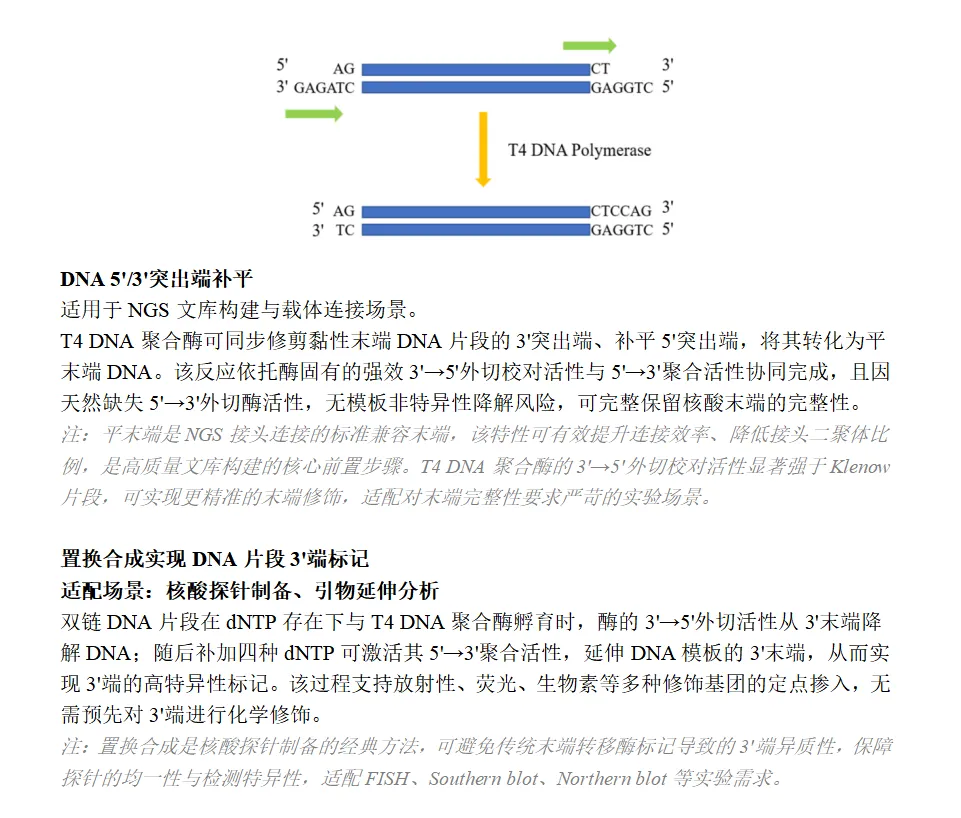
This product is a template-dependent DNA polymerase that can catalyze the synthesis of 5 '→5' →3 'DNA in the presence of primer-template complexes. Expressed by recombinant Escherichia coli (E. coli) strains carrying the cloned T4 DNA polymerase gene, the activity spectrum is clear and controllable, meeting the requirements of high-precision molecular biology experiments. This enzyme possesses potent 3 '→5' exonucidase (verification) activity, significantly higher than that of wild-type Escherichia coli DNA polymerase I, and completely lacks 5 '→3' exonucidase activity, which can prevent non-specific degradation at the end of primers or templates. After strict batch quality control, it has been confirmed that there are no residues of DNase, RNase or non-specific nucleases, ensuring the repeatability of the experiment.

1. Precise activity spectrum
The 3 '→5' external cutting proofreading activity is fully retained, without the interference of 5 '→3' external cutting activity, and the accuracy of end modification is higher.
2. Excellent proofreading ability
The exoglytic activity of 3 '→5' is significantly higher than that of wild-type Escherichia coli DNA polymerase I, and it can efficiently remove mismatched bases and abnormal ends.
3. Template-dependent composition
Strictly rely on primer-template complexes to initiate the 5 '→3' polymerization reaction and avoid non-specific extension by-products.
4. Batch stability of reorganized expression
It is produced by a strictly quality-controlled recombinant expression system, with consistent performance and high purity between batches, and strong repeatability of experimental results.

1. NGS library construction: The terminal repair of DNA fragments, converting sticky ends into flat ends, is a core step in the linker connection of amplicon libraries, shotgun libraries, and targeted enrichment libraries.
2. Nucleic acid probe preparation: Random primer/specific primer extension is used for the preparation of nucleic acid probes labeled with radioactivity, fluorescence, biotin, etc. The absence of 5 '→3' exoglytic activity can prevent the degradation of labeled primers.
3. Molecular Cloning: Preparation of flat-end DNA fragments, suitable for seamless cloning, vector insertion and other experimental requirements.
4. High-fidelity primer extension: Experimental procedures that require precise terminal modification, such as site-directed mutagenesis and Sanger sequencing.
5. Diagnostic reagent research and development: Development of core enzyme raw materials for hybridization and amplification molecular detection reagents.
0756-8699969
Address: No. 88, Shuian 1st Road, Xiangzhou District, Zhuhai City, Guangdong Province
Email: marketing@biori.com
Wechat official account |
Product consultation |
Video Account |