T4 polynucleotide kinase (T4 PNK
Multiple terminal modifications empower NGS library construction and probe labeling
This product is a multifunctional 5' -hydroxykinase for nucleic acids, which can precisely catalyze the terminal modification of DNA, RNA and nucleotide substrates. It is a core tool enzyme for NGS library construction, probe labeling and ligation-dependent molecular biology experiments.

Triple terminal modification activity:
It has three types of clearly defined terminal modification capabilities, covering diverse experimental requirements:
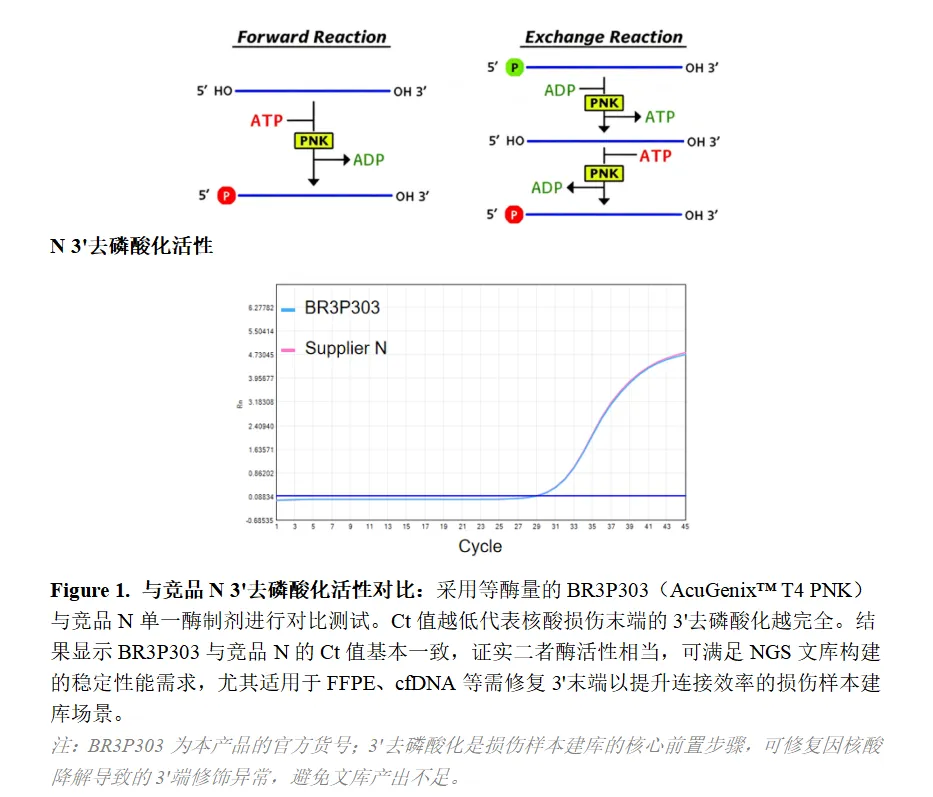
▪ Positive 5' -hydroxyl kinase activity: Transfers the γ -phosphate group of ATP to the 5' -hydroxyl terminal of double-stranded DNA, single-stranded DNA, RNA and nucleoside 3' -monophosphate, achieving 5' -terminal phosphorylation.
▪ 5' -phosphatase/phosphate exchange activity: In the presence of ADP, it can remove the terminal phosphate of 5' -phosphorylated oligonucleotides and catalyze their phosphate exchange with ATP, meeting the site-specific modification requirements in scenarios such as probe labeling.
▪ 3' -phosphatase activity: Hydrolyzes to remove the 3' -phosphate group at the terminal of 3' -monophosphate in DNA, RNA and deoxynucleosides, and repairs the incompatibility issues caused by abnormal terminal modification in damaged samples such as FFPE and cfDNA.
2. Broad-spectrum substrate compatibility
It can efficiently act on double-stranded DNA, single-stranded DNA, RNA and nucleotide monophosphates, and is suitable for multiple scenarios such as gene cloning and RNA research.
3. High reaction efficiency
Under standard reaction conditions, rapid and thorough terminal modification can be achieved, significantly reducing the cost of condition optimization.
High purity and no pollution
After strict batch quality control, there are no detectable residues of DNase, RNase or non-specific nucleases, ensuring the reliability of high-sensitivity experiments.
1. NGS library construction: Phosphorylate DNA fragments and linkers at the 5' end to enhance ligation efficiency; Remove the 3' -terminal phosphate group, repair the damaged ends of FFPE, cfDNA or chemically treated samples, reduce the failure rate of ligation, and increase the output of libraries.
2. Nucleic acid probe preparation: Radioactive, fluorescent or biotin labeling at the 5' end is achieved through forward kinase activity; The site-specific modification of the probe is accomplished through phosphate exchange reactions, which is suitable for the experimental requirements of FISH, Southern blot, Northern blot, etc.
3. Molecular cloning: Prepare phosphorylated linkers, carrier arms and RNA terminals for ligation-dependent cloning processes.
4. Diagnostic reagent development: As core raw materials, it is used for the development of hybrid or ligation-dependent molecular detection reagents that require precise nucleic acid terminal modification.
0756-8699969
Address: No. 88, Shuian 1st Road, Xiangzhou District, Zhuhai City, Guangdong Province
Email: marketing@biori.com
Wechat official account |
Product consultation |
Video Account |